
Ask instructors which light twin taught a generation of pilots to fly on one engine, and many will name the Beechcraft Duchess. Built by Beech between 1978 and 1982, the Model 76 was designed from the start as an affordable, forgiving twin for flight schools and owners stepping up from singles.
Only 437 were made, yet the Duchess is still a familiar sight on training ramps more than forty years later. This guide explains where the Duchess came from, what makes it different from other training twins, how it performs in real numbers and what to expect when you fly one for your multi-engine rating.
Key Takeaways
- The Beechcraft Model 76 Duchess was certified in 1978 and built until 1982; a total of 437 aircraft left the factory in Liberal, Kansas.
- Two 180 hp Lycoming O-360 engines turn counter-rotating propellers, so the Duchess has no critical engine.
- Its T-tail, wide cabin with doors on both sides and docile handling made it a natural choice for Beech Aero Centers and flight schools.
- With one engine inoperative, the book climb rate at maximum weight is only about 235 feet per minute and the single-engine service ceiling is 6,170 feet.
- Carbureted engines, an ageing fleet and parts support are the main things to understand before training in or buying a Duchess.
The Duchess at a Glance
| Item | Beechcraft 76 Duchess |
|---|---|
| Production | 1978–1982, 437 built |
| Engines | 2 × Lycoming O-360-A1G6D (one LO-360), 180 hp each, carbureted |
| Propellers | Hartzell two-blade, constant-speed, full-feathering, counter-rotating |
| Seats | 4 |
| Maximum takeoff weight | 3,900 lb |
| Typical empty weight | About 2,450 lb |
| Usable fuel | 100 US gallons |
| Maximum cruise (6,000 ft) | About 166 KIAS |
| Two-engine climb (sea level) | 1,248 fpm |
| Single-engine climb (max weight) | About 235 fpm |
| Service ceiling | 19,650 ft (two engines), 6,170 ft (one engine) |
| Wingspan | 38 ft |
Figures are typical book values. Always use the Pilot’s Operating Handbook for the specific airplane you fly.
Where the Duchess Came From
In the mid-1970s, Beech, Piper and Grumman American all saw the same opportunity: flight schools and private owners needed a light twin that was cheaper to buy and run than a Baron or a Seneca, but still realistic enough to teach real multi-engine skills. Beech’s answer started as preliminary design PD 289, a proof-of-concept aircraft that began flight testing in September 1974. Early versions borrowed heavily from the single-engine Sierra, but the production airplane became a largely new design with 180 hp engines.
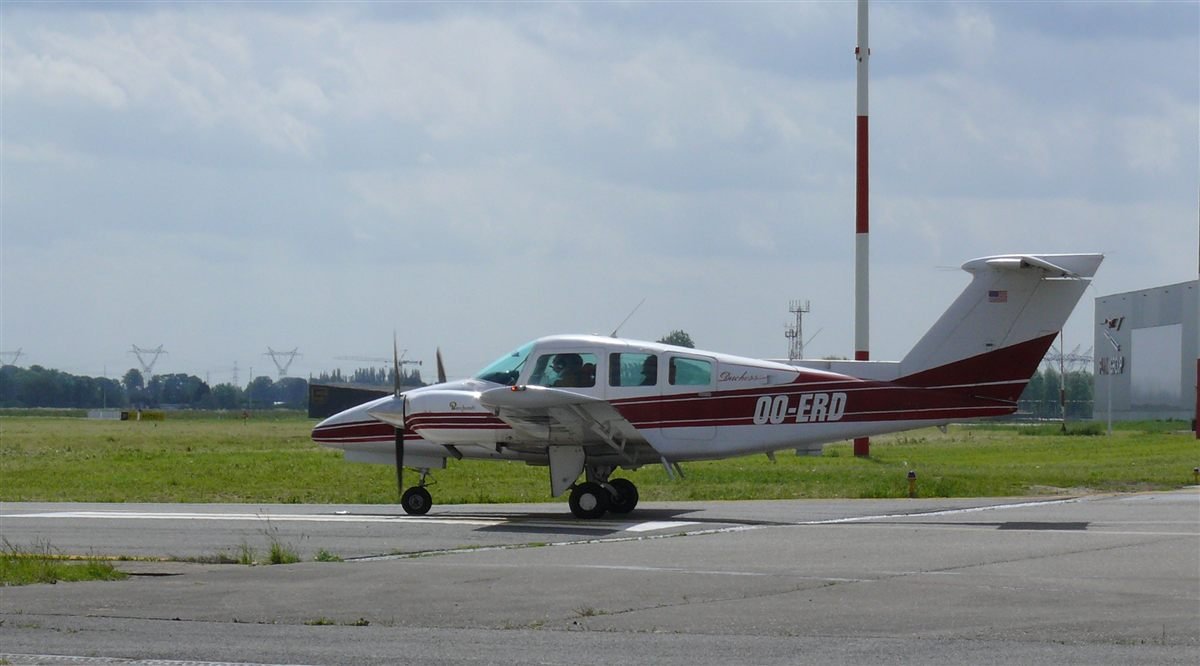
The name came from an employee contest, and the Model 76 Duchess was presented to dealers in 1976. The first production aircraft flew on 24 May 1977, FAA certification followed in January 1978 and deliveries began that spring. Many early airplanes went straight to Beech Aero Centers, the company’s network of flight schools, where they were used to train new multi-engine pilots.
Demand was strong at first: 72 airplanes were delivered in the first year and 213 in 1979. Then the general aviation market collapsed. A recession, high interest rates and growing product-liability costs hit the whole industry, Duchess deliveries fell year after year, and production ended in 1982 after 437 aircraft.
Beech also tested a turbocharged version, the 76TC, in 1979, but that project was cancelled. King Air Magazine has published a detailed history of the Beechcraft Duchess for readers who want to go deeper into its development.
Design Features That Matter to Pilots
Counter-Rotating Propellers
The most important feature of the Duchess for a multi-engine student is its counter-rotating propellers. The left engine turns its propeller clockwise and the right engine turns counter-clockwise (as seen from behind), so the descending blades on both sides are the same distance from the fuselage. That makes the yaw and roll after an engine failure the same whichever engine quits. In other words, the Duchess has no critical engine.
This does not make engine failures easy. Asymmetric thrust still pulls the nose toward the dead engine, and the pilot still has to identify, verify and feather the correct propeller. What counter-rotation removes is the “worse” engine, which simplifies training and gives a little more margin near Vmc.
The T-Tail
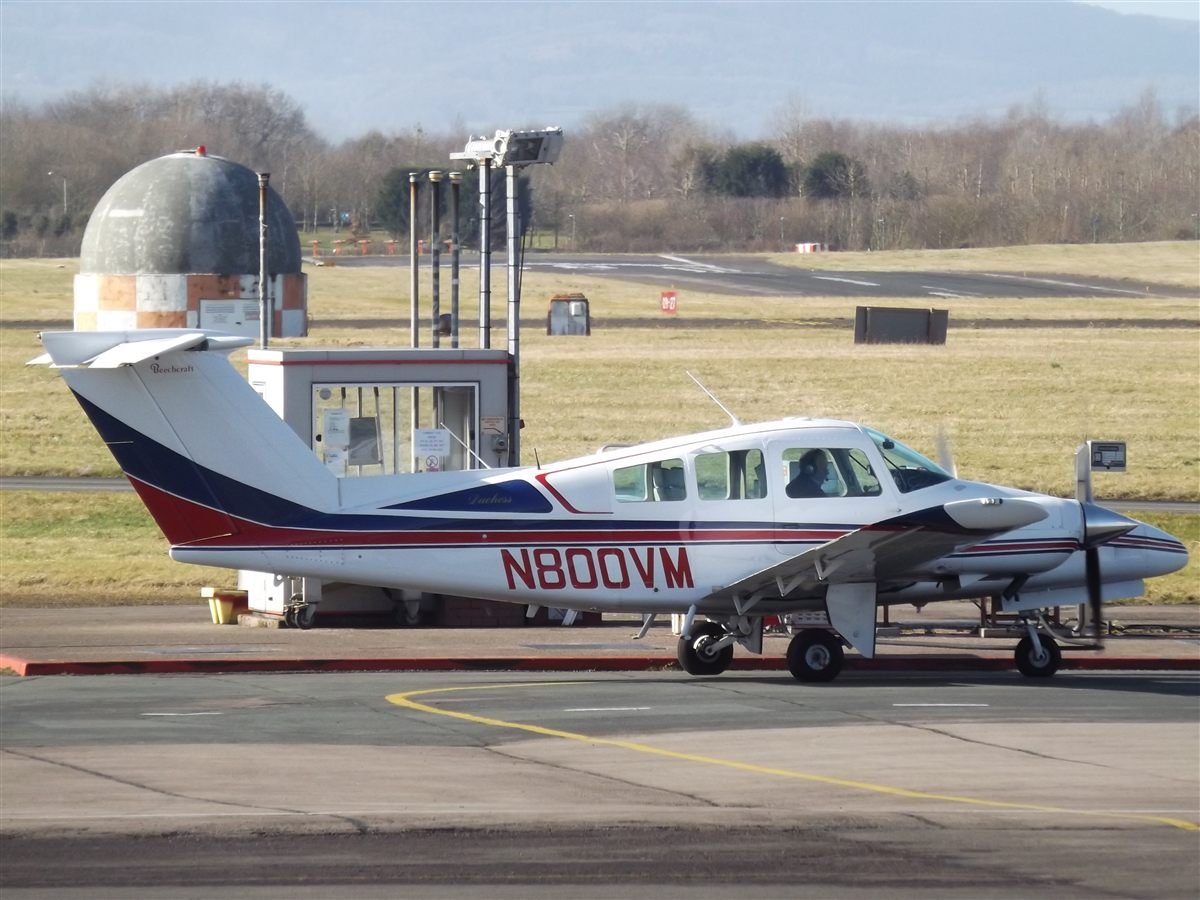
The Duchess has a T-tail, with the horizontal stabilizer mounted on top of the fin. The design keeps the stabilizer out of the propeller slipstream, so pitch trim changes less when power changes.
The trade-off is that the elevator has less airflow at low speed, which pilots notice when lifting the nose on takeoff: the airplane needs a definite pull at rotation and does not lift off early by itself. Students who have flown low-tail singles soon learn to rotate firmly at the correct speed rather than waiting for the airplane to fly off.
A Roomy, Practical Cabin
The Duchess has cabin doors on both sides, which is unusual for a light twin and very useful in training: the instructor and student each get their own door, and the rear seats are easy to reach. The bonded honeycomb wing, electrically operated flaps and electro-hydraulic landing gear came from Beech’s single-engine family, which kept the systems familiar to pilots who already flew Beech singles.
Simple Engines
To keep costs down, Beech used carbureted engines rather than fuel injection. That means fewer parts and easier starting, but it also brings carburetor ice into the picture. Duchess pilots must understand carburetor heat and recognise the symptoms of icing, especially during long descents at low power and in humid air.
Performance in Real Numbers
With both engines running, the Duchess is a pleasant traveller. At maximum cruise power at 6,000 feet it gives about 166 knots indicated, it climbs at roughly 1,250 feet per minute at sea level, and with 100 gallons of usable fuel it can cover a long day’s training or a useful business trip. Takeoff distance at sea level on a standard day is about 1,000 feet.
The picture changes completely when one engine fails. The single-engine climb rate at maximum weight is only about 235 feet per minute at sea level, and the single-engine service ceiling is 6,170 feet. Those numbers are typical for a light twin, but they explain why every engine-failure lesson stresses weight, density altitude and accurate airspeed control.
On a hot day at a high airfield, a fully loaded Duchess may climb very slowly on one engine, or not at all. Our article on losing half the power and more than half the performance explains why.
Speeds Every Duchess Pilot Should Know
Duchess handbooks commonly list a minimum control speed (Vmc) of 65 KIAS, an intentional one-engine-inoperative speed (Vsse) of 71 KIAS and a best single-engine rate-of-climb speed (Vyse, the “blue line”) of 85 KIAS. Stall speed with flaps fully extended and power at idle is about 60 KIAS.
The numbers are close together, and that is the lesson. Vmc is only a few knots above the stall, so a Duchess pilot who lets the airspeed decay after an engine failure can quickly lose directional control. Holding blue line, or the speed your handbook gives for your weight and configuration, is the single most important skill.
Read more about how Vmc changes with conditions in our guide to Vmc in twin-engine aircraft. Always use the speeds in the POH for the airplane you are flying, as instruments, modifications and serial numbers can differ.
Why Flight Schools Choose the Duchess
- No critical engine. Students learn the engine-failure flow without the extra complication of a critical engine.
- Stable and honest handling. The airplane is heavy enough to feel like a “real” twin but forgiving at training speeds.
- Room for two pilots and an observer. The wide cabin and two doors make long training flights comfortable.
- Systems that teach well. Constant-speed propellers, feathering, retractable gear, cowl flaps and crossfeed are all there, without turbochargers or complex fuel systems.
- Lower operating costs than larger twins. Two 180 hp engines burn far less fuel than the larger engines in a Baron or a Seneca.
Duchess Compared With Other Training Twins
The Duchess’s closest rival was always the Piper Seminole, which also uses 180 hp Lycomings and counter-rotating propellers. Pilots often describe the Duchess as roomier and more solid, while the Seminole remains in production and has better parts support. The Piper Seneca is larger, turbocharged from the Seneca II onward and closer to a real business twin, but it costs more to operate.
Modern diesel trainers such as the Diamond DA42 and the efficient Tecnam P2006T offer glass cockpits and lower fuel burn, yet many schools keep the Duchess because it is paid for, well understood and teaches the fundamentals clearly.
Flying the Duchess: Practical Notes
Before Flight
Check fuel quantity visually in both wing tanks, verify the fuel selectors and crossfeed, and sump all drains. Look at the cowl flaps, the propeller blades and the hubs for oil leaks. Because the fleet is old, read the logbooks for recent maintenance and ask the school about any open squawks before your first flight.
Takeoff and Climb
Brief the engine-failure plan before every takeoff: what you will do if an engine fails on the runway, below blue line and after you are climbing at blue line. Rotate firmly at the handbook speed, accelerate to Vyse and retract the gear when a landing on the remaining runway is no longer possible. Keep an eye on cylinder head temperatures and use the cowl flaps as the handbook recommends.
Engine Failure Drills
The memory items are the same as in other light twins: maintain control, set power, drag and configuration, then identify, verify and feather. Our guide to multi-engine memory items covers the flows in detail, and propeller feathering explains why securing the right engine quickly is so important. In training, instructors should simulate failures with zero thrust rather than real shutdowns at low altitude, as discussed in Things I Will Not Do in Multi-Engine Training.
Landings
The Duchess is a stable airplane on approach, but its T-tail and fairly heavy nose mean you should hold the nose off on landing rather than let the nose wheel touch first. Keep a little power in during the flare if the airplane is light, and avoid a fast, flat approach that ends in a long float. In a single-engine approach, keep blue line until landing is assured and delay full flaps until you are sure you will make the runway.
The Beechcraft Duchess in Flight Schools Today
More than four decades after the last airplane left the factory, the Beechcraft Duchess is still working hard on training ramps in North America, Europe and Australia.
Many flight schools bought their airplanes second-hand in the 1990s and 2000s, when the type had already proved itself as a reliable classroom, and have kept them because a well-maintained Duchess remains one of the most cost-effective ways to teach multi-engine flying. Students often meet it during their multi-engine class rating, and some come back to it later when they train as multi-engine instructors.
Part of the reason is simply that the airplane is honest. A Beechcraft Duchess does not hide its weaknesses. Its single-engine performance is modest, its carbureted engines need sensible handling and its T-tail asks for a firm hand at rotation. For an instructor, those characteristics are useful.
They make it easy to show a student why airspeed control, weight and density altitude matter, and they reward good technique in a way that is easy to see. A student who can fly a clean engine-out approach in a Duchess at blue line is well prepared for faster and more complex twins later in a career.
Schools that operate the type also value its comfort. Long training flights with two pilots in the front seats and an observer in the back are much easier in a wide cabin with a door on each side. The cockpit layout is conventional, and many Duchess trainers have been updated with modern avionics, GPS navigators and autopilots, so students can practise instrument procedures in the same airplane they use for engine-out training.
The main challenges for operators are age and parts. Every Beechcraft Duchess flying today needs careful inspection, and some components take longer to source than parts for types still in production. Even so, a strong owner community, experienced maintenance shops and the airplane’s simple systems have kept a large part of the fleet airworthy, and for many instructors the Duchess remains the airplane they would choose to teach the fundamentals of twin-engine flying.
Ownership and Maintenance
Because every Duchess is now more than forty years old, condition matters more than model year. Buyers and schools should look closely at corrosion, the bonded wing structure, landing gear and hydraulic components, engine times and any airworthiness directives that apply to the airframe, engines and propellers. Some parts are now harder to find than for types still in production, so a good relationship with a Beech-experienced maintenance shop is valuable.
Prices depend on engine time, avionics and history. In 2016, King Air Magazine put typical Duchess prices between about $65,000 and $150,000; today’s market should be checked with current listings. Remember to budget for two engine overhauls, two propeller overhauls and higher insurance than for a single. Our article on how much a twin-engine plane costs gives a wider picture.
Checklist Before Your First Duchess Flight
- Read the POH sections on limitations, emergency procedures and performance for your airplane.
- Memorise Vmc, Vsse, Vyse and the stall speeds for your weight.
- Calculate weight and balance and single-engine performance for the day’s conditions.
- Practise the engine-failure flow on the ground until you can do it without the checklist.
- Learn the fuel system, including crossfeed, and the carburetor heat procedure.
- Agree with your instructor how engine failures will be simulated and at what minimum altitudes.
- Review the airplane’s maintenance status and open squawks.
Frequently Asked Questions
Does the Beechcraft Duchess have a critical engine?
No. The Duchess has counter-rotating propellers, so the yaw and roll after an engine failure are the same whichever engine fails. Asymmetric thrust and Vmc still have to be managed carefully.
Is the Duchess a good aircraft for a multi-engine rating?
Yes. It is stable, roomy and simple, it has no critical engine and its systems are typical of light twins. Many schools still use it for multi-engine ratings and instructor training.
How fast does a Beechcraft Duchess fly?
At maximum cruise power at 6,000 feet the Duchess gives about 166 KIAS. Typical training and cruise speeds are a little lower, depending on power setting, weight and altitude.
How many Beechcraft Duchess aircraft were built?
Beech built 437 Model 76 Duchess aircraft between 1978 and 1982, when production ended because of the downturn in general aviation.
What is the Duchess single-engine service ceiling?
The book single-engine service ceiling is 6,170 feet at maximum weight. Real performance on a hot day or with an imperfect technique can be much lower.
Conclusion
The Beechcraft Duchess was born at a difficult time for general aviation and built for only five years, yet it became one of the defining training twins of its era. Counter-rotating propellers, a T-tail, a comfortable cabin and simple systems make it an excellent classroom for engine-out skills. Its performance on one engine is modest, and that is exactly why it teaches the most important multi-engine lessons so well: protect airspeed, respect weight and density altitude, and know your numbers before every flight.
If you are preparing to train in a Duchess or another light twin, the next step is understanding what the rating requires. Continue with How to Get a Multi-Engine Rating: Step-by-Step Guide to see the training stages, flight hours, ground knowledge and checkride preparation you will need.
Header photo: Bidgee, CC BY-SA 3.0 AU, via Wikimedia Commons (cropped).

One Response