
Propeller Feathering in Twin Engine Aircraft: Why It Matters
Propeller Feathering in Twin Engine Aircraft is one of the most important concepts pilots encounter when moving into multi-engine propeller airplanes and turboprops. When one engine fails, the loss of thrust is only part of the problem. The propeller attached to the failed engine can continue rotating in the airflow, producing enormous aerodynamic drag at precisely the moment when the airplane has already lost a substantial part of its available power.
This condition is known as windmilling. Instead of the engine driving the propeller and the propeller producing useful thrust, the airflow drives the propeller. The failed side can then become a major source of drag while the operating engine continues producing thrust on the opposite side of the airplane. The pilot is left managing both reduced performance and a strongly asymmetric aerodynamic condition.
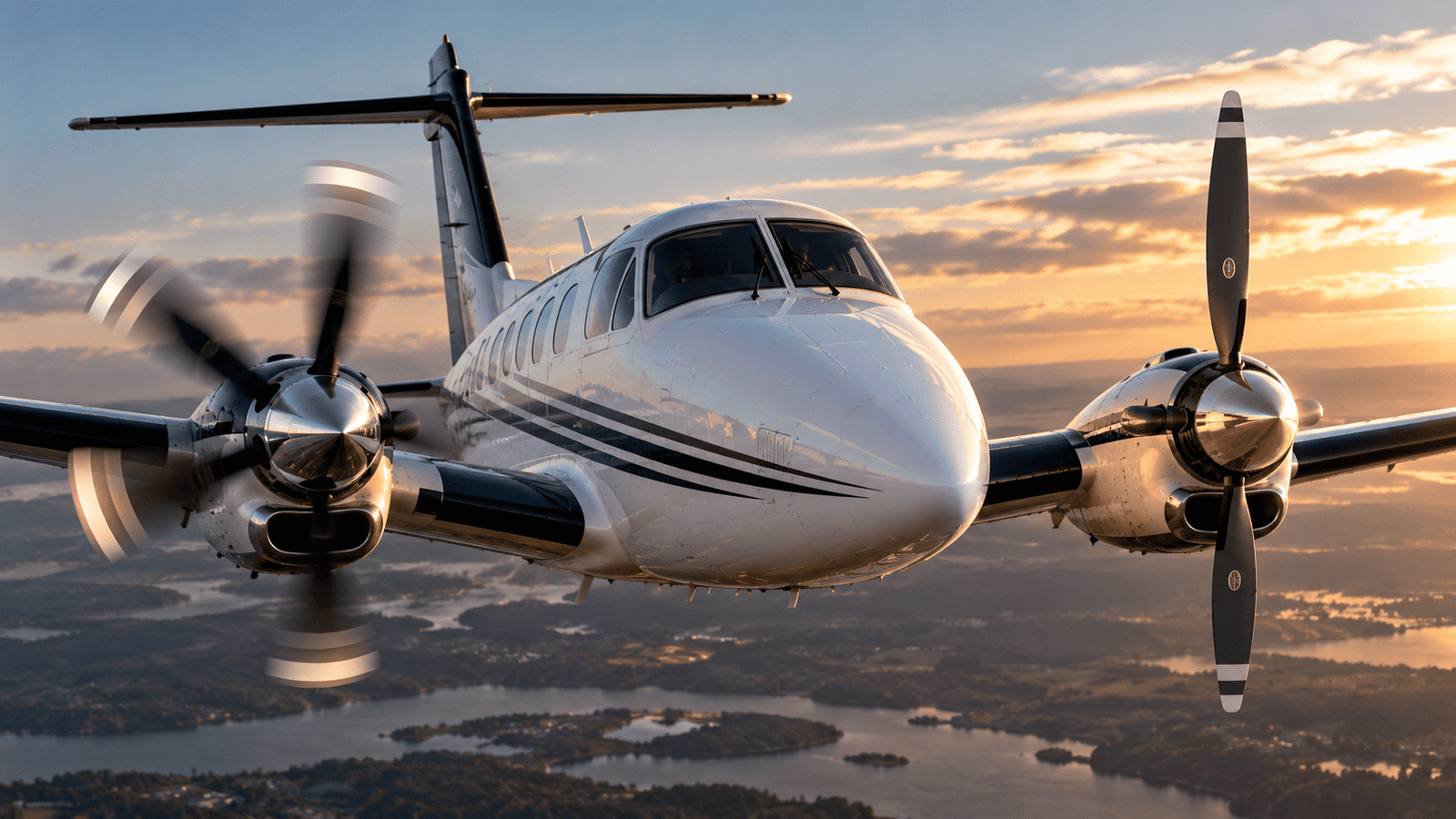
Feathering is designed to reduce that problem. By moving the blades toward a very high pitch angle so that they are much more closely aligned with the relative airflow, the propeller presents less frontal resistance. Rotation can slow dramatically or stop, depending on the aircraft and system, and the drag associated with the failed engine is greatly reduced.
The FAA specifically emphasizes the importance of feathering during multiengine training. Its Airplane Flying Handbook explains that a windmilling propeller can seriously degrade the performance capability of a multiengine airplane and that pilots need to understand the difference between a windmilling propeller and a simulated feathered condition. Федеральная авиационная администрация
What Is Propeller Feathering?
A normal propeller produces thrust because its blades meet the relative airflow at an angle that allows them to accelerate air rearward. A constant-speed propeller continually changes blade angle within its operating range to maintain the selected RPM as airspeed, engine power and propeller loading change.
Feathering moves the blades far beyond their normal thrust-producing position toward a high blade angle. Viewed aerodynamically, the goal is simple: expose as little blade area as practical to the oncoming airflow and therefore minimize the resistance produced by an inoperative propeller.
An easy comparison is moving your hand through water. Hold your palm broadside to the direction of travel and the resistance is substantial. Rotate your hand until its edge moves through the water and resistance falls dramatically. A feathered propeller uses the same basic aerodynamic idea, although the actual mechanism and blade angles are specific to the propeller and aircraft.
The FAA describes a feathered propeller as one whose blades are rotated to a high pitch so that they are streamlined with the direction of flight. In multiengine airplanes, this dramatically reduces the drag associated with an inoperative engine. Федеральная авиационная администрация
What Happens When a Propeller Windmills?
When an engine stops producing useful power, its propeller does not necessarily stop immediately. The airplane is still moving forward through the atmosphere, so the relative airflow passing through the propeller disc can continue driving the blades.
The result is a windmilling propeller.
This distinction is important because a windmilling propeller is not simply a stationary propeller that happens to be attached to a dead engine. It behaves aerodynamically more like a turbine extracting energy from the airflow. That extracted energy is felt by the airplane as drag.
On some aircraft the difference in performance between a feathered and windmilling propeller can be substantial. The FAA specifically warns instructors that pilots must appreciate the performance difference between a simulated feathered propeller and a genuinely windmilling one. Федеральная авиационная администрация
In a twin-engine airplane, that drag occurs on only one side of the aircraft. The result is therefore not merely worse overall performance. It can also intensify the asymmetric condition that the pilot is already trying to control.
An Engine Failure Creates Two Problems
It is tempting to think of an engine failure simply as the disappearance of thrust. In a twin-engine propeller airplane, however, the aerodynamic situation is more complicated.
Imagine the left engine continues operating while the right engine loses power. The left engine still produces thrust from a point offset from the airplane’s centerline. That creates a yawing moment toward the failed side. At the same time, if the right propeller begins windmilling, substantial additional drag is created on the right side.
The pilot is therefore dealing with thrust on one side and drag on the other.
This combination can significantly increase the rudder force required to maintain directional control. The aircraft may also roll and sideslip if the asymmetric condition is not properly managed.
Feathering cannot restore the thrust that has been lost, but it can remove a large portion of the unnecessary drag being generated by the failed side. That can make the airplane substantially easier to control and improve the performance available from the remaining engine.
Why Feathering Matters So Much in Twin-Engine Aircraft
A twin-engine aircraft operating normally benefits from both engines sharing the workload. When one fails, the airplane immediately loses not only thrust but a considerable amount of its excess power.
That distinction is critical. Losing one of two engines does not simply mean losing half of the airplane’s climb performance.
Level flight already requires a substantial portion of total available power. Climb is produced by the power remaining beyond what is necessary to maintain level flight. Losing one engine can therefore eliminate a much larger percentage of the airplane’s available climb capability than the simple “50 percent” assumption suggests.
Now add the drag of a windmilling propeller to that equation. The remaining engine must overcome both the airplane’s normal drag and the additional drag created by the failed powerplant and propeller.
Feathering can therefore make the difference between a twin that has useful one-engine performance and one that struggles badly to maintain altitude.
Feathering Improves Performance, but It Does Not Create Power
This distinction is worth emphasizing because feathering is sometimes described as though it somehow gives the remaining engine more power.
It does not.
The operating engine continues producing whatever power is available under the existing conditions. Feathering improves the situation by reducing drag, allowing more of that available power to be used to maintain airspeed, altitude or climb performance.
The airplane is still operating with reduced power and reduced redundancy. Weight, density altitude, temperature, aircraft configuration and the condition of the operating engine continue to determine whether level flight or a climb is possible.
A feathered propeller therefore improves one-engine-inoperative performance, but it cannot guarantee that a twin will maintain altitude.
Feathering and VMC
Propeller condition also matters when considering directional control and VMC.
VMC represents a minimum control speed determined under specified certification conditions. In practical flying, pilots need to understand the aerodynamic forces behind the number rather than thinking of the red line as an isolated speed.
With one engine producing significant power, asymmetric thrust tends to yaw the airplane toward the inoperative side. Rudder and other aerodynamic effects oppose that yaw. As airspeed decreases, the effectiveness of aerodynamic controls decreases as well.
A windmilling propeller can add considerable drag on the failed side, worsening the overall asymmetric condition. Feathering reduces that drag and helps the pilot manage the airplane more effectively.
This is one reason why Propeller Feathering in Twin Engine Aircraft belongs in the same discussion as asymmetric thrust, directional control, VMC and one-engine-inoperative performance rather than being treated merely as a mechanical propeller procedure.
Why Takeoff Is Especially Critical
An engine failure shortly after takeoff combines several unfavorable conditions at once. Power is high, airspeed may still be relatively low, altitude is limited, the airplane may be heavy, and the pilot has very little time to diagnose what has happened.
If the propeller on the failed engine remains windmilling, its drag can seriously reduce the already limited one-engine performance available during this phase of flight. In some turboprops, automatic systems are therefore designed to reduce propeller drag quickly after a qualifying loss of engine power.
The FAA’s historical certification material explains that autofeather systems were developed in part to reduce the large windmilling drag associated with an engine failure and protect takeoff and climb performance. Such systems also incorporate safeguards because an unintended feathering of a normally operating engine would itself create a serious hazard. Федеральная авиационная администрация
The exact response to an engine failure remains aircraft-specific. Pilots should follow the AFM, POH, QRH or operator procedures applicable to the aircraft rather than substituting a generic feathering sequence.
How Does a Feathering System Work?
There is no single mechanical arrangement that accurately describes every feathering system. This is one of the places where the original simplified explanation of feathering can become misleading.
Depending on the propeller and engine design, blade angle may be controlled through oil pressure, counterweights, springs, governors, electric pumps or combinations of these components. Different systems may use oil pressure to move the blades in different directions, and turboprop architectures can differ considerably from piston-engine propeller installations.
For this reason, saying that “loss of oil pressure automatically feathers every turboprop propeller” would be incorrect.
The general objective remains the same: when feathering is commanded, the system moves the propeller blades toward the high-pitch, minimum-drag feathered position. How the airplane accomplishes that movement must be learned from the documentation for that particular aircraft and propeller system.
Constant-Speed Propellers and Blade Angle
Understanding feathering becomes easier when pilots first understand constant-speed propellers.
During normal flight, the propeller governor automatically changes blade angle to maintain a selected RPM despite changes in airspeed and propeller load. If aerodynamic loading changes, the governor adjusts pitch rather than allowing RPM to change continuously.
The FAA’s Pilot’s Handbook of Aeronautical Knowledge explains this relationship between the governor, blade angle and selected RPM. Modern constant-speed propellers therefore already have the ability to vary blade pitch through a significant range during normal operation. Федеральная авиационная администрация
Feathering extends the concept into an abnormal configuration. Instead of selecting the blade angle required to produce efficient thrust, the system moves the blades toward an angle intended to minimize drag from an engine that is no longer producing useful power.
Autofeather Systems
Many turboprop airplanes incorporate some form of automatic feathering or automatic drag-reduction protection, particularly because engine failure during takeoff can leave very little time for manual intervention.
An autofeather system monitors parameters associated with engine power and, when the system is armed and its required conditions are satisfied, can command the affected propeller toward feather following a qualifying power loss.
This can reduce drag much more rapidly than waiting for a pilot to diagnose the failure and manually feather the propeller.
However, not every turboprop uses the same system, and not every automatic drag-reduction system produces full feather.
For example, FAA accident-study material on the Fairchild SA227 describes its negative torque sensing system. NTS moves the blades toward a higher pitch to reduce negative torque and drag, but the FAA explicitly notes that this protection does not fully feather the propeller. Pilot action is still required to obtain full feather when appropriate. Федеральная авиационная администрация
This is a perfect example of why aircraft-specific systems knowledge matters.
Fixed-Shaft Turboprops Can Produce Enormous Windmilling Drag
Feathering becomes especially significant in certain turboprop designs because the propeller may be mechanically connected to components that require considerable power to rotate.
FAA turboprop transition guidance explains that an engine failure in a fixed-shaft constant-speed turboprop can create a serious drag condition because the windmilling propeller may be forced to drive the compressor. In a twin-engine aircraft, the resulting drag can become a serious control problem unless the failure is recognized and the appropriate propeller is feathered. Федеральная авиационная администрация
This shows why feathering is more than a convenience. In some aircraft, the difference between windmilling and feathered conditions has major consequences for both performance and controllability.
Free-Turbine and Fixed-Shaft Designs Are Not Identical
Not all turboprop engines connect the propeller to the gas generator in the same way. Some employ free-turbine arrangements, while others use fixed-shaft designs. These architectural differences influence how the propeller behaves after power loss and how the feathering system is engineered.
For pilots, the important lesson is not to assume that experience with one turboprop automatically explains another. The cockpit controls may look similar while the mechanical sequence behind them is quite different.
Professional transition training should therefore include the actual engine-propeller relationship, governor operation, feathering mechanism, overspeed protection and automatic systems installed on the aircraft being flown.
Identify Before You Feather
Feathering is beneficial when performed on the failed engine.
Feathering the operating engine is a very different situation.
That is why multi-engine training places so much emphasis on correctly identifying and verifying the affected engine before completing an irreversible securing action. Pilots often learn identification techniques such as “dead foot, dead engine,” but a mnemonic is only an aid to identification. It is not a replacement for the verification procedure specified for the aircraft.
The operating conditions immediately following an engine failure can be stressful. Yaw, noise changes, instrument indications, warnings and performance deterioration may occur almost simultaneously. Acting quickly matters, but acting on the wrong engine can turn a manageable single-engine problem into a loss of all useful thrust.
The correct identification, verification and feathering sequence therefore needs to become part of disciplined multi-engine procedure rather than an impulsive reaction.
Feathering Does Not Replace Aircraft Control
The urgency associated with propeller feathering can create another problem: fixation.
After an engine failure, pilots may immediately look down at engine instruments or begin manipulating controls while the airplane is yawing and losing airspeed. This reverses the correct order of priorities.
The airplane must remain under control.
Directional control, attitude and appropriate airspeed have to be protected while the pilot identifies the problem and completes the aircraft-specific engine-failure procedure. Feathering improves the aerodynamic situation, but it cannot help if the pilot allows the airplane to depart controlled flight while attempting to reach the propeller lever.
This is particularly important close to the ground, where altitude cannot be traded indefinitely for airspeed or recovery.
Feathering During Pilot Training
Actual feathering deserves careful treatment during flight training. It is useful for pilots to understand how the airplane truly behaves with a propeller feathered, but shutting down and restarting an engine in flight introduces additional risk.
FAA guidance therefore distinguishes between simulated feathering and actual feathering. In many training situations, an instructor establishes a zero-thrust setting on the simulated failed engine to approximate the drag associated with a feathered propeller without actually shutting the engine down.
The FAA also recommends that actual feathering training be conducted at altitudes and positions from which a safe landing at an established airport can be made if the propeller cannot be successfully unfeathered. Its guidance states that unfeathering and restart should be planned to be complete no lower than 3,000 feet AGL. Федеральная авиационная администрация
Repeated feathering and unfeathering can also be hard on engines and airframes, another reason these exercises are performed deliberately rather than casually.
Zero Thrust Is Not the Same as Windmilling
This distinction is particularly important for pilots who complete much of their engine-out training with simulated failures.
An instructor may establish a zero-thrust power setting to approximate the drag of a feathered propeller while keeping the engine running. That makes training safer and avoids repeated shutdown-and-restart cycles.
But a zero-thrust simulation does not reproduce the enormous drag that can be created by an actual windmilling propeller.
A student who has experienced only zero-thrust simulations may therefore be surprised by how badly performance deteriorates when an actual engine fails and its propeller remains unfeathered. The FAA specifically encourages instructors to demonstrate and explain this difference so that pilots appreciate the importance of timely feathering after a genuine failure. Федеральная авиационная администрация
Can a Feathered Propeller Be Restarted?
In many installations, yes—but the procedure is entirely aircraft-specific.
If the reason for the shutdown has been resolved or circumstances justify attempting a restart, the pilot may have a procedure for unfeathering the propeller and restarting the engine. Some systems use stored oil pressure, an electric unfeathering pump, starter assistance or other mechanisms to move the blades away from the feathered position.
The important point is that feathering is not universally a permanent state for the remainder of the flight. At the same time, a pilot should never attempt a restart merely because the system allows one. The original cause of the shutdown, available altitude, aircraft controllability, checklist guidance and operational circumstances all matter.
A failed engine that presents evidence of serious mechanical damage or fire is a very different situation from an engine intentionally shut down during training.
Does a Feathered Propeller Always Stop Completely?
Not necessarily.
The primary objective is drag reduction, not simply creating a visually stationary propeller. Depending on the system, airflow, blade angle and mechanical condition, the propeller may stop or its rotation may reduce dramatically.
This is why pilots should think about feathering aerodynamically rather than visually. The useful question is not merely “Has the propeller stopped?” but whether the blades have moved to the correct aircraft-specific feather position and the expected reduction in drag has occurred.
A stopped propeller in an inappropriate blade position and a properly feathered propeller are not conceptually the same thing.
Feathering on the Ground
Propeller position after shutdown varies considerably among aircraft designs. Some turboprop propellers may move toward feather as part of the normal shutdown sequence, while other installations use different blade positions or ground-handling procedures.
Ground operation also introduces concepts such as beta range and reverse thrust on aircraft equipped for them. Those modes serve different purposes from inflight feathering and should not be treated as interchangeable blade positions.
Pilots and technicians therefore need to use the procedures specified by the manufacturer rather than assuming that a practice observed on one turboprop should be reproduced on another.
Feathering, Beta and Reverse Are Different
These three terms all involve propeller blade angle, but they describe very different operating conditions.
Feather places the blades at a high angle intended to minimize aerodynamic drag from an inoperative propeller.
Beta range allows direct control of blade angle within a ground-operating range on many turboprops and is commonly associated with taxi and ground handling.
Reverse moves the propeller blades into a range that produces reverse thrust and can assist deceleration after landing where the aircraft is designed and approved for its use.
Confusing these concepts is dangerous because a blade angle useful on the ground can be entirely inappropriate in flight. Aircraft limitations specify how these operating ranges may be used.
What About Jet Engines?
Jet-powered airplanes do not use propeller feathering because they do not have external propellers whose blade pitch can be moved into a feathered position.
However, it would be misleading to say that a failed turbofan creates virtually no drag. A failed jet engine can still produce aerodynamic and internal drag, and airflow may continue rotating parts of the engine depending on its design and the circumstances.
The more useful distinction is that a turboprop has a large controllable-pitch propeller specifically designed to be moved toward a minimum-drag feather position following an appropriate engine failure. A turbofan does not have an equivalent pilot-controlled propeller-feathering function.
Both twin-engine jets and twin-engine turboprops still face the fundamental problem of asymmetric thrust after one engine loses power. Pilots must maintain directional control and manage the resulting reduction in performance, although the systems and procedures used to handle the failure differ considerably.
Common Misunderstandings About Propeller Feathering
One common misconception is that the propeller should always be feathered immediately whenever an engine indication appears abnormal. In reality, pilots must correctly diagnose and verify the condition and follow aircraft-specific procedures. Feathering the wrong engine can create a much more serious emergency.
Another misconception is that every turboprop automatically feathers following any engine failure. Autofeather logic, arming conditions and system design vary significantly among aircraft, and some systems provide only partial drag reduction.
A third misconception is that feathering restores normal performance. It does not. The aircraft still has one less operating engine. Feathering simply reduces the aerodynamic penalty created by the inoperative propeller and helps the airplane make better use of the power that remains.
Finally, feathering should not be viewed as an isolated mechanical trick. It is part of the larger aerodynamic problem involving asymmetric thrust, directional control, airspeed and one-engine-inoperative performance.
Why Feathering Can Make Such a Dramatic Difference
Consider the aerodynamic situation immediately after a twin-engine turboprop loses one engine. The operating engine continues generating substantial thrust. The failed engine generates none. If its propeller is windmilling, it may simultaneously create significant drag on the failed side.
The airplane therefore experiences a large imbalance while also having less total power available.
Feathering removes much of that unnecessary drag. The pilot still needs rudder input and proper aircraft configuration, and the airplane may still be unable to climb under some conditions. But the aerodynamic situation can become significantly more manageable.
FAA lessons learned from turboprop accidents repeatedly emphasize this relationship between windmilling drag, feathering and aircraft control. On some designs, an unfeathered propeller following a power loss can create enough drag to become a serious controllability issue. Федеральная авиационная администрация
Training for the Moment That Matters
The purpose of feathering training is not simply to teach a pilot to move a propeller control.
A well-trained twin-engine pilot should recognize the aerodynamic symptoms of power loss, maintain directional control, protect airspeed, identify and verify the affected engine, understand what the propeller is doing, and execute the correct aircraft-specific procedure without allowing troubleshooting to replace flying.
Simulator training is particularly valuable for complex turboprops because failures can be introduced at demanding phases of flight without exposing a real airplane to unnecessary risk. Engine failures during takeoff, instrument approaches, missed approaches and adverse weather can be practiced repeatedly while instructors change the surrounding scenario.
The result should be more than procedural memory. The pilot should understand why feathering matters and be able to recognize when the expected drag reduction has—or has not—occurred.
Propeller Feathering as Part of Twin-Engine Airmanship
Propeller Feathering in Twin Engine Aircraft demonstrates a larger principle of multi-engine flying: redundancy is valuable only when the pilot understands how to manage the airplane after part of that redundancy has been lost.
A second engine does not make an engine failure irrelevant. The remaining engine creates asymmetric thrust, performance may deteriorate dramatically, and the inoperative propeller can become an enormous source of drag if it is allowed to windmill.
Feathering addresses one part of that problem by transforming the failed propeller from a major aerodynamic liability into a much lower-drag configuration. The pilot then has a better opportunity to stabilize the aircraft, evaluate its actual one-engine performance and decide how to continue the flight safely.
Conclusion
Propeller Feathering in Twin Engine Aircraft is far more than changing the angle of a set of propeller blades. After an engine failure, a windmilling propeller can extract energy from the airflow, create substantial drag, and intensify the asymmetric forces already acting on the airplane. Moving the affected propeller toward feather reduces that drag and can significantly improve both controllability and one-engine-inoperative performance.
The most important lesson, however, is that feathering cannot be separated from the rest of twin-engine airmanship. Pilots must maintain control, protect airspeed, correctly identify and verify the affected engine, understand the specific propeller system installed on their aircraft, and follow the approved procedure. Automatic systems can provide valuable protection, but their capabilities and limitations vary between aircraft and should never be assumed.
Feathering is also a good example of why the safety advantage of having two engines is more complicated than simply having an extra source of power. Redundancy can provide valuable options after an engine failure, but asymmetric thrust, aircraft performance, pilot training, and correct emergency management all determine how useful that redundancy really is. Continue with Are Twin Engine Planes Safer? to explore how engine redundancy, pilot proficiency, aircraft design, and engine-out performance shape the real safety differences between single- and twin-engine aircraft.

One Response
Editor’s note, one practical point to add: on many piston twins the propellers have anti-feathering (centrifugal) latches that stop the blades from feathering once RPM drops below a certain value. If a windmilling prop slows down too much before the pilot feathers it, it may no longer be possible to feather it. That is one more reason the “identify, verify, feather” sequence should be done promptly and exactly as your aircraft’s checklist says. Always check the POH/AFM for your specific airplane.
A question for readers who fly twins: does your airplane have autofeather, and how did your instructor demonstrate the difference between zero-thrust and a real windmilling propeller?