
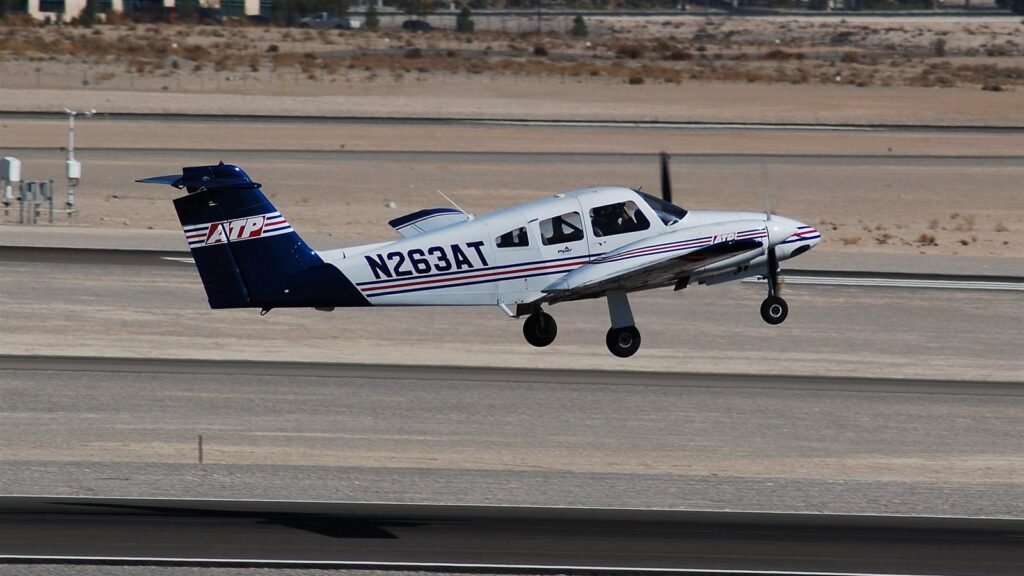
Walk around almost any airport where pilots train for a multi-engine rating or fly light twins for business, and you will probably see a Piper Seneca. In production since the early 1970s, the PA-34 has been a six-seat family twin, an air-taxi workhorse and, above all, one of the most common multi-engine training aircraft in the world. This guide explains how the Seneca developed through five generations, why its counter-rotating propellers matter, how it performs, what goes wrong in service and what to expect if you are about to fly one.
Key Takeaways
- The Seneca (PA-34) first flew in the early 1970s and has been built in five main versions, from the normally aspirated Seneca I to the intercooled, glass-cockpit Seneca V.
- Every Seneca has counter-rotating propellers, so neither engine is “critical”, but Vmc and single-engine performance still demand respect.
- From the Seneca II onward the engines are turbocharged, which keeps power available at altitude and greatly improved single-engine climb and ceiling.
- Turbocharged engines need careful handling: smooth throttle movements, attention to manifold pressure and patience with cooling.
- Many Seneca accidents happen during training, often when engine failures are simulated with the fuel selector or mixture instead of a zero-thrust throttle setting.
The Seneca at a Glance
| Version | Introduced | Engines | Main changes |
|---|---|---|---|
| Seneca I (PA-34-200) | 1971–72 | 2 × 200 hp Lycoming IO-360, normally aspirated | Original design, counter-rotating propellers, six seats |
| Seneca II (PA-34-200T) | mid-1970s | 2 × 200 hp Continental TSIO-360-E, turbocharged | Turbocharging, longer ailerons, much better single-engine ceiling |
| Seneca III (PA-34-220T) | 1981 | 2 × 220 hp Continental (220 hp for five minutes, 200 hp continuous) | Higher RPM limit, 4,750 lb takeoff weight, electric flaps |
| Seneca IV | 1994 | 2 × 220 hp Continental, turbocharged | New cowlings with round inlets, refined interior |
| Seneca V | 1997 | 2 × 220 hp Continental TSIO-360-RB, turbocharged and intercooled | Intercoolers, later Garmin G1000 and GFC 700 autopilot |
Sources differ slightly on the first production year: some give 1971, when the type appeared, others 1972, the first full year of deliveries. Either way, the Seneca has now been in service for more than five decades.
Where the Seneca Came From
In the early 1970s Piper already had the four-seat Twin Comanche and the larger Aztec and Navajo. The Seneca filled the gap between them: a roomy, simple twin built around the fuselage of the six-seat Cherokee Six, with a large rear door for loading people and baggage. According to Aviation Consumer, Piper built 360 Senecas in 1972 alone and sold 933 Seneca Is in three years, and the Twin Comanche left the line soon after the Seneca arrived.
The Seneca was designed for pilots stepping up from singles. It is not the fastest twin of its era, but it is forgiving, has a wide cabin of about four feet and can carry a family with bags. These same qualities later made it a favourite of flight schools.
Generation by Generation
Seneca I: Simple, Roomy and Underpowered
The first Seneca used two 200 hp Lycoming IO-360 engines with no turbocharging. On a cool day at sea level it performed well enough, but as Piper raised the gross weight from 4,000 to 4,200 lb, single-engine performance suffered. The single-engine rate of climb dropped from about 230 to 190 feet per minute, and the single-engine service ceiling fell from 5,200 to 3,650 feet. Early owners also complained about heavy controls, pitch stability and Dutch roll in turbulence, which Piper addressed with aileron and other changes during production.
A 3,650-foot single-engine ceiling is a sobering number. On a hot day at a mountain airport, an early Seneca that loses an engine may simply not be able to climb. This is why density altitude planning is so important in any normally aspirated light twin; see our article on density altitude and aircraft performance.
Seneca II: Turbocharging Changes Everything
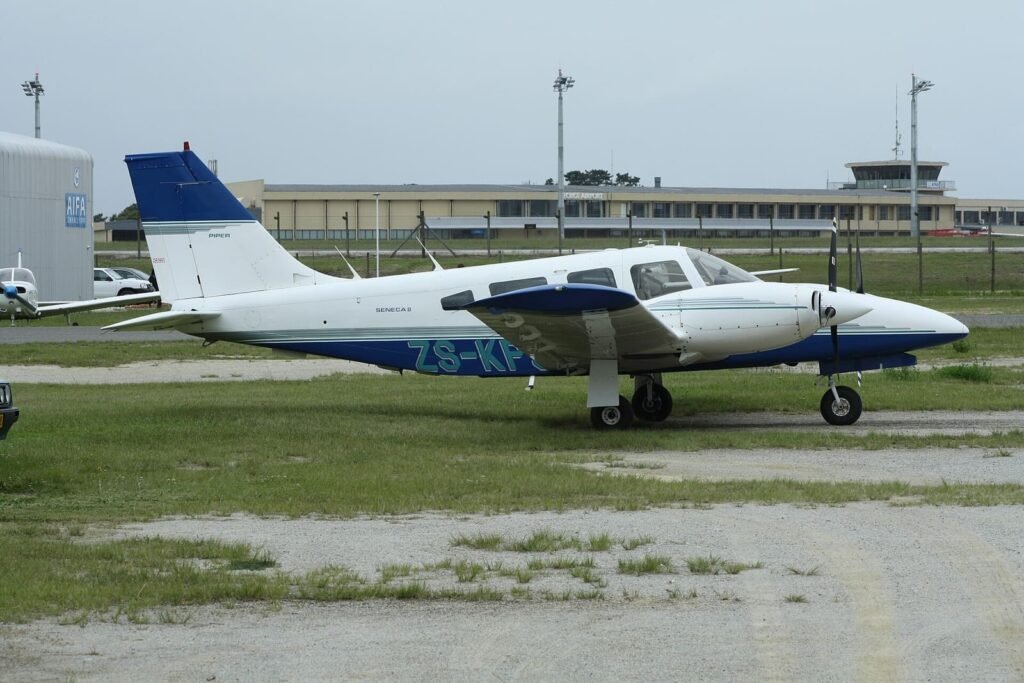
The Seneca II replaced the four-cylinder Lycomings with six-cylinder, turbocharged Continental TSIO-360-E engines. They were rated at 200 hp at sea level and could produce about 215 hp at 12,000 feet. The effect on single-engine performance was dramatic: Aviation Consumer lists a single-engine climb rate of 235 feet per minute and a single-engine ceiling of 13,400 feet, more than three times the figure of the late Seneca I.
The turbo system on the Seneca II used a fixed wastegate (often called a fixed bypass). It is simple, but it requires the pilot to manage manifold pressure carefully and can overboost if the throttles are pushed up quickly. Many owners later fitted automatic controllers and intercoolers to make the engines easier to manage and longer-lived.
The Seneca II also gained longer ailerons for better roll control, a higher gross weight of 4,570 lb and optional extended-range fuel. In 1979 Piper offered three-blade propellers and a propeller synchrophaser.
Seneca III: More Power and More Weight
Introduced in 1981, the Seneca III used Continental engines that could produce 220 hp for up to five minutes, with 200 hp available continuously. The RPM limit rose from 2,575 to 2,800. Maximum takeoff weight went up to 4,750 lb, with a maximum landing weight of 4,513 lb. Piper also changed the pneumatic system from pressure to vacuum, switched to electric flaps and refined the flight controls with a bobweight in the stabilator system and an anti-servo tab on the rudder.
Seneca IV and V: Refinement and Glass Cockpits
The Seneca IV of 1994 brought new cowlings with round, axisymmetric inlets that reduced drag, plus interior improvements. The Seneca V followed in 1997 with intercooled TSIO-360-RB engines that hold rated power up to around 19,500 feet. Later Seneca Vs received the Garmin G1000 three-screen panel and the GFC 700 autopilot, turning the old design into a modern IFR platform. The price followed: late new Seneca Vs sold for more than one million US dollars.
Counter-Rotating Propellers: Why There Is No Critical Engine
On most twins, both propellers turn clockwise when viewed from behind. Because of P-factor, the descending blade of each propeller produces more thrust than the ascending one, so the thrust line of the right engine sits farther from the centreline than that of the left. Losing the left engine therefore leaves the larger yawing moment, and the left engine is called the critical engine. Our article on determining the critical engine (PAST) explains the four factors in detail.
The Seneca solves this by turning the propellers in opposite directions: the left propeller turns clockwise and the right propeller counter-clockwise, as seen from the cockpit. The descending blades are both closer to the fuselage, the thrust lines are symmetrical, and losing either engine produces the same yaw. This makes engine-out handling more predictable and is one reason the Seneca, like the Piper Seminole, is popular for training.
It does not remove the risk, though. Losing one engine still produces strong asymmetric thrust, the airplane still has a minimum control speed, and below Vmc the rudder cannot hold it straight. For the factors behind this, see prop wash, torque and P-factor.
Performance in Real Numbers
Exact figures depend on the model, the serial number and the equipment, so always use the Pilot’s Operating Handbook for the airplane you fly. As a guide, owner reports and published reviews give the following:
| Item | Typical figure |
|---|---|
| Cruise, normally aspirated Seneca I | 160–170 knots at 65% power and 10,000 ft |
| Cruise, turbocharged models | about 180 knots or more in the high teens and low flight levels |
| Fuel burn, turbocharged models | about 24–28 US gallons per hour in total |
| Service ceiling (Seneca V) | 25,000 ft |
| Single-engine ceiling (Seneca II) | about 13,400 ft |
| Maximum takeoff weight | 4,000–4,200 lb (Seneca I), 4,570 lb (II), 4,750 lb (III to V) |
| Useful load | about 1,200–1,500 lb, lower on heavily equipped Seneca Vs |
| Usable fuel | about 93 US gallons standard on early models, up to about 123 with extended-range tanks |
| Baggage | two compartments, 100 lb each |
| Runway | sea-level fields of about 3,000 ft are comfortable with both engines |
Two points are worth remembering. First, the Seneca is not a true six-seater with full fuel: with six adults on board, fuel has to be reduced. Our guide to multiengine weight and balance shows how to work this out. Second, “comfortable with both engines” is not the same as “safe after an engine failure”. Losing an engine on a light twin often costs far more than half the climb performance, as explained in lose one engine, lose half the power.
Why Flight Schools Choose the Seneca
- No critical engine. Engine-out training is the same on both sides, which makes it easier to learn the technique before moving to conventional twins.
- Turbocharged systems. Students learn manifold pressure management, high-altitude operations and oxygen use, which prepares them for larger piston twins and turboprops.
- Complex and IFR-capable. Retractable gear, constant-speed propellers and, in later models, a glass cockpit and autopilot make it a good platform for instrument and commercial training.
- Room in the back. A second student can sit in the cabin and learn by watching, which many schools use for cost-sharing.
- Familiar Piper layout. Pilots coming from Cherokees and Arrows recognise the cockpit and systems.
The trade-off is cost. The Seneca burns more fuel than a Seminole or a diesel DA42 and its turbocharged engines are more expensive to maintain, so hourly rates are usually higher.
Seneca Compared With Other Training Twins
| Piper Seneca | Piper Seminole | Diamond DA42 | |
|---|---|---|---|
| Seats | 6 (5–6 in the Seneca V) | 4 | 4 |
| Engines | Turbocharged Continentals (from Seneca II) | Normally aspirated Lycomings | Jet-fuel piston engines (Austro or Thielert) |
| Counter-rotating propellers | Yes | Yes | No |
| Strength | High-altitude performance, cabin space | Low cost, simple systems | Low fuel burn, modern glass cockpit |
| Typical role | Multi-engine, commercial and IFR training, light charter | Initial multi-engine rating | Multi-engine and IFR training, especially in Europe |
Read more about the alternatives in our articles on the Piper Seminole, the Diamond DA42 Twin Star and the Tecnam P2006T.
Flying the Seneca: Practical Notes
Managing the Turbochargers
The most common mistake pilots make when moving to a Seneca II or III is treating the throttles like those of a normally aspirated engine. Push them forward too quickly on takeoff and a fixed-wastegate engine can overboost. Bring them back too suddenly at altitude and the engines cool quickly. Good practice is to advance the throttles smoothly, watch manifold pressure all the way to the limit, and plan descents early so power can be reduced gradually. Always follow the POH limits for manifold pressure and cylinder head temperature.
Know Your Speeds
Before your first flight, write down Vmc (the red line), Vyse (the blue line), Vxse and the single-engine climb figures for your exact model and weight. They vary between versions, so do not rely on numbers from another Seneca. Our article understanding the blue line explains why Vyse is the most important speed after an engine failure.
Engine Failure Drills
The memory items are the same as in any light twin: maintain control, power up, clean up the drag, identify, verify and feather. Our guide to PAST and COMBATS memory items covers them step by step, and propeller feathering explained shows what happens to the propeller when you feather it.
Landings
The Seneca has a reputation for hard and bounced landings when flown too fast or flared too high. A stable approach at the published speed, with power used to control the descent, prevents most problems. Many instructors also teach students to fly a full single-engine approach and to decide early whether a go-around is possible on one engine, since in many conditions it is not.
What the Accident Record Shows
When Aviation Consumer reviewed 100 recent Seneca accidents, several patterns stood out:
- Training accidents were common. Many happened when instructors simulated engine failures by moving the fuel selector or pulling the mixture, which can leave the engine unable to recover quickly. Using a zero-thrust throttle setting is much safer.
- Late intervention on single-engine approaches. Instructors sometimes waited too long before taking control or restoring power.
- Hard, bounced or porpoised landings appeared 14 times, which the review considered high, plus seven runway overruns.
- Mechanical failures were rare. Only six accidents were caused by engine or mechanical problems, and half of those were propeller blade failures linked to ignored airworthiness directives.
- Landing gear proved robust, and runway loss-of-control and fuel-related accidents were below average.
The review also advised against carrying passengers on flights that include single-engine training. The lesson is the same as for every twin: most accidents come from decisions and technique, not from the airplane. Our article on asymmetric thrust explains what happens in the first seconds after an engine failure.
Ownership and Maintenance
For a buyer, the Seneca offers a lot of airplane for the money, but it needs a careful pre-purchase inspection:
- Airworthiness directives. The original Seneca accumulated close to 50 ADs over its life. Check that every one has been complied with, especially those affecting propellers.
- Turbochargers. Fixed-wastegate systems on early turbo models tend to overboost and wear faster. Look at the history of turbos, exhaust systems and any controller or intercooler modifications.
- Engine overhauls. The engine TBO on early Continental engines was raised from 1,400 to 1,800 hours. Budget for two engines, not one.
- Speed brakes and options. Some aircraft have aftermarket speed brakes, intercoolers, three-blade propellers or STOL kits. They add value but also add items to inspect. Water can freeze in some speed brake installations and stop them retracting fully.
Prices cover a very wide range. Aviation Consumer quoted about $35,000 for a 1972 Seneca I, around $385,000 for a 2003 Seneca IV and over $1 million for a 2019 Seneca V. One long-term owner of a Seneca III reported total operating costs of about $364 per hour including engine reserves. Read more about the cost of light twins in how much does a twin-engine plane cost.
Checklist Before Your First Seneca Flight
- Confirm which model you are flying (I, II, III, IV or V) and read that version’s POH.
- Write down Vmc, Vyse, Vxse, gear and flap limit speeds and the single-engine ceiling for today’s weight.
- Learn the turbocharger limits: maximum manifold pressure, RPM and cylinder head temperature.
- Do a full weight and balance calculation; with six seats it is easy to exceed the limits.
- Check the fuel system: tank selectors, crossfeed and the fuel needed for your trip plus reserves.
- Agree with your instructor how engine failures will be simulated, and insist on zero thrust rather than fuel or mixture cuts.
- Calculate takeoff, accelerate-stop and single-engine climb performance for the day’s density altitude.
- Brief what you will do if an engine fails before rotation, after liftoff with gear down, and after gear retraction.
Frequently Asked Questions
Does the Piper Seneca have a critical engine?
No. The Seneca’s propellers turn in opposite directions, so the thrust lines are symmetrical and losing either engine produces the same yaw. The aircraft still has a Vmc, and engine-out control is still demanding.
Is the Seneca a good aircraft for a multi-engine rating?
Yes, especially if you want experience with turbocharged engines and a heavier airplane. It is more expensive per hour than a Seminole or DA42, so many students choose it for commercial or instrument training rather than for the initial rating only.
How fast does a Piper Seneca fly?
The normally aspirated Seneca I cruises at about 160–170 knots. Turbocharged models typically cruise at around 180 knots or more at higher altitudes, burning about 24–28 US gallons per hour in total.
What is the difference between the Seneca I and Seneca II?
The Seneca I has normally aspirated Lycoming engines and a low single-engine ceiling. The Seneca II has turbocharged Continental engines, more weight capacity and a single-engine ceiling of about 13,400 feet, which makes it far more capable at altitude.
How much does a Piper Seneca cost?
Prices depend on the model, engine times and avionics. Older Seneca Is can cost tens of thousands of dollars, mid-life Seneca IIIs and IVs several hundred thousand, and late Seneca Vs around one million dollars. Running costs for two turbocharged engines are significant.
Conclusion
More than fifty years after it first flew, the Piper Seneca is still one of the most practical ways to step into twin-engine flying. Its counter-rotating propellers make engine-out handling predictable, its turbocharged engines teach pilots how to manage power at altitude, and its roomy cabin makes it useful long after the checkride. At the same time, the type’s history shows that a twin is only as safe as the pilot’s preparation: knowing the numbers for your exact model, respecting single-engine performance and training engine failures with discipline matter more than the second engine itself.
If you are planning to train in a Seneca or another light twin, the next step is understanding exactly what the rating requires. Continue with How to Get a Multi-Engine Rating: Step-by-Step Guide to see the training stages, flight hours, ground knowledge and checkride preparation needed to fly twin-engine aircraft.
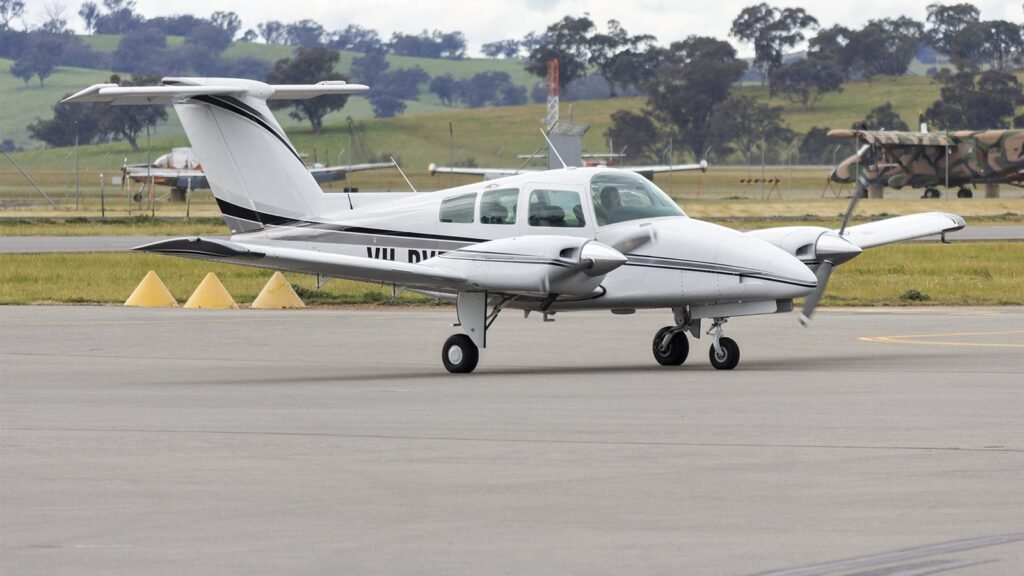
Header photo: Bob Adams, CC BY-SA 2.0, via Wikimedia Commons (cropped). Seneca II photo: Bob Adams, CC BY-SA 2.0, via Wikimedia Commons (cropped).

2 Responses