
Ask a group of multi-engine pilots what an engine failure feels like and you will probably receive several different answers. One pilot may describe the sudden pressure required on the rudder pedal. Another may remember the unmistakable yaw toward the failed engine. A flight instructor may immediately start talking about VMC, while someone flying a light piston twin may remember just how quickly the airplane’s performance changed when one propeller began windmilling.
All of those experiences describe different parts of the same aerodynamic problem: Asymmetric Thrust in Twin Engine Aircraft.
In normal twin-engine flight, both engines produce thrust on opposite sides of the aircraft’s centerline. When their thrust is reasonably balanced, the resulting forces are also balanced. But if one engine suddenly loses power while the other continues operating, that symmetry disappears.
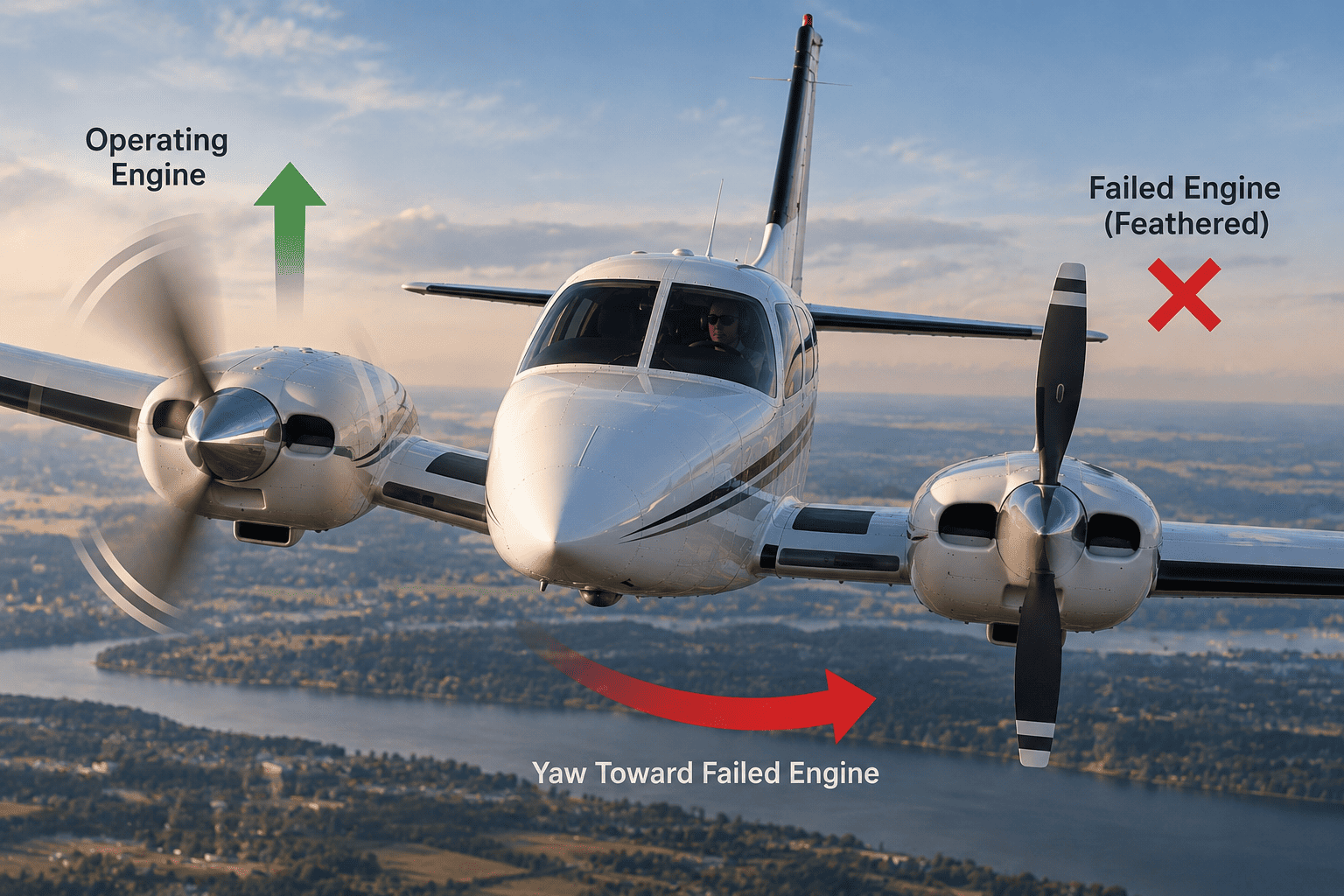
The remaining engine is now producing thrust from one side of the aircraft, creating a yawing moment. The airplane tends to turn toward the engine producing less thrust, and the pilot must respond quickly enough to maintain directional control.
On paper, the concept sounds straightforward. From the cockpit—especially close to the ground—it can feel considerably more dramatic.
How Pilots Describe an Asymmetric Thrust Condition
One of the most common descriptions from pilots is that an engine failure in a conventional wing-mounted twin is immediately recognizable as a directional-control problem.
Imagine the right engine failing while the left engine continues producing substantial power. The left engine is still pushing the aircraft forward, but that thrust is being applied some distance from the aircraft’s centerline.
The result is a moment that attempts to yaw the nose toward the failed right engine.
A pilot does not simply notice a lower engine indication and then calmly decide what to do next. Depending on the aircraft, power setting, airspeed, and phase of flight, the first indication may be physical: yaw, changing rudder pressure, roll tendency, noise, vibration, or an unexpected change in aircraft performance.
This is why experienced multi-engine pilots repeatedly emphasize one priority above troubleshooting:
Fly the airplane first.
Before identifying exactly what happened, before reaching for a checklist, and before making a radio call, the pilot has to keep the aircraft under control.
Why One Operating Engine Creates Yaw
The basic physics of Asymmetric Thrust in Twin Engine Aircraft comes from the position of the engines.
On a conventional twin with engines mounted on the wings, each engine’s thrust line is laterally displaced from the aircraft’s center of gravity. With both engines producing similar thrust, their yawing effects largely balance one another.
Remove the thrust from one side and that balance disappears.
The operating engine now produces a yawing moment around the aircraft’s center of gravity. The greater the thrust and the greater the effective distance between the thrust line and the aircraft’s centerline, the more significant that moment can become.
This explains why asymmetric thrust becomes particularly important at high power settings. An engine failure during a low-power cruise or descent can feel quite different from losing an engine while the other is producing takeoff power.
For pilots, this is not merely an aerodynamic curiosity. It explains why an engine failure immediately after takeoff is one of the most demanding situations encountered in multi-engine training.
Yaw Is Only Part of the Story
Pilots often describe asymmetric thrust as “the airplane pulling toward the dead engine.” That is useful as an initial mental picture, but the actual aerodynamics involve more than yaw alone.
Yaw changes the airflow around the aircraft and interacts with roll, sideslip, drag, and the control inputs required from the pilot. Maintaining heading with rudder alone while keeping the wings perfectly level can create a sideslip, and that sideslip increases drag precisely when the aircraft has already lost a substantial amount of available power.
This is why coordinated engine-out flight in a twin is more sophisticated than simply “pressing the opposite rudder.”
The pilot is trying to achieve a controllable and aerodynamically efficient condition while preserving airspeed and extracting the best available performance from the remaining engine.
“Dead Foot, Dead Engine”
One of the most recognizable phrases in multi-engine training is:
“Dead foot, dead engine.”
The idea is simple.
Suppose the right engine loses power. The aircraft tends to yaw right, so the pilot needs left rudder to oppose that yaw. The left foot is doing the work, while comparatively little pressure is required from the right foot.
The “dead” foot therefore points toward the suspected “dead” engine.
Pilots often find this mnemonic useful because it translates an aerodynamic event into something physically noticeable through the controls. Instead of relying only on gauges, the pilot can use the aircraft’s directional behavior as part of the identification process.
But experienced instructors add an extremely important warning:
Identification is not verification.
Before shutting down, feathering, or otherwise securing an engine, the pilot must verify that the suspected engine is actually the one that has failed, using the procedure appropriate to that aircraft.
Getting that step wrong can turn one failed engine into two engines that are no longer producing useful power.
Why the Rudder Becomes So Important
A pilot transitioning from a single-engine airplane quickly discovers that the rudder takes on a much more prominent role during engine-out flight.
When asymmetric thrust creates yaw, rudder input generates an opposing aerodynamic moment. If the right engine fails and the left engine remains operative, substantial left rudder may be required, depending on the aircraft and operating condition.
But the rudder only works because air is flowing around it.
As airspeed decreases, its aerodynamic effectiveness decreases as well. Meanwhile, if the operative engine remains at high power, the asymmetric yawing moment can remain substantial.
This relationship leads directly to one of the most important concepts in multi-engine flying: VMC.
VMC and Asymmetric Thrust in Twin Engine Aircraft
VMC is commonly described as minimum control speed with the critical engine inoperative under specified certification conditions. It is closely connected to asymmetric thrust because it represents a boundary involving the pilot’s ability to maintain directional control under those conditions.
The FAA explains that VMC changes with factors including power on the operating engine, drag from the inoperative propeller, aircraft weight, center of gravity, configuration, and bank. Increased operating-engine power increases VMC, while a windmilling propeller on the failed engine can make the condition more adverse.
This is where some pilot descriptions become overly dramatic.
Flying below the published VMC does not mean an airplane automatically and instantly enters a spin. VMC is not a magical speed at which control suddenly switches from “available” to “impossible” in every real-world configuration.
But allowing airspeed to deteriorate while maintaining high asymmetric power can seriously reduce directional-control margin. If the pilot continues demanding performance while control authority disappears, loss of control can follow.
That is why multi-engine instructors repeatedly teach pilots not to sacrifice airspeed in an attempt to force the aircraft to climb.
The FAA has specifically highlighted recurrent VMC and single-engine training as an important means of reducing multi-engine loss-of-control events.
The Windmilling Propeller Problem
Pilots of piston twins frequently mention another part of an engine failure that may surprise pilots coming from single-engine aircraft: the enormous drag associated with a windmilling propeller.
After an engine loses power, its propeller may continue rotating because airflow is driving it.
Instead of producing useful thrust, that propeller can now contribute significant drag. For an airplane already operating with only part of its normal power available, the performance penalty can be substantial.
This is why feathering systems are so important on many propeller-driven twins.
Feathering rotates the propeller blades toward a low-drag orientation relative to the airflow, reducing the drag produced by the failed engine’s propeller. FAA material confirms that a windmilling propeller produces a more adverse VMC condition than a feathered propeller, while feathering can significantly reduce the drag associated with a power loss.
From the pilot’s perspective, the difference is important not only for controllability but also for the aircraft’s ability to maintain altitude or achieve any remaining climb performance.
Why Pilots Bank Toward the Operating Engine
Another point frequently mentioned by multi-engine pilots is the slight bank used toward the operating engine.
At first this can sound counterintuitive. If the airplane is already experiencing asymmetric thrust, why intentionally bank it?
The answer involves zero sideslip.
Using appropriate rudder together with a small bank toward the operating engine can produce a more aerodynamically efficient engine-out condition. FAA guidance explains that approximately 2–3 degrees of bank can normally allow a twin to attain zero sideslip, although the appropriate technique is aircraft-specific and certification demonstrations may use up to five degrees of bank toward the operating engine.
This reduces unnecessary drag and can improve the airplane’s engine-out performance compared with holding the wings level with large rudder input and allowing a significant sideslip.
For pilots of light twins, a few degrees can therefore matter considerably when the available performance margin is already small.
The Critical Engine Makes the Story More Interesting
Some twin engine airplanes introduce another concept that new multi-engine pilots need to understand: the critical engine.
On many conventional twins whose propellers rotate in the same direction, failure of one particular engine has a more adverse effect on handling and performance than failure of the other. This is related to propeller aerodynamic effects and the resulting effective thrust location.
That engine is called the critical engine.
However, pilots are quick to point out that this is not universal.
Some twins use counter-rotating propellers specifically so that the asymmetric effects are more similar regardless of which engine fails. The FAA notes that on twins with a counter-rotating right engine, neither engine is more critical than the other for this purpose.
This is another reason why multi-engine procedures cannot simply be transferred blindly from one airplane to another.
The aerodynamics may be universal, but the aircraft-specific response is not.
What Asymmetric Thrust Feels Like During Takeoff
Ask pilots when they least want to experience asymmetric thrust, and the answer is predictable:
Immediately after takeoff.
This is the point where several unfavorable factors can arrive at the same time. The aircraft is close to the ground, the operating engine may be producing high power, airspeed is relatively low, configuration may still be changing, and there may be little altitude available for diagnosis or recovery.
An engine failure at altitude gives the pilot something incredibly valuable: time.
An engine failure shortly after liftoff may not.
This is why multi-engine pilots spend so much time briefing takeoff contingencies and practicing engine failures in controlled training environments. The purpose is not simply to memorize a sequence of levers. It is to establish priorities that remain usable when the workload suddenly increases.
Maintain directional control. Protect airspeed. Establish the appropriate configuration. Identify and verify the problem. Then complete the aircraft-specific procedure.
The precise sequence belongs to the aircraft’s approved procedures—not to a generic forum post.
Asymmetric Thrust Can Begin Before an Engine Completely Fails
One useful point raised in pilot discussions is that asymmetric thrust does not require a completely dead engine.
Any significant difference in thrust between the left and right sides can create an asymmetric condition.
One engine may lose only part of its power. A propeller may behave abnormally. Engine response may differ during power changes. A mechanical problem may cause one powerplant to produce significantly less thrust than the other.
The aerodynamic result is still an imbalance.
That distinction matters because real failures do not always arrive as a clean, unmistakable “engine running / engine stopped” event.
A pilot may instead notice unexplained yaw, different engine indications, vibration, or an inability to obtain expected performance.
That is where system knowledge and disciplined diagnosis become especially important.
Does Asymmetric Thrust Mean a Twin Cannot Fly on One Engine?
No—and this is where discussions about twin-engine safety often become oversimplified.
A properly operated twin may remain controllable after one engine fails, and depending on the aircraft and conditions, it may be capable of maintaining altitude or climbing.
But one operating engine does not automatically guarantee positive climb performance.
Weight, density altitude, temperature, aircraft configuration, propeller drag, terrain, icing, and the performance of the remaining engine all matter. A light piston twin operating high, hot, and heavy may have very little excess performance available after an engine failure.
This is why pilots distinguish between controllability and performance.
Maintaining directional control does not necessarily mean the airplane can climb.
Likewise, an aircraft that theoretically has positive single-engine climb performance still needs to be flown correctly to achieve it.
What Experienced Twin Pilots Keep Coming Back To
Read enough pilot discussions about asymmetric thrust and the same themes appear again and again.
The first is airspeed. Trying to make the airplane climb by continuously increasing pitch can sacrifice the very airspeed needed for control.
The second is directional control. Troubleshooting is useless if the pilot loses control of the aircraft while trying to determine why an engine failed.
The third is verification. “Dead foot, dead engine” can assist identification, but the wrong engine should never be secured simply because a mnemonic seemed to point toward it.
And finally, experienced pilots repeatedly return to aircraft-specific knowledge. A Piper Seminole, Beechcraft Baron, Diamond DA42, Tecnam P2006T, and larger turbine twin do not have identical systems, procedures, or engine-out performance.
The physics behind asymmetric thrust may be shared, but the correct pilot response must come from proper training and the approved information for the aircraft being flown.
Why Asymmetric Thrust Training Matters
Perhaps the most useful lesson from pilot stories is that asymmetric thrust is much easier to understand after experiencing it safely with an instructor.
A diagram can show the thrust vectors. A textbook can explain yawing moments. A VMC chart can demonstrate how configuration changes controllability.
But feeling the rudder pressure change when simulated power is removed from one engine creates a different kind of understanding.
Suddenly, “dead foot, dead engine” is not merely a phrase. The relationship between power, airspeed, yaw, bank, and control becomes something the pilot can physically recognize.
That is why recurrent engine-out training matters even after the multi-engine checkride is finished. The FAA’s current safety material specifically encourages improved and more frequent single-engine training in multi-engine airplanes as a way to address loss-of-control risk.
For pilots who want a deeper technical reference, Chapter 13: Transition to Multiengine Airplanes in the FAA Airplane Flying Handbook covers multiengine aerodynamics, VMC, critical-engine effects, engine-out operations, and related procedures.
Conclusion
Asymmetric Thrust in Twin Engine Aircraft is one of the defining aerodynamic challenges of multi-engine flying. When one engine loses power while the other continues producing thrust, the airplane does not simply lose part of its performance. The imbalance can produce significant yaw, increase drag, reduce climb capability, and place much greater demands on directional control.
Pilot experiences consistently reinforce the same priorities: maintain control, protect airspeed, recognize the asymmetric condition, and avoid becoming distracted by troubleshooting before the aircraft is stabilized. Techniques such as correct rudder input, appropriate bank toward the operating engine, proper engine identification and verification, and reducing the drag of a failed propeller can all become critical parts of managing the situation.
Most importantly, asymmetric thrust demonstrates why a second engine should be considered a valuable resource rather than a guarantee of continued safe flight. Aircraft weight, density altitude, configuration, remaining-engine performance, and pilot response all influence whether a twin can climb, maintain altitude, or must accept a controlled descent after losing power.
The consequences become especially clear when real accidents are examined. Continue with Twin Engine Power Loss Accidents: 5 Critical Safety Lessons to see how asymmetric thrust, declining airspeed, VMC, degraded single-engine performance, aircraft configuration, and pilot decision-making can determine whether a power-loss event ends in a controlled landing or develops into a loss-of-control accident.

One Response