
Multi-Engine Flight Instructor: Teaching in a Twin-Engine Airplane
Becoming a Multi-Engine Flight Instructor (MEI) represents a major step beyond simply learning how to fly a twin-engine airplane. A multi-engine pilot must demonstrate safe aircraft control, understand aircraft systems, manage normal and abnormal operations, and respond correctly when one engine becomes unavailable. An instructor has to do all of those things while simultaneously observing another pilot, explaining what is happening, anticipating errors, evaluating risk, and remaining ready to intervene before an instructional exercise develops into an unsafe situation. That combination of technical knowledge, flying skill, instructional ability, and judgment is what makes the Multi-Engine Flight Instructor qualification so valuable.
For pilots pursuing professional aviation careers, adding multi-engine airplane privileges to a flight instructor certificate can broaden the range of aircraft and students they are qualified to teach. More importantly, MEI training forces pilots to understand twin-engine aerodynamics at a much deeper level. Concepts such as asymmetric thrust, VMC, critical-engine effects, zero sideslip, VYSE, propeller drag, single-engine climb performance, and engine identification can no longer remain definitions memorized for a checkride. A Multi-Engine Flight Instructor must understand how those concepts interact and be capable of explaining them clearly while simultaneously maintaining safe control of the airplane.
What Does a Multi-Engine Flight Instructor Do?
A Multi-Engine Flight Instructor is a certificated flight instructor who holds the appropriate airplane multi-engine instructor privileges and can provide applicable training in multi-engine airplanes within the privileges and limitations of the instructor certificate. This may include working with pilots pursuing multi-engine qualifications, preparing for practical tests, developing proficiency in twin-engine aircraft, or improving their understanding of engine-out operations, performance, and aircraft systems. For career-oriented pilots, becoming an MEI can also provide valuable experience operating and teaching in aircraft that demand considerably more systems knowledge and performance awareness than typical primary trainers.
The responsibility is considerably greater than simply demonstrating maneuvers from the right seat. During a training flight, the instructor may need to monitor the student’s directional control while watching airspeed, engine indications, traffic, altitude, configuration, and aircraft systems, all while explaining what the student should be doing and why. During simulated engine failures in particular, several conditions can begin changing at once, and the instructor must recognize the developing situation before the student necessarily understands what is happening. The MEI therefore needs to remain mentally ahead of both the aircraft and the student.
Why Teaching in a Twin-Engine Airplane Is Different
Twin-engine instruction introduces aerodynamic and performance considerations that do not exist in the same form in a conventional single-engine trainer. With both engines producing approximately symmetrical thrust, the airplane may feel stable and predictable. If one engine loses power while the other continues producing substantial thrust, however, the balance changes immediately. The airplane can yaw toward the inoperative engine, drag may increase significantly, climb capability can deteriorate, and the pilot may need substantial rudder input to maintain directional control.
For a Multi-Engine Flight Instructor, the challenge is not simply knowing how to correct the condition. The MEI must watch how the student responds to it. A student experiencing asymmetric thrust may initially focus on the engine instruments, rush into an identification procedure, apply incorrect rudder, allow airspeed to decay, or become so focused on maintaining altitude that directional-control margin begins to disappear. The instructor must allow enough freedom for the student to recognize and correct mistakes while also knowing exactly when intervention becomes necessary. That balance between allowing learning and maintaining safety is one of the most important skills developed during MEI training.
Twin-Engine Aerodynamics Become Teaching Material
A pilot preparing for an initial multi-engine rating may learn the definitions of VMC, critical engine, asymmetric thrust, P-factor, accelerated slipstream, spiraling slipstream, torque, and zero sideslip. An MEI applicant needs to move beyond memorization and understand how these ideas fit together. If one engine fails, the instructor should be able to explain why the airplane yaws, why the operating engine’s power setting matters, why airspeed is critical to rudder effectiveness, why a windmilling propeller creates a significant performance penalty, and why a small bank toward the operating engine can improve the engine-out condition.
This deeper level of understanding becomes obvious when the instructor begins teaching from the right seat. It is relatively easy to say that the airplane needs rudder after an engine failure. It is much more useful to explain that the operating engine is producing thrust at a lateral distance from the airplane’s centerline, creating a yawing moment that must be opposed aerodynamically. As airspeed decreases, aerodynamic control effectiveness decreases, while high power on the operating engine can continue producing a strong asymmetric moment. Understanding that relationship allows the student to see VMC not as an isolated red line on an airspeed indicator but as part of the larger problem of directional control during asymmetric flight.
Asymmetric Thrust: The Center of Multi-Engine Instruction
Asymmetric thrust is one of the defining subjects of twin-engine training. When both engines operate normally, their thrust generally creates a balanced propulsion condition. When one engine becomes inoperative or produces substantially less power, the remaining thrust acts asymmetrically and creates a yawing moment toward the lower-power side. Depending on the aircraft and propeller arrangement, additional aerodynamic effects can influence the severity of the condition, while the drag of an unfeathered or windmilling propeller can make the performance problem considerably worse.
For a student encountering a simulated engine failure, the experience can initially be confusing because several sensory cues arrive almost simultaneously. The aircraft may yaw, rudder pressure changes, engine sound changes, performance begins deteriorating, and instrument indications may confirm that one engine is no longer producing normal power. A good MEI teaches the student to organize these cues rather than react impulsively. The first objective is to maintain aircraft control and appropriate airspeed, followed by systematic identification and verification of the affected engine using procedures applicable to the specific aircraft. For a deeper look at the aerodynamics behind this condition, see Asymmetric Thrust in Twin Engine Aircraft.
Aircraft Control Must Come Before Troubleshooting
One of the most important habits a Multi-Engine Flight Instructor can teach is that an engine failure initially creates an aircraft-control problem. A perfectly executed checklist has little value if the pilot allows airspeed and directional control to deteriorate while working through it. This is especially important when the operating engine remains at high power, because the asymmetric yawing moment can be substantial while aerodynamic control effectiveness decreases as airspeed falls.
The student therefore needs to develop a disciplined sequence of priorities: maintain control, establish the appropriate airspeed and configuration, identify the affected engine, verify the identification, and then complete the aircraft-specific securing or troubleshooting procedure. The exact sequence and checklist actions depend on the airplane and its approved procedures, so generic memory aids should never replace the AFM or POH. What the MEI can teach universally is the underlying priority: fly the airplane before attempting to fix the airplane.
Teaching “Dead Foot, Dead Engine” Correctly
“Dead foot, dead engine” is one of the most familiar mnemonics in multi-engine training. If one engine fails and the airplane begins yawing toward that side, the pilot normally applies rudder toward the operating engine to maintain directional control. The foot applying little or no useful rudder pressure may therefore correspond to the suspected inoperative engine, helping the pilot organize the initial response to an asymmetric condition.
A good Multi-Engine Flight Instructor, however, must make clear that identification is not the same as verification. The pilot should not shut down or feather an engine simply because a mnemonic appears to identify it. Before taking an irreversible action, the affected engine must be verified according to the procedure appropriate to the aircraft. This distinction is particularly important because incorrectly securing the operating engine after the other engine has already lost power can turn a manageable one-engine-inoperative situation into a complete loss of thrust.
Understanding VMC Instead of Memorizing the Red Line
VMC is another subject that separates superficial multi-engine knowledge from genuine understanding. Students often first encounter VMC as the red radial line on the airspeed indicator and may think of it as a single fixed boundary below which the airplane suddenly becomes uncontrollable. For an instructor, that explanation is inadequate. VMC is associated with specific certification conditions, while actual directional-control characteristics vary with the aerodynamic and operational conditions present during a particular flight.
The fundamental relationship is between the forces attempting to yaw the aircraft and the aerodynamic control authority available to oppose them. High power on the operating engine can increase the asymmetric yawing moment, while decreasing airspeed reduces aerodynamic control effectiveness. Propeller condition, aircraft configuration, CG position, bank angle, density altitude, and other factors can also affect the situation. The MEI’s job is therefore to teach students to recognize a shrinking directional-control margin rather than treating VMC merely as another airspeed to memorize.
The FAA provides a detailed discussion of these concepts in the Airplane Flying Handbook, Chapter 13: Transition to Multiengine Airplanes. This chapter is particularly useful for MEI applicants because it covers multiengine aerodynamics, VMC, engine-out operations, critical-engine effects, aircraft performance, and techniques used to maintain control following an engine failure.
What Factors Affect VMC?
An MEI applicant should be able to explain VMC factors as parts of the same aerodynamic problem. Greater operating-engine power generally produces a stronger asymmetric yawing moment, while reduced airspeed provides less aerodynamic control authority. A windmilling propeller on the inoperative side can produce substantial drag and worsen the asymmetric condition, while CG position affects the leverage available to the rudder. Bank angle is also important because an appropriate small bank toward the operating engine can contribute to the favorable engine-out condition.
These factors should not be taught as an isolated list designed only for an oral examination. The student should understand what each factor does to either side of the aerodynamic problem: does it increase the asymmetric forces that the pilot must control, or does it change the effectiveness of the controls available to oppose them? Once the student understands that relationship, VMC becomes much easier to understand conceptually and much harder to forget.
Zero Sideslip and Banking Toward the Operating Engine
During one-engine-inoperative flight, students are commonly taught to use appropriate rudder together with a small bank toward the operating engine. At first this can seem counterintuitive because the student may believe that maintaining wings-level flight should represent the most balanced condition. In reality, wings level with substantial rudder can produce sideslip and additional drag, which is particularly undesirable when single-engine performance is already limited.
A slight bank toward the operating engine, combined with the proper rudder input, can establish the favorable zero-sideslip condition used in engine-out flight. The exact indications and techniques vary by aircraft, but the aerodynamic principle is important for an MEI to explain: the objective is not merely to keep the heading constant but to do so with an efficient combination of control inputs. In a light twin that may have only a small amount of excess power available after an engine failure, avoiding unnecessary drag can make a meaningful difference.
Teaching the Critical Engine
The FAA defines the critical engine as the engine whose failure would most adversely affect aircraft performance or handling characteristics. In conventional twins whose propellers rotate in the same direction, propeller-related aerodynamic effects can make the failure of one engine more adverse than the failure of the other. This is where familiar multi-engine concepts such as P-factor, accelerated slipstream, spiraling slipstream, and torque become relevant.
A Multi-Engine Flight Instructor should explain these effects as physical relationships rather than simply asking students to memorize acronyms. The applicant should also recognize that not every twin has a traditional critical engine. Aircraft using counter-rotating propellers can substantially reduce or eliminate the left-versus-right critical-engine distinction. This is an excellent example of why multi-engine instruction must remain aircraft-specific: a rule learned in one twin should not automatically be assumed to apply identically to another.
Single-Engine Performance: Two Engines Do Not Mean Half the Performance
Perhaps one of the most important misconceptions for an MEI to correct is the belief that losing one of two engines means losing approximately half of the airplane’s performance. The relationship is much less favorable because aircraft performance depends not simply on total power, but on how much excess power remains after the power required for continued flight is satisfied. A twin may use a large proportion of its available power simply to maintain level flight, meaning that removing one engine can eliminate most or, under unfavorable conditions, all of the excess power previously available for climbing.
This is why a light twin can remain controllable after an engine failure yet be incapable of maintaining altitude under certain conditions. Weight, density altitude, temperature, configuration, propeller drag, and the performance of the operating engine all influence the result. An MEI should teach students to distinguish controllability from performance. Maintaining directional control does not guarantee a positive climb rate, and a controlled descent at an appropriate airspeed may be a much safer outcome than attempting to hold altitude by allowing airspeed to decay.
Weight and Density Altitude in Twin-Engine Training
Weight and density altitude become particularly important when discussing engine-out performance. A heavily loaded airplane operating from a high-elevation airport on a hot day can have dramatically less single-engine climb capability than the same aircraft flying at a lower weight near sea level in cool conditions. Reduced air density affects engine power, propeller effectiveness, and aerodynamic performance, while additional weight increases the power required to maintain flight and climb.
An instructor should therefore teach students to calculate and evaluate performance before the flight rather than discovering the aircraft’s limitations after an engine fails. POH or AFM performance information, aircraft weight, pressure altitude, temperature, runway environment, obstacles, and expected configuration should all contribute to the pilot’s preflight understanding. The second engine provides redundancy, but it does not create unlimited performance, and an MEI should make that distinction clear from the beginning of training.
VYSE and the Importance of Airspeed Discipline
In many light twins, VYSE is marked by the familiar blue radial line on the airspeed indicator and is often simply called “blue line.” Students can quickly memorize the number, but a Multi-Engine Flight Instructor needs to teach what it represents and why airspeed discipline becomes so important after an engine failure. VYSE is the published best rate-of-climb speed with one engine inoperative under the conditions established for the aircraft and provides an important reference during engine-out operations.
A common and potentially dangerous reaction to poor single-engine climb performance is to raise the nose in an attempt to preserve altitude. If the airplane does not have sufficient excess power, however, increasing pitch cannot create additional climb capability. Instead, airspeed may decrease and directional-control margin can shrink. An MEI should teach students that maintaining an appropriate airspeed may require accepting a descent. Preserving control and energy is more important than attempting to force the airplane to achieve performance it cannot provide.
Teaching Engine Identification, Verification, and Securing
Engine-out procedures require a balance between prompt action and deliberate verification. Once aircraft control and appropriate airspeed have been established, the pilot needs to identify the engine that appears to have failed. Rudder pressure, engine instruments, sound, and other aircraft-specific indications can assist with identification, but the next step is crucial: verify the affected engine before taking an irreversible action.
This discipline deserves significant attention during MEI training because the consequences of an incorrect shutdown can be severe. The instructor should teach a logical progression—control, identify, verify, secure—while emphasizing that the actual controls, memory items, and checklist procedures depend on the airplane. Repeated practice should help students develop a response that is organized rather than rushed, allowing them to act efficiently without becoming so eager to complete the checklist that they inadvertently secure the operating engine.
Simulated Engine Failures and Instructor Responsibility
Simulated engine failures are among the most valuable parts of multi-engine training, but they also create one of the clearest examples of instructor responsibility. The MEI intentionally introduces an abnormal condition so that the student can experience asymmetric flight, recognize the associated cues, and practice the correct response. Because performance and directional-control margins may be reduced, the instructor must carefully consider altitude, weather, traffic, terrain, aircraft configuration, student experience, and the method used to simulate the failure.
The instructor also needs a clear intervention point before beginning the maneuver. Allowing a student to make a correctable mistake can be valuable because the student learns to recognize and recover from it, but allowing a demonstration to continue while airspeed and directional control deteriorate can turn training into a real emergency. Good MEI instruction is therefore not about creating the most dramatic engine failure possible. It is about creating a controlled learning environment in which the aerodynamic lesson can be experienced without unnecessarily reducing the safety margin.
Engine Failure After Takeoff
An engine failure shortly after takeoff is one of the most demanding scenarios discussed in light twin training because several unfavorable conditions may exist simultaneously. Power is high, airspeed is relatively low, altitude is limited, configuration may still be changing, obstacles may be present, and there is very little time available for diagnosis. If asymmetric thrust develops during this phase, directional control and airspeed become immediate priorities.
The Multi-Engine Flight Instructor should also teach that the presence of a second engine does not automatically mean the takeoff can safely continue. Actual one-engine-inoperative performance depends on aircraft weight, density altitude, temperature, configuration, obstacle environment, and the performance of the remaining engine. In some conditions the aircraft may climb; in others it may barely maintain altitude or be unable to do so. The correct mindset is therefore not “a twin can always continue after losing an engine,” but “know what this specific airplane can realistically do under today’s conditions.”
Rejected Takeoffs and Pre-Takeoff Planning
Engine failures and other serious abnormalities do not always require continued flight. If a significant problem occurs early in the takeoff roll while sufficient runway remains, rejecting the takeoff may be the safest and simplest response. The decision becomes much more complicated as the aircraft approaches liftoff or becomes airborne, which is why the instructor should teach the student to consider possible actions before advancing the throttles.
A meaningful multi-engine takeoff briefing should reflect the aircraft, runway, obstacles, weather, and expected performance rather than becoming a memorized speech. The student should know what conditions would lead to an immediate reject, what the priorities will be if a failure occurs after liftoff, and what performance can reasonably be expected on one engine. This preparation reduces the amount of new decision-making required during an already high-workload event.
Aircraft Systems Knowledge for the MEI
A Multi-Engine Flight Instructor needs strong aircraft-systems knowledge because many abnormal situations in a twin involve more than simply determining which engine is operating. Propeller systems are particularly important in piston twins because the instructor needs to explain constant-speed operation, governors, feathering, and why a windmilling propeller can create so much drag. Fuel systems can involve multiple tanks, pumps, selectors, and crossfeed arrangements, while electrical systems may include multiple alternators or generators, separate buses, batteries, and load-shedding procedures.
Landing gear systems, engine controls, vacuum or pneumatic systems where installed, anti-icing or deicing equipment, and emergency-extension systems may also form part of the aircraft-specific knowledge required to teach effectively. The instructor’s goal should not be to have the student memorize a diagram and forget it after the practical test. Systems training should explain what resources remain after a failure, what redundancy has actually been lost, and how a system malfunction can affect the larger operational picture.
Learning to Fly and Teach From the Right Seat
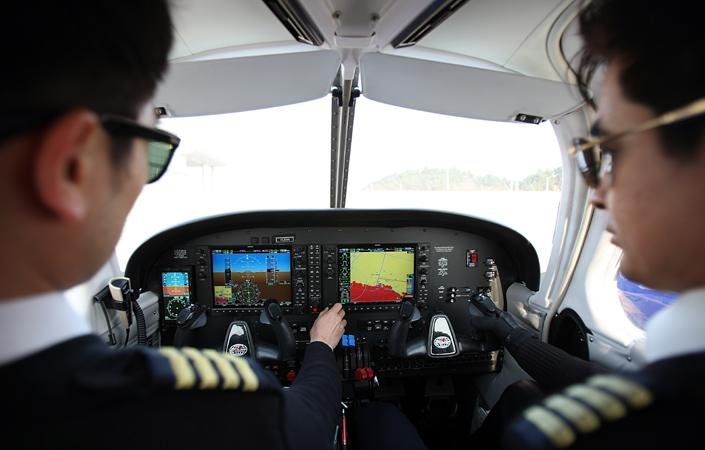
Even an experienced multi-engine pilot can initially find right-seat flying unfamiliar. The visual perspective changes, the relationship between the pilot and runway centerline feels different, and engine controls may be reached from a different angle. These changes usually become manageable with practice, but MEI training adds another layer: the applicant must perform accurately from the right seat while simultaneously delivering instruction.
That means a maneuver is no longer complete simply because altitude, heading, and airspeed remain within standards. The instructor applicant needs to explain what is happening, identify likely errors, observe the student, maintain situational awareness, and remain prepared to take control. The FAA’s current Flight Instructor for Airplane Category Airman Certification Standards provides the standards used to evaluate instructor applicants, including aeronautical knowledge, risk management, instructional competence, and applicable flight proficiency.
From Flying a Maneuver to Teaching a Maneuver
This is one of the biggest conceptual changes in MEI training. A pilot preparing for a commercial multi-engine practical test may ask, “Can I perform this maneuver correctly?” The instructor applicant needs to ask several additional questions: Can I explain it clearly? Do I understand why each control input is required? What mistakes is a student likely to make? How will I recognize those mistakes? What correction should I give, and at what point should I intervene?
This teaching mindset is particularly important during engine-out operations because the instructor cannot become so focused on delivering an explanation that basic aircraft control is neglected. A technically perfect lecture about VMC is useless if the airplane is simultaneously losing airspeed. Effective MEI instruction therefore combines explanation with continuous monitoring, and the instructor must know when to stop talking and simply fly the airplane.
Ground Training for a Multi-Engine Flight Instructor
Ground preparation for the Multi-Engine Flight Instructor rating should build a connected understanding of the airplane rather than a collection of memorized oral-exam answers. Important areas include multi-engine performance, weight and balance, aerodynamics, engine-inoperative performance, normal and emergency procedures, aircraft systems, asymmetric thrust, VMC and its associated factors, critical-engine concepts, zero sideslip, VYSE and VXSE where applicable, propeller systems, fuel and electrical systems, landing gear, performance calculations, and risk management.
The important difference is that each topic should now be studied from an instructor’s perspective. The applicant is not merely preparing to answer a question about VMC; the applicant is preparing to teach VMC to a pilot who may initially misunderstand it. Similarly, knowing how the fuel system works is not enough—the instructor should anticipate the misconceptions a student might develop and be able to explain how a system problem could influence an actual multi-engine emergency.
Why MEI Lesson Plans Should Explain “Why”
Lesson-plan development can be one of the most useful parts of MEI preparation because teaching immediately exposes gaps in understanding. It is easy to write “feather the propeller to reduce drag” on a flashcard. A useful lesson needs to explain that after an engine failure the airflow can continue driving an unfeathered propeller, producing significant drag; moving the blades toward the feathered position reduces that drag and can improve one-engine-inoperative performance.
The same approach should be applied throughout MEI training. Instead of simply telling a student to bank slightly toward the operating engine, explain the zero-sideslip condition. Instead of telling the student to maintain blue line, explain the relationship between available power, airspeed, climb capability, and directional control. Instead of memorizing critical-engine factors, connect them to the actual forces affecting the airplane. When students understand the reason behind an action, they are much more likely to apply it correctly when workload increases.
FAA Requirements for the Multi-Engine Instructor Rating
For U.S. certification, applicants should use current FAA regulations, certification guidance, and applicable Airman Certification Standards rather than relying solely on a flight school’s published course description. The FAA currently provides the Flight Instructor for Airplane Category ACS as the applicable standards document for airplane flight instructor certification. Applicants can also use the FAA’s main Airman Certification Standards page to confirm that they are working from the current version.
For an additional airplane multi-engine instructor rating, the applicant needs the appropriate underlying pilot qualifications and must satisfy the applicable requirements of Part 61. Flight experience in the relevant category and class is particularly important because an instructor must possess enough practical experience in multi-engine airplanes to teach their operation rather than simply understand the concepts academically. Applicants should verify their individual eligibility, required training, experience, and endorsements before beginning a course because the certification path can differ depending on the certificates and instructor ratings already held.
The Five-Hour Make-and-Model Limitation
Another rule often discussed during MEI preparation concerns instructor experience in a particular multiengine airplane. Under the applicable limitations of 14 CFR §61.195, a flight instructor providing training required for a certificate or rating in a multiengine airplane must meet the applicable PIC experience requirement in the specific make and model involved.
This is separate from the broader category-and-class experience associated with obtaining the instructor rating itself. An instructor can therefore hold an MEI rating while still needing additional make-and-model experience before providing certain certificate- or rating-oriented instruction in a particular twin. This distinction is important because instructor privileges must always be considered together with applicable limitations, aircraft qualifications, and experience requirements.
Part 61 and Part 141 MEI Training
MEI training may be conducted through different regulatory structures. Under Part 61, training is generally proficiency-driven rather than built around a particular school’s fixed course stages. The applicant must satisfy the applicable eligibility requirements, receive the required training and endorsements, demonstrate the necessary instructional and flying proficiency, and pass the FAA practical test. The actual amount of training required can therefore vary considerably depending on the applicant’s previous multi-engine experience and proficiency.
Part 141 training, by contrast, is conducted under an FAA-approved school curriculum and may include prescribed ground and flight-training content, stage checks, and end-of-course requirements. The exact curriculum should be verified with the approved school and its current FAA-authorized training course outline rather than treating the hours advertised by one flight school as a universal requirement for every Part 141 MEI program. For many applicants, the more useful question is not simply which path has fewer published hours, but which structure best fits their existing multi-engine proficiency, schedule, learning style, and training objectives.
Preparing for the MEI Practical Test
Preparation for the MEI practical test should focus on the ability to teach while performing, rather than merely repeating the preparation used for a commercial multi-engine checkride. The evaluator may ask the applicant to explain technical subjects, demonstrate maneuvers from the instructor position, identify common student errors, correct simulated mistakes, and demonstrate appropriate risk management. The applicant therefore needs to become comfortable shifting continuously between the roles of pilot and teacher.
A useful preparation technique is to practice every maneuver aloud. Explain the objective, describe the aerodynamic principle, state the safety considerations, demonstrate the maneuver, identify common mistakes, and explain how those mistakes should be corrected. If the applicant can fly an engine-out maneuver accurately but cannot explain what the airplane is doing, the instructional skill is incomplete. Conversely, a polished ground explanation is not enough if the applicant cannot maintain safe aircraft control while teaching from the right seat.
Common Problems During MEI Training
One common problem is knowing the correct answer without being able to explain the reason behind it. An applicant may memorize all of the VMC factors yet struggle when asked why a particular factor affects directional control. Another common problem is fixation: the instructor applicant becomes so focused on the simulated failed engine that airspeed, altitude, traffic, or aircraft configuration receives insufficient attention. Both problems indicate that the applicant has not yet developed the broad situational awareness expected of a Multi-Engine Flight Instructor.
Another challenge is learning when to intervene. Flight instruction necessarily involves allowing students to make mistakes because recognizing and correcting errors is part of learning. In multi-engine training, however, some errors can reduce the safety margin quickly, particularly during high-power asymmetric flight at lower airspeeds. A good MEI learns to distinguish between a mistake that can safely continue long enough for the student to recognize it and a developing condition that requires immediate instructor action.
Risk Management During Twin-Engine Instruction
Risk management becomes particularly important when an instructor is deliberately creating simulated abnormal situations. Before beginning an engine-out exercise, the MEI should consider altitude, terrain, weather, traffic, aircraft performance, student proficiency, and the consequences of an actual engine problem occurring while one engine is already being simulated as inoperative. The instructor should also understand how the chosen simulation technique affects the aircraft and when normal power should be restored.
The human factor is equally important because students do not always respond predictably. A student may freeze, apply the wrong rudder, move the wrong engine control, overcorrect the yaw, become fixated on an instrument, or instinctively raise the nose as performance deteriorates. The instructor’s responsibility is to anticipate these possibilities and structure the exercise so that there is enough margin to correct them. Good MEI training should feel challenging and realistic, but it should never depend on allowing the aircraft to approach an unnecessarily hazardous condition.
How MEI Training Improves Your Own Twin-Engine Flying
One of the unexpected benefits of becoming a Multi-Engine Flight Instructor is that learning to teach often improves the instructor’s own understanding of twin-engine aircraft. A pilot can pass a checkride with a mixture of conceptual understanding and memorized procedures, but teaching makes weaknesses much more difficult to hide. If you cannot clearly explain why a windmilling propeller produces such a severe performance penalty, why VMC is not simply a universal fixed boundary, or why a slight bank toward the operating engine is beneficial, those subjects probably require further study.
This process turns procedural knowledge into conceptual knowledge. The instructor begins to see asymmetric thrust, drag, VMC, airspeed, aircraft configuration, and single-engine performance as connected pieces of the same aerodynamic problem. That broader understanding can improve decision-making even when the instructor is flying without a student because the pilot becomes less dependent on memorized rules and better able to interpret what the aircraft is actually doing.
MEI as a Professional Aviation Qualification
For pilots building an aviation career, the MEI rating can expand instructional opportunities and provide experience in more complex aircraft. Teaching multi-engine students can expose instructors to advanced systems, performance planning, instrument operations, abnormal procedures, and decision-making situations that differ substantially from routine primary instruction in a single-engine trainer. It can therefore become a valuable stage in a pilot’s professional development.
At the same time, multi-engine instructional time should not be viewed merely as a convenient way to accumulate flight hours. The instructor is teaching pilots how to manage an airplane whose performance and handling characteristics can change dramatically after the loss of one engine. A good MEI should therefore aim to produce students who understand not only how to pass a multi-engine practical test but also what their aircraft can realistically do when redundancy is reduced and how quickly poor decisions can consume the remaining safety margin.
Building an Efficient MEI Training Strategy
Because twin-engine aircraft are expensive to operate, efficient preparation can reduce both training time and cost. Much of the instructor-level preparation can be completed before the engine is ever started. Applicants can develop lesson plans, review aircraft systems, study the POH or AFM, practice performance calculations, rehearse emergency flows, and teach technical subjects aloud to another pilot. Chair-flying from the right-seat perspective can also help applicants become comfortable with the sequence of instruction before adding the workload of an actual flight.
Before each training flight, it is useful to know exactly what will be taught, what the learning objective is, what common student errors are expected, and what safety boundaries will be used. Flying frequently enough to maintain continuity can also reduce the amount of each lesson spent relearning previous skills. The goal is not simply to minimize flight time but to make expensive aircraft time productive by completing as much conceptual and instructional preparation as possible on the ground.
What Makes a Good Multi-Engine Flight Instructor?
A strong Multi-Engine Flight Instructor is not necessarily the pilot who can produce the smoothest demonstration or recite the longest list of aerodynamic facts. The most effective instructor is the one who can take complicated twin-engine concepts and make them understandable without oversimplifying the risks. Students should leave a lesson understanding why the airplane behaved as it did, what warning signs appeared before a problem became serious, and how their control inputs affected the outcome.
Good MEIs also develop conservative judgment. They understand that a training objective is never more important than maintaining a safe margin, that engine-out performance must be calculated rather than assumed, and that simulated emergencies should remain simulations. Most importantly, they teach students that a second engine is an additional resource—not a guarantee that every engine failure will have a comfortable outcome. That lesson is useful not only during training but throughout a pilot’s entire experience operating twin-engine aircraft.
Conclusion
Becoming a Multi-Engine Flight Instructor represents much more than adding another set of privileges to a flight instructor certificate. It requires a pilot to understand twin-engine aerodynamics deeply enough to teach them, fly accurately from the instructor position, recognize student errors before they become dangerous, and maintain situational awareness while managing the additional workload created by asymmetric operations. VMC, asymmetric thrust, critical-engine effects, zero sideslip, VYSE, propeller drag, weight, density altitude, aircraft systems, and one-engine-inoperative performance all become interconnected parts of the instructor’s knowledge rather than isolated subjects learned for a checkride.
The most valuable MEI training ultimately teaches judgment as much as technique. Students need to learn that aircraft control comes before troubleshooting, that an engine should be verified before it is secured, that protecting airspeed may be more important than attempting to maintain altitude, and that the presence of a second engine does not guarantee positive climb performance. An instructor who can communicate those principles clearly is doing more than preparing another pilot for an FAA practical test; that instructor is helping build the decision-making habits required for safe twin-engine flying.
Those same principles become even more significant when twin-engine aircraft operate far from convenient diversion airports, where aircraft reliability, systems endurance, planning, and crew decisions must work together for an extended period. Continue with Extended Diversion Time Operations (EDTO) to explore how diversion planning, engine reliability, fuel, maintenance, alternate airports, and human decision-making support safe long-range twin-engine operations.





One Response