Extended-Range Twin-Engine Operations transformed long-distance commercial aviation by allowing modern twin-engine aircraft to fly routes that take them far beyond conventional diversion distances from suitable airports.
For a twin-engine aircraft, the central ETOPS question is simple but critical:
If one engine fails hundreds or thousands of miles from the planned destination, can the aircraft and crew safely complete a diversion on the remaining engine?
Answering that question requires far more than demonstrating that the aircraft can remain airborne with one engine inoperative. ETOPS considers propulsion reliability, aircraft systems, maintenance, fuel reserves, diversion airports, weather, crew procedures and the possibility that an emergency may involve more than an engine failure.
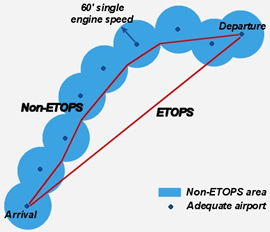
The FAA describes ETOPS authorization for two-engine airplanes in terms of routes containing points farther than one hour, at normal one-engine-inoperative cruise speed in still air, from an adequate airport.
Modern international terminology also includes Extended Diversion Time Operations (EDTO). ICAO’s current EDTO guidance covers both airplanes with two turbine engines and airplanes with more than two turbine engines.
Why ETOPS Matters for Twin-Engine Aircraft
Early long-range airline operations favored aircraft with three or four engines partly because twin-engine aircraft were subject to tighter diversion limitations.
As turbine-engine reliability improved, regulators gradually allowed appropriately approved twin-engine aircraft to operate farther from diversion airports.
The FAA first introduced guidance in 1985 permitting qualifying twin-engine operations up to 120 minutes from an adequate airport. Later guidance expanded this capability to 180 minutes and ultimately beyond.
This development changed international aviation.
Twin-engine aircraft could now operate efficient routes across oceans, deserts, polar regions and other remote areas without remaining constantly close to conventional diversion airports.
But the increased route flexibility came with additional safety requirements.
The 60-Minute Threshold
A fundamental reference point in Extended-Range Twin-Engine Operations is the traditional 60-minute threshold.
For FAA ETOPS purposes, the route criterion for a two-engine airplane is based on whether the route contains a point more than one hour from an adequate airport when flying at the approved one-engine-inoperative cruise speed under still-air conditions.
The important phrase is still air.
Wind encountered during the actual flight does not simply redefine the approved ETOPS operating area. ICAO guidance similarly explains that the 60-minute non-EDTO and EDTO operating areas are established using ISA and still-air conditions.
Once a planned route extends beyond the applicable threshold, additional extended-operations requirements become relevant.
Adequate and Suitable ETOPS Aerodromes
Diversion airports form the foundation of ETOPS route planning because extended-range twin-engine operations are only practical when the aircraft has realistic landing options available throughout the route. Two terms are particularly important: adequate aerodrome and suitable ETOPS alternate. An adequate aerodrome must satisfy the operational requirements applicable to the aircraft, which can include runway length and strength, available instrument approaches, navigation facilities, airport lighting, communications, weather reporting, rescue and firefighting capability where required, airport operating status, and aircraft landing performance. Simply being geographically close to the aircraft does not automatically make an airport useful as a diversion option.
A suitable ETOPS alternate must meet an additional standard. It must not only be adequate from an infrastructure and performance standpoint, but must also satisfy the applicable dispatch requirements for the time period during which it may be needed. Weather therefore becomes a major planning factor. An airport may have an excellent runway and full approach capability, yet still be unsuitable as the planned ETOPS alternate if the forecast conditions are expected to fall below the required planning minima. This distinction is critical because ETOPS route planning is based on usable diversion capability, not simply the number of airports shown on a chart.
ETOPS Entry Point and Exit Point
The ETOPS portion of a route is defined by specific points that mark when the aircraft enters and leaves the extended-diversion environment. The ETOPS Entry Point (EEP) is the point at which the aircraft enters the ETOPS segment of the route. Before crossing it, the crew should have current information about the condition and availability of the relevant diversion aerodromes, because once the aircraft enters the segment, its dependence on those airports becomes significantly more important.
The ETOPS Exit Point (EXP) marks the opposite transition. Once the aircraft passes the EXP, it has left the extended-range portion of the flight and returned to an area where the applicable non-ETOPS diversion-time criteria are satisfied. These entry and exit points are therefore not just theoretical markers on a flight plan; they define the operational boundaries within which the additional ETOPS planning, monitoring, and diversion considerations apply.
What Is an ETOPS Equal Time Point?
An Equal Time Point (ETP) is a point along the planned route from which the estimated time to two relevant diversion airports is equal under the assumptions used for the calculation. It is especially useful when comparing diversion options, because the closest airport by distance is not necessarily the quickest airport to reach. Wind, altitude, aircraft configuration, one-engine-inoperative performance, and depressurization profiles can all significantly alter the time required to reach each alternate. For that reason, flight planners may calculate different ETPs for different emergency scenarios rather than relying on one fixed geographic midpoint.
ETOPS Is More Than Engine Reliability
The name ETOPS can make the concept appear to revolve entirely around the risk of losing one engine, but the safety philosophy is much broader. Engine reliability is extremely important, especially because an in-flight shutdown in a twin-engine aircraft immediately leaves only one engine operating. However, ETOPS planning also addresses the wider question of whether the aircraft can continue safely after a serious failure and complete a diversion without losing critical systems or exhausting its available resources.
This requires attention to electrical generation, hydraulic systems, fuel supply, fire detection and suppression, navigation and communication equipment, pressurization, cargo fire protection, ice protection, APU availability, and engine oil systems. That is why ETOPS approval concerns not only the engine model but the complete aircraft-engine combination and the operator’s maintenance and operational program. The reliability of one component matters, but the real objective is ensuring that the aircraft remains a safe and functional system during a long diversion.
ETOPS Diversion Times
ETOPS authorization developed progressively as aircraft systems and propulsion reliability improved. Historically, ETOPS-120 allowed routes planned within 120 minutes of an appropriate diversion airport under the applicable assumptions, while ETOPS-180 expanded this capability to 180 minutes and opened many more efficient transoceanic routes. Additional approvals beyond 180 minutes later allowed qualifying aircraft-engine combinations and operators to use even longer diversion times.
Longer approval does not mean the aircraft can simply operate indefinitely far from airports. Each route must still satisfy the applicable requirements for fuel, alternates, weather, system capability, maintenance, and crew procedures. In other words, the diversion time is only one element of ETOPS planning; the underlying safety structure must remain intact for every segment of the flight.
Engine Reliability in Extended-Range Operations
Reliable propulsion is central to extended-range twin-engine operations because an in-flight engine shutdown immediately reduces the aircraft to one operating engine. Historically, ETOPS development therefore placed strong emphasis on in-flight shutdown rates (IFSD) and on demonstrating that the propulsion system could achieve the level of reliability required for progressively longer diversion times.
However, engine reliability statistics alone are not enough. ETOPS programs also use maintenance procedures designed to identify problems before departure and reduce the chance of common-cause failures affecting both engines. These practices can include enhanced monitoring, oil-consumption tracking, engine-condition monitoring, and specific controls intended to prevent the same maintenance error from being introduced on both sides of the aircraft. The result is a safety system that combines engineering reliability with disciplined operational and maintenance practices.
ETOPS Critical Fuel Scenario
Fuel planning is one of the most important elements of Extended-Range Twin-Engine Operations because a long diversion must remain possible even after a serious failure. A normal flight plan asks how much fuel is required to reach the destination with the necessary reserves, but ETOPS adds another layer: how much fuel would be needed if a major failure occurred at the least favorable point of the extended-range segment?
This leads to the critical fuel scenario. The planner evaluates the applicable diversion cases and determines which one requires the greatest amount of fuel. The resulting requirement must then be protected in the operational fuel plan, ensuring that the aircraft has enough fuel not only for the planned trip but also for the most demanding credible diversion scenario.
Engine Failure Scenario
Consider a twin-engine aircraft cruising over a remote area when one engine fails. The aircraft may no longer be able to remain at its optimum two-engine cruise altitude, so the crew may need to descend to an altitude where one-engine-inoperative performance is sustainable. The diversion calculation therefore has to consider engine-out descent or drift-down, the one-engine-inoperative cruise altitude, diversion speed, forecast winds, anti-icing requirements, fuel consumption, and the fuel needed for approach and landing.
A turbine twin may remain fully controllable with one engine inoperative while still having substantially different range, altitude, and fuel-burn characteristics from normal two-engine cruise. This is why engine-out diversion planning must be based on actual aircraft performance data rather than the assumption that the airplane will simply continue flying normally at half power.
Depressurization and Combined Failure Scenarios
A loss of cabin pressurization creates a different type of problem because the aircraft may need to descend rapidly to an altitude where occupants can safely breathe using the available oxygen provisions and approved emergency procedures. At that lower altitude, aerodynamic drag and fuel consumption may increase considerably, which means a depressurization diversion can require more fuel than a simple engine-out diversion.
An even more demanding situation occurs when depressurization and engine failure happen together. The aircraft may need to descend while simultaneously operating with only one engine, forcing the crew to account for emergency descent, terrain clearance, one-engine-inoperative limitations, diversion altitude, fuel burn, weather, and diversion-airport suitability all at once. The scenario that produces the greatest fuel requirement becomes particularly important in the critical-fuel calculation.
ETOPS Weather Planning
ETOPS alternates must satisfy the applicable planning weather criteria, but the exact minima depend on the operator, aircraft, available approaches, and governing regulations rather than one universal set of values for every flight. Relevant considerations may include forecast ceiling and visibility, instrument approach availability, runway status, crosswind, runway condition, temporary restrictions, and navigation-aid availability.
It is also important to distinguish dispatch planning minima from the actual landing minima that would apply during a real diversion. The purpose of dispatch criteria is to provide sufficient confidence that the airport will remain usable during the relevant time window, while the actual approach and landing decision later depends on the real conditions and applicable landing requirements at that moment.
Monitoring Before and During the ETOPS Segment
Crossing the ETOPS Entry Point is an important operational milestone because once the aircraft enters the extended-range segment, the condition of the diversion airports and the aircraft itself becomes especially significant. Before the EEP, crews should evaluate changes in alternate weather, runway availability, airport operating status, navigation facilities, NOTAMs, aircraft systems, and fuel status. If an intended alternate is no longer acceptable, the crew may need to select another airport, modify the route, or avoid entering the ETOPS segment altogether.
ETOPS planning does not stop once the aircraft crosses the EEP. During the extended segment, the crew continues monitoring aircraft status, fuel, weather, and the condition of relevant diversion airports. A runway can close, weather can deteriorate, an approach aid can become unavailable, or an aircraft system can develop a fault, so the diversion strategy must remain dynamic throughout the flight rather than being treated as a fixed plan created before departure.
Deviations and Diversion Decisions
Significant ATC or weather deviations can change the aircraft’s relationship to its approved diversion airports. If the flight must deviate from the planned track, the revised route should remain consistent with the applicable ETOPS authorization and diversion strategy. When necessary, the crew and dispatcher may need to reassess alternates or modify the route so that the aircraft remains within the authorized area of operation.
An alternate airport may also become unsuitable after the aircraft has already entered the ETOPS segment. This does not automatically place the aircraft in immediate danger, but it does require the crew to reassess the available options based on aircraft condition, remaining fuel, weather, terrain, distance, diversion time, and the urgency of any malfunction. The safest airport is not always the geographically nearest one; the goal is to select the option that provides the best overall landing opportunity under the actual conditions.
Diversion After an Engine Failure
If a twin-engine aircraft actually loses an engine during an ETOPS flight, the event moves from planning theory into real-time engine-out management. The crew must first maintain control and establish the appropriate one-engine-inoperative configuration before moving on to diversion strategy. Depending on aircraft type and failure, this may include confirming and securing the failed engine, establishing OEI cruise or drift-down, evaluating diversion airports, declaring the appropriate emergency, calculating fuel remaining at the alternate, and coordinating with ATC and dispatch.
The approved aircraft procedures always take priority over generic guidance because every twin-engine type has its own system logic, engine-out performance, drift-down profile, and checklist sequence. The role of ETOPS planning is to ensure that when such a failure occurs, the crew already has realistic diversion options and sufficient aircraft capability to use them.
Why ETOPS Has Been Successful
Modern ETOPS demonstrates how reliability engineering, operational planning, maintenance standards, and pilot training can expand what twin-engine aircraft are capable of doing safely. Twin-engine airliners now routinely operate routes that once strongly favored three- and four-engine aircraft, but this capability was not achieved simply because engines became more reliable.
The real safety system combines reliable engines, redundant aircraft systems, disciplined maintenance, fuel planning, diversion airports, weather planning, crew training, and continuous monitoring. That broader philosophy is what makes extended-range twin-engine operations practical: the aircraft is not expected to avoid every failure, but it is designed, maintained, planned, and operated so that a serious failure remains manageable even when the nearest suitable airport is a long way away.
Conclusion
Extended-Range Twin-Engine Operations demonstrate how modern twin-engine aviation manages the consequences of operating far from immediate landing options. ETOPS does not assume that an engine, pressurization system or other critical component will never fail. Instead, it creates layers of protection so that a serious failure remains manageable even during a long diversion.
For pilots, the most important lesson extends beyond long-haul airline operations. Understanding asymmetric thrust, one-engine-inoperative performance, aircraft systems, fuel management and disciplined emergency decision-making begins much earlier in a pilot’s career.
For a broader look at how pilots develop those skills before moving into more advanced twin-engine operations, continue with our guide to Multi Engine Flight Training: Why Every Future Twin Engine Pilot Needs It.
For regulatory reference, the FAA Extended Operations guidance and EASA ETOPS guidance provide authoritative material on extended operations.