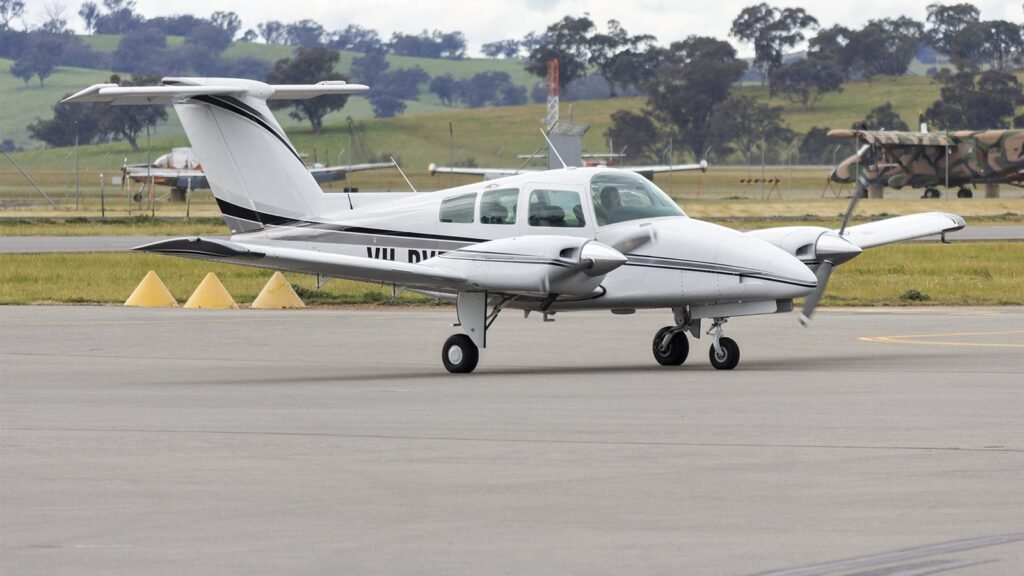
Park a Twin Navion aircraft on any ramp and someone will walk over to ask what it is. From a distance it looks like the familiar Navion, the rugged four-seat single built after the Second World War, until you notice an engine on each wing and no propeller on the nose. This article tells the story of the type: why it was created, how the different versions compare, what it is like to fly, and what anyone considering one of these rare classics should know.
From Navion to Twin Navion
The Navion was designed by North American Aviation right after the war as a modern personal airplane, borrowing ideas from the company’s military designs: a strong airframe, a sliding canopy, retractable tricycle gear and generous control authority. Production soon passed to Ryan Aeronautical, and the Navion earned a reputation as a tough, stable and forgiving airplane that could use short and rough strips.
In the early 1950s twin-engine light aircraft were in demand, but new designs were expensive. Converting an existing, proven airframe was an attractive shortcut. The best-known conversion came from Jack Riley, whose company removed the nose engine, faired over the nose and mounted a smaller engine on each wing. The result kept the Navion cabin and handling while adding the redundancy of a second engine.
The Main Versions
| Version | Background | Character |
|---|---|---|
| Riley Twin Navion | Original early-1950s conversion of existing Navions | Modest power per engine; proved the concept |
| Temco D-16 / D-16A | Conversions produced by Temco (Texas Engineering and Manufacturing); the D-16A received more powerful engines | Better climb and cruise than the first conversions |
| Camair Twin Navion | Later development with considerably larger engines and other changes | The fastest and most capable of the family, but heavier and thirstier |
Exact engine models, weights and performance vary between individual airplanes because many were modified again over the decades. Anyone evaluating a specific airplane should rely on its own flight manual supplement and records.
Why the Concept Was Attractive
- A proven airframe: the Navion was already known for strength and benign handling.
- A clear nose: without a propeller in front, the cabin became quieter and visibility over the nose improved.
- Redundancy: for business pilots of the 1950s, a second engine offered more options at night and over difficult terrain.
- Lower cost than a new design: conversion reused parts and certification work from the original airplane.
What It Is Like to Fly
Pilots who fly Twin Navions usually describe an airplane that feels like a Navion first and a twin second: stable, heavy on the controls in a reassuring way, and comfortable on approach. The sliding canopy and high seating give a good view. Like any light twin, though, it has to be flown with discipline. The lower-powered versions in particular have limited single-engine climb, so engine-failure planning before every takeoff, attention to weight and density altitude, and a firm grasp of VMC are essential. Our articles on what makes a light twin and engine failure performance explain why these margins matter.
Owning a Twin Navion Today
Only a small number of Twin Navions were built, and fewer still are airworthy, so ownership is closer to caring for a classic than to buying a common twin. Points to consider:
- Records and approvals: conversions were approved through supplemental certification, so complete paperwork for every modification is important.
- Parts: airframe parts are shared with the single-engine Navion, which has an active owner community; conversion-specific parts may need to be sourced or fabricated.
- Maintenance: find a shop familiar with Navions and with older twins; budget for two engines, two propellers and ageing systems.
- Insurance: rare types with small fleets can be harder to insure; experience in the type or in similar twins helps.
- Training: fly with an instructor who knows the airplane, and practise engine-out procedures at a safe altitude or in a simulator.
Twin Navion vs Other Classic Light Twins
Compared with factory-designed twins of the same era, such as the Piper Apache or the Aero Commander, the Twin Navion is rarer and more of a conversation piece. It offers Navion handling and a distinctive look, while purpose-built twins usually have better parts support and more standard systems. For a broader view of light twins and how they differ, see twin-engine plane types and the list of twin-engined aircraft.
Key Takeaways
- The Twin Navion is a conversion of the post-war North American/Ryan Navion into a light twin, first by Riley and later by Temco and Camair.
- It keeps the Navion’s sturdy, stable character while adding a second engine.
- Single-engine performance varies by version; disciplined twin technique is required.
- Today it is a rare classic: records, parts and specialist maintenance are the main ownership challenges.
If you are interested in how designers size the tail of a light twin to keep it controllable on one engine, read our summary of research on sizing the empennage of multi-engine propeller aircraft.