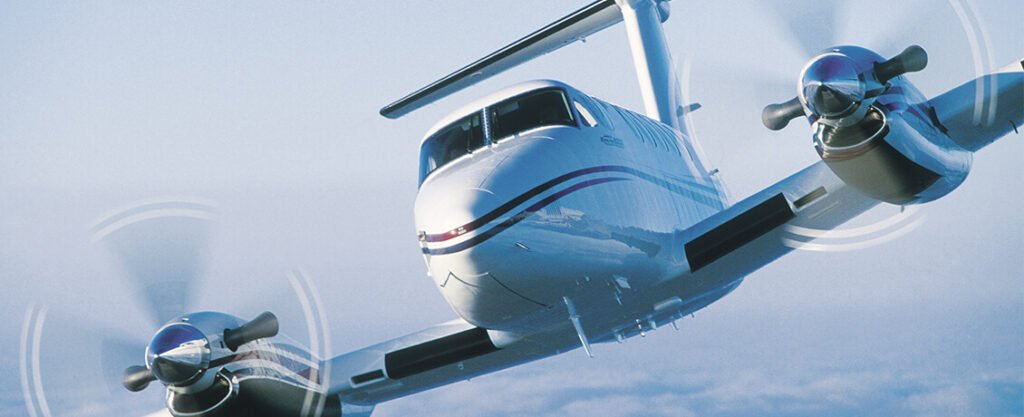
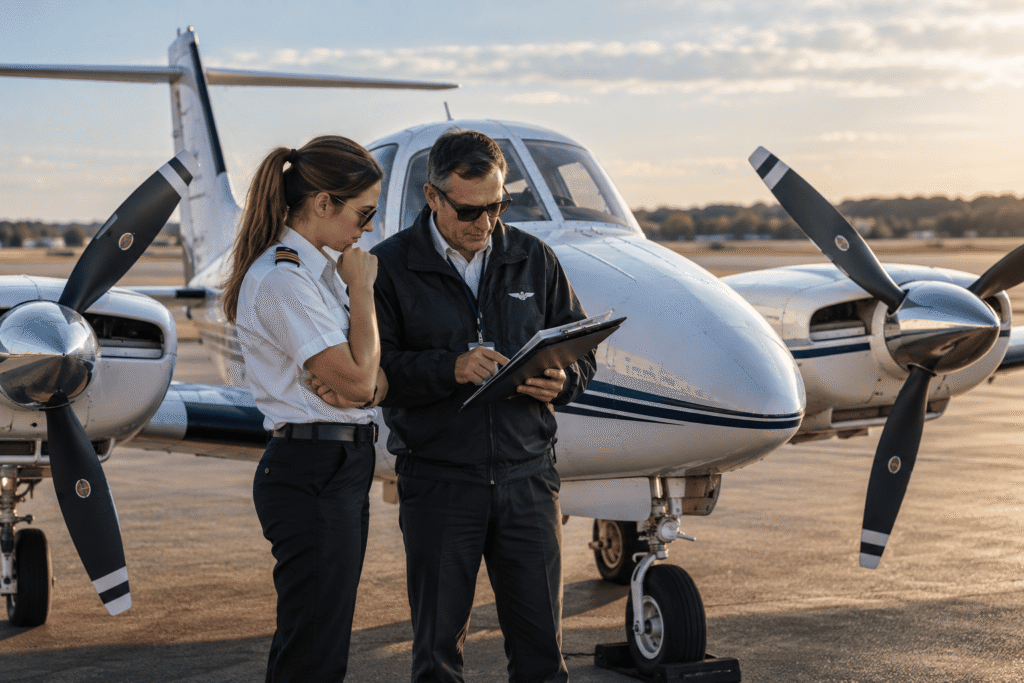
Becoming a Twin Engine Commercial Pilot is an important step in the progression from basic aircraft handling toward more advanced professional flying. A pilot who moves from a single-engine trainer into a multiengine airplane is not simply learning to manage another throttle. The transition introduces asymmetric thrust, one-engine-inoperative performance, more complex aircraft systems, higher workload and a new level of performance planning and risk management.
Single-engine training builds the foundation: aircraft control, navigation, weather interpretation, communication, judgment and procedural discipline. Twin-engine training builds on that foundation by introducing situations in which the airplane may remain capable of flight after losing an engine, but only if the pilot understands how dramatically its aerodynamics and performance have changed.
That distinction is what makes multi-engine experience so valuable in professional pilot development. The FAA’s Airplane Flying Handbook dedicates an entire chapter to transition to multiengine airplanes, covering systems, feathering propellers, performance, weight and balance, takeoffs, engine failures, VMC and one-engine-inoperative operations. Федеральная авиация
What Does It Mean to Become a Twin Engine Commercial Pilot?
A commercial pilot certificate establishes that a pilot has reached the applicable knowledge, experience and practical-test standards required for commercial pilot privileges. A multiengine class rating identifies qualification within the airplane multiengine land or sea class, depending on the rating involved. These concepts should not be collapsed into the simplistic idea that every commercial pilot must automatically be multiengine qualified.
In practice, however, multiengine experience becomes highly relevant for pilots who intend to progress toward many professional operations involving twin-engine airplanes. It introduces aircraft and procedures that more closely resemble the environment pilots may encounter later in turbine aircraft, charter operations, corporate aviation and eventually air-carrier training.
FAA itself cautions against confusing certification minimums with airline hiring standards. For example, it notes that although 250 hours is the FAA minimum total flight experience associated with the standard commercial pilot certificate path, airlines establish their own experience requirements and may value particular types of flight time differently. Федеральная авиация
So the real value of becoming a Twin Engine Commercial Pilot is not simply adding another line to a certificate. It is developing another layer of professional competence.
Why Twin-Engine Training Changes the Way a Pilot Thinks
When both engines of a conventional light twin are operating normally, the airplane may feel surprisingly familiar to a pilot coming from a single-engine aircraft. The FAA notes that small multiengine airplanes generally handle much like single-engine airplanes while both engines are functioning normally. The major difference appears when one engine stops producing thrust. Федеральная авиация
At that moment, the pilot does not simply have less power.
The airplane becomes asymmetric.
One engine continues producing thrust from one side of the aircraft while the other no longer contributes the same force. Depending on the propeller condition, the failed side may also produce considerable drag. Yaw develops, roll tendencies may appear, performance deteriorates and the pilot must control the aircraft while identifying and managing the failure.
That changes the nature of pilot training. Instead of asking only, “Can I fly the maneuver accurately?” the pilot must also ask, “What happens if I lose part of the airplane’s capability right now?”
That is a much more professional way of thinking about flight.
The Second Engine Adds Capability—and Complexity
Twin-engine airplanes are sometimes described as inherently safer simply because they have a second engine. The reality requires more nuance.
Redundancy can provide an important safety advantage. If one engine fails, another source of thrust may remain available. But the remaining engine does not automatically guarantee that the aircraft can climb, maintain altitude or continue the flight normally.
Aircraft weight, density altitude, temperature, configuration, airspeed, propeller drag and terrain all influence the outcome. In some conditions, a light twin may have limited or even negative single-engine climb capability.
At the same time, losing an engine creates an asymmetric-control problem that does not exist in the same form in a single-engine airplane.
For a Twin Engine Commercial Pilot, the second engine therefore represents both additional capability and additional responsibility.
Understanding Asymmetric Thrust
Asymmetric thrust is at the center of multiengine flying.
Suppose the right engine fails while the left engine continues producing power. Because the operating engine is positioned away from the aircraft’s longitudinal centerline, its thrust creates a yawing moment toward the failed engine. The pilot must oppose that tendency, primarily with rudder, while maintaining the appropriate aircraft attitude and airspeed.
But yaw is only part of the problem. Propeller effects, sideslip and aircraft geometry can create additional aerodynamic forces, while a windmilling propeller on the failed engine can substantially increase drag.
A proficient commercial multiengine pilot therefore does not treat an engine failure as a checklist exercise. The pilot understands the forces acting on the aircraft and uses that knowledge to keep it under control while the procedure is completed.
VMC: More Than a Red Line
One of the most recognizable concepts in twin-engine training is VMC, or minimum control speed with the critical engine inoperative under specified certification conditions.
Students often first encounter VMC as the red radial line on the airspeed indicator. But simply memorizing that line does not demonstrate meaningful understanding.
VMC is connected to a balance between the asymmetric forces attempting to yaw the aircraft and the pilot’s available directional-control authority. Power on the operating engine, aircraft configuration, center of gravity, propeller condition, density altitude and bank all influence the aerodynamic situation.
The FAA specifically emphasizes recurrent understanding of VMC because loss of control following power loss remains a significant multiengine training concern. FAA safety material notes that improved and more frequent single-engine training could help reduce multiengine loss-of-control events. Федеральная авиация
For a commercial pilot, the lesson is straightforward: the red line is important, but understanding why it exists is more valuable than memorizing the number.
VYSE and the Blue Line
If VMC is closely associated with directional control, VYSE addresses another part of the engine-out problem: performance.
VYSE is the best rate-of-climb speed with one engine inoperative under the conditions applicable to the aircraft’s published data. It is commonly represented by the blue radial line on light multiengine airplane airspeed indicators.
The FAA’s multiengine guidance describes these two ideas together: the red radial line relates to minimum control speed, while the blue radial line relates to obtaining the airplane’s best available performance with an inoperative engine. Федеральная авиация
A pilot must understand that controllability and performance are different things. An airplane can be controllable but unable to climb. Conversely, achieving the best possible single-engine performance requires correct airspeed, configuration and technique.
This distinction becomes particularly important near the ground.
Engine Failure After Takeoff
Few training scenarios demand more discipline than an engine failure shortly after takeoff.
The aircraft may be heavy, power is high, airspeed is relatively low and altitude provides little time for troubleshooting. If the failed propeller remains windmilling, additional drag can further reduce the performance available from the remaining engine.
The pilot’s first responsibility is therefore not to immediately begin manipulating switches. It is to maintain aircraft control.
Directional control and appropriate airspeed must be protected while the failure is recognized and the applicable aircraft-specific procedure is performed. Depending on the phase of takeoff and aircraft performance, the safest decision may involve rejecting the takeoff, landing ahead or continuing under one-engine-inoperative procedures.
This is why professional multiengine training places so much emphasis on pre-takeoff planning. The pilot should be thinking about the possibility of an engine failure before power is applied, not inventing a strategy after the failure occurs.
Propeller Feathering and Engine-Out Performance
A failed engine can become an enormous source of drag if its propeller continues windmilling.
Feathering moves the propeller blades toward a high-pitch position that aligns them more closely with the relative airflow, greatly reducing drag. This does not restore the lost engine’s power, but it can significantly improve the aircraft’s ability to use the power that remains.
The FAA’s multiengine chapter specifically includes feathering systems as part of the knowledge required for transition to multiengine airplanes. Федеральная авиация
For the Twin Engine Commercial Pilot, feathering is therefore not simply a mechanical action involving a propeller control. It is part of a larger aerodynamic strategy: maintain control, reduce unnecessary drag, configure the aircraft correctly and obtain the best performance available from the remaining engine.
Identify, Verify, Then Secure
An engine failure creates urgency, but urgency cannot be allowed to produce an incorrect action.
Pilots are taught methods for identifying which engine has failed, often including the familiar “dead foot, dead engine” concept. If the airplane yaws and rudder pressure is required to maintain directional control, the relaxed foot can provide an initial clue about the affected side.
Identification, however, is not enough.
Before taking an irreversible action such as feathering or shutting down an engine, the pilot should complete the verification procedure appropriate to that aircraft. The precise sequence varies by airplane, which is why generic memory aids cannot replace the approved checklist and aircraft-specific training.
The reason is obvious: shutting down the engine that is still producing power can transform a manageable engine-out situation into a much more serious emergency.
Single-Engine Performance Is Not “Half the Performance”
This is one of the most important lessons in multiengine training.
If a twin loses one of two engines, it loses approximately half of its available propulsion—but that does not mean it retains half of its climb performance.
Climb depends on excess power or thrust beyond what is required for level flight. When one engine is lost, much of that excess disappears. At the same time, asymmetric flight and the failed powerplant can introduce additional drag.
The result can be a dramatic reduction in climb capability.
Weight and atmospheric conditions make the situation even more important. A heavily loaded airplane departing from a high-elevation airport on a hot day may have substantially less one-engine climb performance than the same airplane operating light from a cool, sea-level airport.
Commercial pilots need to understand those numbers before departure.
Performance Planning Becomes a Professional Skill
Commercial flying requires pilots to stop thinking of aircraft performance as an academic exercise completed only during training.
Takeoff distance, accelerate-stop considerations where applicable, climb capability, obstacle clearance, landing performance, weight and balance, density altitude and one-engine performance can all affect whether a flight should be conducted as planned.
A Twin Engine Commercial Pilot should therefore be able to use the actual performance data for the aircraft rather than relying on general assumptions such as “the other engine will get us home.”
The FAA’s Airplane Flying Handbook treats performance and limitations as a major part of multiengine transition training, alongside weight and balance and normal and abnormal operations. Федеральная авиация
That reflects a broader professional principle: good pilots do not merely react well when something goes wrong. They calculate whether the aircraft has sufficient margins before the flight begins.
Twin-Engine Aircraft Systems
Moving into a multiengine airplane usually means moving into a more complex systems environment.
Pilots may encounter constant-speed and feathering propellers, retractable landing gear, multiple fuel tanks and pumps, crossfeed systems, dual electrical sources, combustion heaters, deicing or anti-icing equipment, autopilot systems and more sophisticated engine instrumentation.
The specific equipment depends entirely on the aircraft, but the training philosophy remains consistent: pilots need to understand not only where a switch is, but what the system does and what changes when part of it fails.
For example, losing an alternator in a twin may not initially seem urgent because another electrical source remains available. But the pilot still needs to know which buses remain powered, whether load shedding is required, what redundancy has been lost and how the failure changes the risk of continuing into instrument conditions or at night.
Systems knowledge is therefore closely connected to decision-making.
Fuel Systems and Crossfeed
Twin-engine fuel systems deserve particular attention because having two engines does not necessarily mean that each engine can use fuel from every tank in every configuration.
Depending on the airplane, normal fuel feed, auxiliary tanks, transfer pumps and crossfeed systems can create multiple possible configurations. The pilot must know which selections are normal, which are abnormal and which may be prohibited during particular phases of flight.
Crossfeed is especially important because its purpose and operating limitations are aircraft-specific. A pilot should never assume that procedures learned in one twin transfer directly to another.
Professional training therefore moves beyond memorizing a fuel diagram. The pilot should be able to explain what will happen to fuel flow after a particular valve or pump is selected and recognize indications that the system is not behaving as expected.
Electrical Failures in a Twin
Multiple engines often provide multiple sources of electrical generation, creating redundancy that can help keep essential systems operating after a failure.
But redundancy can also hide developing problems.
If one alternator or generator fails, the airplane may continue operating normally enough that the pilot feels little immediate urgency. Yet the remaining electrical source is now carrying a different load and the airplane no longer has the same protection against another failure.
Commercial-level systems management means understanding these secondary consequences.
The question is not simply, “Can I continue flying?” It is also, “What redundancy have I lost, what additional failure would now become critical, and does continuing the flight still make operational sense?”
Instrument Flying and Multi-Engine Operations
The source material correctly connects professional multi-engine development with instrument skills, but the two qualifications should not be treated as though one automatically includes the other.
Instrument proficiency is its own discipline. What multi-engine flying does is add another layer of workload when instrument conditions and an aircraft abnormality occur simultaneously.
Imagine flying an approach in IMC when one engine loses power. The pilot must maintain instrument control, manage asymmetric thrust, configure the airplane, communicate with ATC, complete appropriate checklists, monitor the remaining engine and still stay ahead of the approach.
That is why combining instrument proficiency with multiengine competence becomes so valuable in professional flying.
Commercial Standards Demand Precision
A commercial pilot is expected to demonstrate more than basic safety.
The FAA currently evaluates Commercial Pilot – Airplane applicants under FAA-S-ACS-7B, published in April 2024 and effective since May 31, 2024. The ACS integrates knowledge, risk management and flight skills rather than treating them as unrelated parts of the test. Федеральная авиация
For a commercial multiengine applicant, this means aircraft control must be accompanied by sound judgment and understanding. A technically accurate maneuver does not compensate for poor risk management, and excellent theoretical knowledge does not compensate for weak aircraft control.
Professional standards require the pieces to work together.
Multi-Engine Training Builds Workload Management
One of the less obvious benefits of multi-engine training is that it teaches pilots how to manage competing demands.
An engine failure can create yaw, performance deterioration, abnormal indications and increased workload at exactly the same moment. The pilot may need to fly the airplane, identify the failure, communicate, use a checklist, evaluate terrain and weather, and decide whether to divert.
Trying to solve everything simultaneously is rarely effective.
Instead, pilots learn to prioritize. Aircraft control comes first. Time-critical actions are completed when appropriate. Lower-priority troubleshooting waits until the airplane is stable.
That ability to establish priorities under pressure is valuable far beyond the multiengine checkride.
Decision-Making Matters as Much as Aircraft Handling
Professional flying frequently involves situations in which there is no dramatic emergency and no single obviously correct answer.
Weather may be deteriorating. A system may be operating abnormally but not completely failed. Fuel reserves may still be legal but less comfortable than planned. An engine indication may remain within limits while behaving differently from normal.
Commercial pilots need to recognize these situations before they become emergencies.
Multi-engine training provides a useful environment for developing this judgment because the airplane contains more systems, more redundancy and more potential failure combinations. Instead of automatically continuing because “we still have another engine,” a good pilot evaluates what capability has been lost and how much safety margin remains.
Crew Coordination Starts Before the Airline Cockpit
A light twin used for commercial training may be flown by a single pilot, so multi-engine training should not be confused with airline crew training.
Nevertheless, it can begin developing habits that later become important in multi-pilot environments. Clear briefings, checklist discipline, standardized callouts, anticipation and organized workload all help create a more professional cockpit.
Pilots can also learn to communicate clearly with instructors, examiners, ATC and passengers while continuing to manage the aircraft.
Later, when a pilot enters formal crew resource management training, those habits provide a useful foundation.
Does Multi-Engine Training Prepare You for an Airline?
It helps—but it should not be oversold.
A light piston twin is not an airliner. It does not reproduce the mass, inertia, automation, turbine systems, high-altitude environment, crew structure or operating procedures of a transport-category jet.
What it does provide is an introduction to several concepts that remain relevant later: asymmetric thrust, engine-out decision-making, redundancy, system failures, performance planning and higher cockpit workload.
That makes multiengine experience a valuable developmental step rather than a miniature airline course.
FAA requirements for airline transport pilots are substantially different. For example, applicants pursuing an ATP certificate with an airplane multiengine class rating are subject to additional qualification requirements, including the ATP Certification Training Program where applicable. Федеральная авиация
Multi-Engine Rating and Commercial Pilot Certification
This area is often oversimplified in flight-school marketing.
A pilot can pursue commercial privileges in different airplane classes, and holding a commercial pilot certificate does not automatically grant multiengine privileges. Likewise, adding an airplane multiengine class rating involves the training, endorsements and practical-test requirements applicable to the applicant’s existing certificate and rating situation.
The exact pathway therefore depends on what the pilot already holds.
A person pursuing an initial commercial certificate with an airplane multiengine rating has a different regulatory path from a pilot who already holds a commercial airplane single-engine rating and later adds multiengine privileges.
That distinction matters when planning training because not every pilot needs the same number of hours or exactly the same practical-test tasks.
The Commercial Multi-Engine Practical Test
The practical test is designed to determine whether the applicant can consistently meet the applicable commercial standards while managing the additional complexity of a multiengine airplane.
Preparation therefore includes normal operations as well as engine-out knowledge and skills. Aircraft systems, performance, limitations, emergency procedures, VMC-related concepts and one-engine-inoperative operations become important parts of the applicant’s preparation.
The current FAA Commercial Pilot for Airplane Category ACS is available through the official FAA Airman Certification Standards page. Федеральная авиация
Pilots preparing for a checkride should use the current ACS rather than relying solely on older training articles, videos or checkride reports because standards and task tables can change.
Common Mistakes During Commercial Multi-Engine Training
One common mistake is focusing too heavily on memorized procedures without understanding the aerodynamics behind them. A pilot may know exactly which control comes next but struggle when the scenario differs from the training sequence.
Another is allowing airspeed to deteriorate while concentrating on engine identification or a checklist. In asymmetric flight, airspeed is directly connected to both performance and available control authority, so fixation can quickly create a more serious problem.
Students can also become too confident in the second engine. The existence of another engine does not guarantee positive climb performance, especially when the airplane is heavy or density altitude is high.
Finally, some pilots treat VMC demonstrations as exercises in reaching the red line. The purpose is to recognize and recover from the developing loss-of-control condition—not to prove how close the airplane can be brought to an unsafe state.
Why Recurrent Engine-Out Training Matters
Passing a practical test proves proficiency at a particular point in time. It does not guarantee that rarely used emergency skills remain sharp indefinitely.
Actual engine failures are uncommon, meaning a pilot may go years without using the procedures that become most important when an engine finally does fail.
The FAA has specifically highlighted the value of improved and more frequent single-engine training in multiengine airplanes as a way to reduce loss-of-control events. Федеральная авиация
For professional pilots, recurrent training should therefore be viewed as part of maintaining competence rather than as an administrative obligation.
Building Confidence Without Creating Overconfidence
The source article correctly identifies confidence as one benefit of multi-engine training, but there is an important distinction between confidence and complacency.
Useful confidence comes from understanding the airplane well enough to manage abnormal situations deliberately. It is based on systems knowledge, repeated practice, performance planning and realistic awareness of limitations.
Overconfidence develops when the pilot begins assuming that two engines automatically make every situation manageable.
Good twin-engine training should produce the first and actively discourage the second.
How Twin-Engine Experience Supports a Professional Career
Multi-engine experience can become an important part of a pilot’s professional development, particularly when pursuing jobs involving multiengine airplanes or building toward more advanced certificates and qualifications.
But no single rating guarantees employment.
FAA explicitly notes that airlines establish their own minimum experience standards and may place different value on turbine time, particular aircraft experience and other qualifications depending on the carrier and market. Федеральная авиация
The strongest reason to pursue multiengine training is therefore not that a rating automatically creates an airline career. It is that the training develops capabilities that become increasingly relevant as aircraft and operations become more complex.
From Student Pilot to Professional Aviator
The transition into twin-engine flying often marks an important change in how pilots view themselves and their responsibilities.
Early flight training naturally focuses heavily on physical aircraft control. As experience grows, professional development increasingly involves planning, systems knowledge, risk management, standardization and decision-making.
A Twin Engine Commercial Pilot needs all of these skills at the same time.
The pilot must be able to control the aircraft precisely while understanding its systems, anticipate how performance will change if an engine fails, evaluate whether a flight has sufficient margins, manage abnormal situations without fixation and recognize when the safest decision is to stop, divert or land.
That combination—not simply the presence of two throttles—is what makes multiengine commercial training an important stage of pilot development.
What Makes a Strong Twin Engine Commercial Pilot?
A strong commercial multiengine pilot does not simply perform maneuvers accurately when the airplane is operating normally. The pilot understands how the aircraft behaves when one engine stops producing thrust and can recognize the relationship between airspeed, directional control, drag and performance before those factors become critical.
Systems knowledge is equally important. The pilot understands enough about the propellers, fuel system, electrical system, landing gear and other installed equipment to recognize failures and predict their consequences rather than merely reacting to warning lights.
Finally, professional competence requires judgment. Sometimes the correct response is to continue under a well-managed abnormal condition. Sometimes it is to return immediately. Sometimes the best decision is made before takeoff when performance calculations reveal that the available margin is not sufficient.
The commercial standard is ultimately about combining knowledge, risk management and skill—the same three elements around which the FAA structures its current ACS.
Conclusion
Becoming a Twin Engine Commercial Pilot represents much more than progressing from one engine to two. Multi-engine training introduces pilots to asymmetric thrust, VMC, VYSE, feathering, one-engine-inoperative performance, more complex aircraft systems, and a level of workload that demands disciplined prioritization and decision-making.
Those lessons have value far beyond a single practical test. They teach pilots to distinguish aircraft controllability from aircraft performance, understand what redundancy can and cannot provide, calculate margins before takeoff, and continue flying the airplane while managing abnormal situations. As pilots progress toward more sophisticated aircraft and professional operations, these habits become an increasingly important part of safe and competent flying.
For pilots who want to take their twin-engine knowledge one step further, the next challenge is learning not only to perform these procedures but to teach, explain, and safely demonstrate them to another pilot. Continue with Multi-Engine Flight Instructor to explore MEI training, right-seat proficiency, engine-out instruction, VMC, asymmetric thrust, aircraft systems, and the skills required to teach in a twin-engine airplane.