
Beechcraft King Air Training: Professional Twin-Engine Turboprop Flying
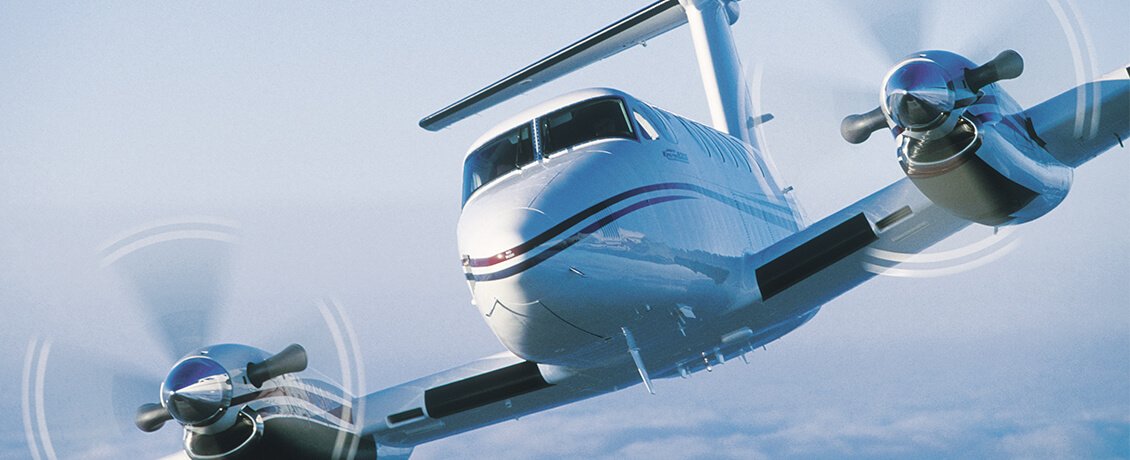
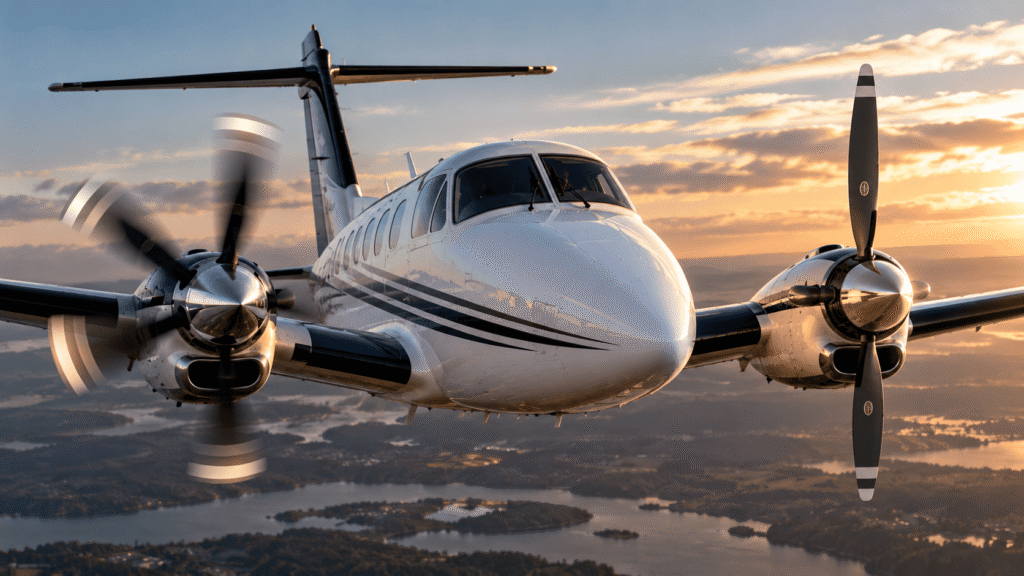
Beechcraft King Air Training is much more than learning the cockpit layout of another airplane. The King Air family represents a significant transition into professional twin-engine turboprop operations, where pilots must combine multi-engine aerodynamics with turbine-engine management, sophisticated aircraft systems, high-altitude operations, pressurization, advanced avionics and disciplined abnormal-procedure training. From the King Air 90 and 100 families through the widely operated 200 Series and the newer King Air 250 and 260, these aircraft demand a level of systems knowledge and operational planning that goes well beyond basic multi-engine flying.
Professional training therefore focuses not only on how to operate a King Air when everything is working normally, but also on what happens when the normal sequence is interrupted. An engine failure, pressurization problem, electrical abnormality, propeller malfunction, severe weather encounter or high-workload instrument approach can rapidly require the pilot to manage several systems simultaneously. Effective King Air training develops the knowledge and habits needed to recognize those situations early, maintain aircraft control and use the airplane’s available redundancy intelligently.
FlightSafety currently provides professional pilot training for the Beechcraft King Air 90, 100, 200, 250 and 260 at learning centers in Atlanta, Tampa and Wichita, while King Air maintenance training is offered in Wichita. FlightSafety also states that its King Air 90 and 200 Series training courseware and devices were developed in conjunction with Beechcraft/Textron Aviation.
Why King Air Training Is Different From Basic Multi-Engine Training
A pilot entering a King Air program may already hold substantial multi-engine experience, but the transition to a pressurized twin-engine turboprop introduces a different combination of performance, systems and workload. The fundamental aerodynamics of asymmetric flight remain important: if one engine loses thrust while the other continues producing power, directional control, drag, airspeed and one-engine-inoperative performance immediately become critical considerations. However, a King Air pilot must manage those aerodynamic problems while also understanding turbine engines, propeller governing, autofeather or related aircraft-specific systems, electrical generation, pressurization, environmental systems and more advanced avionics.
The aircraft also operates in an environment where events develop more quickly. Higher climb, cruise and descent speeds mean that pilots have less time to become mentally established before the next phase of flight begins. A pilot who is still configuring avionics while descending toward a terminal area may soon find that checklist completion, weather evaluation, approach briefing and aircraft configuration are competing for attention. Beechcraft King Air Training therefore develops not only manipulation skills but also anticipation, workload management and disciplined use of procedures.
The King Air Family: 90, 100, 200, 250 and 260
The King Air name represents a large family rather than a single airplane. Different generations have introduced changes in engines, avionics, propellers, cockpit layouts, systems and performance, meaning that training must always remain specific to the model and configuration being flown. A pilot familiar with an older King Air should not assume that every switch, limitation, checklist or automation feature transfers unchanged into a newer aircraft.
The 200-series family has become particularly important in professional turboprop operations, and the modern King Air 260 continues that lineage. According to the current official Beechcraft specifications, the King Air 260 uses two Pratt & Whitney Canada PT6A-52 engines rated at 850 shaft horsepower each, has a maximum takeoff weight of 12,500 pounds and a maximum operating altitude of 35,000 feet. Beechcraft publishes a maximum cruise speed of 310 KTAS and maximum range of 1,720 nautical miles under the manufacturer’s specified conditions.
The King Air 260 also incorporates modern features intended to reduce workload, including digital pressurization and the ThrustSense autothrottle system, while retaining the twin-engine turboprop architecture that has defined the King Air family. These developments make transition training particularly important because pilots moving between generations may encounter substantial differences in avionics and automation even though the aircraft belong to the same broad family.
Understanding the PT6 Turboprop Engine
One of the most important transitions during King Air pilot training is developing a practical understanding of turboprop powerplants. The Pratt & Whitney Canada PT6 family is fundamentally different from the reciprocating engines found in many light twins. Instead of thinking primarily in terms of manifold pressure, mixture and piston-engine temperatures, pilots must understand turbine-engine operating limits, propeller control, torque, interstage turbine temperature or aircraft-specific temperature indications, gas-generator speed and the relationships among these parameters during starting, takeoff, climb and cruise.
The goal is not simply to memorize which gauge has which limit. A professional King Air pilot needs to understand what is happening inside the powerplant and why particular procedures exist. Starting deserves particular attention because turbine-engine starts require careful monitoring of the correct sequence and engine indications. Abnormal temperature rise, inadequate acceleration or another abnormal start indication must be recognized quickly and handled using the applicable aircraft procedures.
The FAA’s Airplane Flying Handbook specifically includes a chapter devoted to transition to turbopropeller-powered airplanes. It discusses turboprop engines, powerplant operation, reverse thrust and beta-range operations, electrical systems, operational considerations and training considerations, making it a useful external reference alongside the aircraft’s approved manuals and training material.
Twin-Engine Aerodynamics Still Matter
The sophisticated systems of a King Air do not eliminate the fundamental aerodynamic problem created when thrust becomes asymmetric. If one engine loses power, the operating engine continues producing thrust away from the airplane’s centerline, creating a yawing moment that must be controlled. At the same time, the inoperative side can introduce additional drag depending on propeller condition, while available climb performance is reduced.
This is why professional Beechcraft King Air Training must connect systems knowledge with multi-engine aerodynamics. The pilot needs to understand not only which checklist follows an engine failure but why airspeed and directional control remain priorities before troubleshooting begins. An applicant who can perfectly recite a memory sequence but allows airspeed or heading to deteriorate has misunderstood the larger problem.
The FAA devotes Chapter 13 of its Airplane Flying Handbook to multiengine operations, emphasizing the significant differences between normal twin-engine flight and one-engine-inoperative flight. That chapter specifically addresses the aerodynamic and performance considerations that make multiengine airplanes a distinct training category.
Engine Failure Is an Aircraft-Control Problem First
When a twin-engine turboprop experiences an engine failure, the first challenge is not identifying every system affected by the failure. It is continuing to fly the airplane. Asymmetric thrust can produce significant yaw, aircraft performance changes, workload rises and the pilot may immediately be presented with warnings or indications competing for attention.
Professional training reinforces a hierarchy in which aircraft control remains fundamental. The pilot establishes the appropriate attitude and airspeed, maintains directional control, correctly identifies the abnormal condition and then completes the applicable aircraft-specific procedure. The exact sequence depends on the King Air model, configuration and approved checklist, which is why generic memory aids should never replace the AFM, POH or operator procedures.
This becomes particularly important during low-altitude operations. An engine failure during cruise allows substantially more time and altitude for diagnosis than an abnormality immediately after takeoff. Simulator training can expose pilots to these high-risk situations repeatedly without requiring an actual aircraft to be placed in an unnecessarily hazardous training condition.
Simulator Training and Realistic Emergency Scenarios
One of the major advantages of professional King Air training is the ability to reproduce failures that would be impractical or inappropriate to create deliberately in the aircraft. Simulator-based scenarios can expose pilots to engine failures, electrical abnormalities, pressurization problems, instrument failures, adverse weather and high-workload instrument operations while allowing instructors to control exactly when and how the scenario develops.
This changes the nature of training. Instead of simply demonstrating a procedure once, pilots can practice recognition, decision-making and recovery under different conditions. An engine failure can occur during takeoff, climb, cruise or approach, producing completely different operational problems even though the mechanical failure may be similar. The instructor can also combine failures with weather, traffic or other workload to determine whether the pilot continues prioritizing aircraft control correctly.
FlightSafety describes its King Air programs as combining expert instructors, immersive technology and integrated training systems. The organization also offers online instructor-led ground training for certain King Air configurations and online ground school for the King Air 250 Fusion, followed by simulator training at an appropriate learning center.
Engine Failure During Takeoff
Few scenarios demonstrate the importance of twin-engine training more clearly than an engine failure during takeoff. The aircraft is operating at high power, altitude is limited, configuration may still be changing and there may be obstacles ahead. At the same time, the sudden loss of one engine produces asymmetric thrust and reduces the performance available to continue the climb.
Training therefore needs to address more than simply executing an engine-failure checklist. Before takeoff, the crew should already understand aircraft weight, runway available, environmental conditions, applicable performance data and the operational plan for an abnormal event. Once airborne, aircraft control, appropriate airspeed and correct identification of the problem become critical while the pilot or crew manages configuration and applicable procedures.
The presence of two engines should never encourage the assumption that the aircraft has unlimited performance after losing one. A twin-engine airplane can be fully controllable while its climb performance is substantially reduced. Knowing the difference between controllability and performance is fundamental to professional multi-engine operations.
VMC and Directional Control
Minimum control speed is a familiar subject to pilots who already hold multi-engine qualifications, but professional turboprop training reinforces the aerodynamic reasoning behind it. VMC is not simply a red line to be memorized. It is connected to the relationship between asymmetric forces and the aerodynamic control authority available to oppose them under specified conditions.
Operating-engine power, aircraft configuration, propeller condition, bank angle, center of gravity and atmospheric conditions can influence directional-control characteristics. The pilot therefore needs to recognize a deteriorating control margin rather than treating the published VMC as though nothing important happens until a single precise number appears on the airspeed indicator.
For King Air pilots, this understanding becomes particularly important because turboprop engines can produce substantial power. Strong asymmetric thrust combined with inappropriate airspeed management can create a serious control problem. Good training teaches the pilot to recognize the developing aerodynamic situation early instead of merely reacting after control becomes difficult.
Propeller Management and Feathering
The propellers are central to both normal King Air operation and engine-out performance. A propeller attached to an inoperative engine can produce significant drag if its blade condition is inappropriate, which is why pilots need a clear understanding of governing, feathering and the aircraft-specific systems designed to manage propeller behavior during an engine failure.
Training should connect cockpit actions with aerodynamic consequences. The pilot should understand why reducing propeller drag matters, how the applicable feathering system works, what indications confirm that the expected action has occurred and what alternative procedures are available if it does not. This systems-level understanding becomes much more valuable than simply memorizing the position of a lever.
Newer aircraft may also incorporate automation that changes how some of these tasks are managed. Training therefore needs to explain both what the automated system normally accomplishes and what the pilot must do if the automation does not behave as expected.
Pressurization and High-Altitude Operations
King Air aircraft can operate far above the altitudes associated with many entry-level piston twins, which makes pressurization and high-altitude physiology important parts of pilot preparation. The King Air 260, for example, has a published maximum operating altitude of 35,000 feet. At those altitudes, pressurization is not simply a passenger-comfort system; it is an important part of safe aircraft operation.
Pilots need to understand cabin altitude, differential pressure, pressurization schedules, environmental controls and the indications associated with abnormal pressurization. They must also recognize that a pressurization problem at high altitude can rapidly change the priorities of the flight. Oxygen use, descent planning, terrain, weather and ATC coordination may suddenly become part of the same problem.
FAA turboprop transition guidance includes high-altitude operations, oxygen-system checks, simulated rapid decompression and emergency descent among the subjects that should be incorporated into transition flight training.
Electrical Systems and Redundancy
One of the advantages of a sophisticated twin-engine airplane is redundancy, but redundancy is useful only when the pilot understands what has been lost after a component fails. King Air training therefore needs to go beyond identifying generators, buses and switches on a schematic. Pilots should understand how electrical power is normally distributed, what happens after the loss of a generating source, which equipment remains available and what actions are required to protect the remaining system.
The same principle applies throughout the aircraft. Two engines, multiple electrical sources and other redundant components create additional options, but they also create more complicated failure modes. A pilot who simply sees redundancy as “backup equipment” may miss the operational consequences of losing part of the system.
Professional systems training should therefore repeatedly ask a practical question: What still works after this failure, and what does the failure change about the rest of the flight?
Fuel Systems and Flight Planning
Fuel-system knowledge is another area where professional King Air training needs to connect diagrams with operational decisions. Pilots should understand tank arrangement, fuel quantity indications, transfer or feed logic where applicable, fuel pumps, limitations and the procedures associated with abnormal indications. The goal is not simply to reproduce a fuel schematic during ground school but to understand how the system behaves throughout an actual flight.
Fuel planning also needs to account for the airplane’s mission, weather, alternate requirements, reserves and the effect of changing conditions. Published maximum-range numbers are useful for understanding the aircraft’s capability but should never be confused with the range available on every operational flight. For example, Beechcraft publishes a maximum range of 1,720 nautical miles for the King Air 260 under specified manufacturer conditions, including the assumptions stated with its performance data.
A trained pilot therefore uses approved performance information for the actual aircraft and flight rather than planning from a marketing specification alone.
Modern Avionics and Automation
Modern King Air variants can provide pilots with highly capable integrated avionics and automation, dramatically improving situational awareness when they are used correctly. At the same time, sophisticated automation creates its own training requirement. A pilot needs to understand what the system is doing, what it will do next and how to recognize when the selected or armed mode is not the one intended.
The King Air 260 adds workload-reduction technologies including digital pressurization and ThrustSense autothrottle, alongside modern touchscreen avionics. These systems can make normal operations more efficient, but they do not remove the need for systems knowledge or manual flying proficiency.
Good Beechcraft King Air Training therefore avoids teaching automation as a sequence of button pushes. Instead, pilots learn mode awareness, appropriate levels of automation for different phases of flight and how to continue safely if a normally relied-upon automated function becomes unavailable.
Instrument Flying in the King Air
The speed and capability of the King Air family make instrument proficiency particularly important. An approach that develops slowly in a training aircraft can unfold much more rapidly in a high-performance turboprop. Pilots need to stay ahead of the airplane by configuring avionics, briefing procedures, anticipating altitude restrictions and planning aircraft configuration before workload peaks.
Simulator scenarios are particularly useful here because an instructor can combine instrument conditions with other abnormalities. A pilot may be required to fly an approach after an engine failure, manage changing weather while handling a system problem or execute a missed approach when the aircraft is already operating with reduced redundancy.
These scenarios test much more than instrument-scanning ability. They reveal whether the pilot can prioritize, use automation intelligently, communicate effectively and avoid fixation when several demands arrive simultaneously.
Crew Resource Management and Single-Pilot Operations
King Air aircraft can be operated in different crew environments depending on aircraft configuration, certification, regulations and the operation involved. Training therefore needs to reflect how the airplane will actually be flown. In a two-pilot environment, clearly defined responsibilities, checklist discipline, communication and cross-checking allow workload to be distributed. A crew that fails to communicate, however, can turn two pilots into two independent sources of confusion.
Single-pilot operations create a different challenge because the same individual must fly, communicate, manage automation, complete checklists, evaluate weather and diagnose abnormalities. Effective training emphasizes workload management and teaches the pilot to avoid performing low-priority tasks at moments when aircraft control and situational awareness demand full attention.
The underlying principle is the same in either environment: available resources should reduce workload rather than create additional complexity.
Maintenance Training Is Part of King Air Safety
The original professional training program is notable because it does not focus only on pilots. FlightSafety also offers maintenance training for King Air technicians at its Wichita Maintenance Learning Center, including classroom and practical training. The organization states that its facility includes maintenance classrooms, an engine shop and hangar, while its King Air training portfolio includes specialized technician development programs.
This matters because reliable twin-engine operations depend on more than pilot proficiency. Pilots need aircraft that have been maintained correctly, while technicians benefit from understanding how systems behave operationally and how faults present themselves to crews. Strong communication between flight crews and maintenance personnel can also improve troubleshooting because accurate discrepancy reports give technicians more useful information than vague statements that a system “didn’t work.”
For a complex turboprop fleet, pilot training and maintenance training are therefore different parts of the same safety system.
Recurrent Training Matters
Completing initial Beechcraft King Air Training does not permanently preserve proficiency. Procedures that are rarely used are precisely the procedures most likely to become important during an abnormal situation. Engine failures, emergency descents, electrical problems and other serious events may never occur during years of ordinary flying, which is good operationally but creates a proficiency challenge.
Recurrent training allows pilots to revisit those low-frequency, high-consequence situations in a controlled environment. It also provides an opportunity to correct habits that may have developed during routine operations, refresh systems knowledge and practice manual flying or abnormal procedures that automation normally makes unnecessary.
The objective is not simply to repeat the same course. Effective recurrent training should restore proficiency in skills that ordinary flying does not regularly exercise and challenge the pilot with scenarios requiring judgment rather than predictable checklist demonstrations.
Scenario-Based Training Builds Better Decisions
One of the strongest approaches to advanced pilot training is scenario-based instruction. Instead of announcing that an engine will fail in thirty seconds, the instructor creates an operational situation and allows the pilot to recognize the developing problem. Weather, traffic, runway conditions or another system abnormality may be introduced at the same time, forcing the pilot to decide what actually deserves attention first.
The FAA provides multiengine scenario examples for instructors and training developers and encourages scenarios to be adapted to the particular aircraft, environment and training philosophy. This approach is especially valuable in a King Air because many real decisions cannot be reduced to a single memory item.
A pilot who has practiced making decisions under realistic workload is better prepared to adapt when the real event does not look exactly like the example in a training manual.
From Light Twins to a King Air
Pilots transitioning from piston twins should recognize that their previous multi-engine experience provides an important foundation but does not eliminate the need for dedicated turboprop transition training. Concepts such as asymmetric thrust, VMC, directional control and one-engine-inoperative performance remain relevant, but turbine engines, propeller systems, pressurization, higher operating altitudes, greater speeds and more complex systems introduce additional layers.
The FAA reflects this distinction in its own training material. Chapter 13 of the Airplane Flying Handbook addresses transition to multiengine airplanes, while Chapter 15 separately addresses transition to turbopropeller-powered airplanes. A King Air pilot effectively needs knowledge from both worlds: the aerodynamic discipline of multi-engine flying and the systems and operational knowledge associated with turboprop aircraft.
That combination is exactly what makes King Air training so valuable for pilots moving toward more advanced professional aircraft.
What Professional King Air Training Should Produce
The ultimate goal of training is not a pilot who can simply pass a simulator evaluation or remember every switch position. A properly trained King Air pilot should understand what the airplane is doing, anticipate what it will do next and recognize when the situation is beginning to depart from expectations. Systems knowledge, checklist discipline and automation proficiency should support that understanding rather than replace it.
The pilot should also leave training with realistic respect for the airplane’s capabilities and limitations. The King Air family offers substantial speed, range, redundancy and operational flexibility, but none of those characteristics make judgment less important. In fact, greater aircraft capability often means that pilots can reach more demanding environments, operate at higher altitudes and encounter situations in which poor decisions develop much more quickly.
Professional Beechcraft King Air Training therefore succeeds when pilots leave not merely knowing more about the aircraft, but thinking further ahead of it.
Conclusion
Beechcraft King Air Training brings together two demanding areas of aviation: twin-engine flying and professional turboprop operations. Pilots transitioning into the King Air 90, 100, 200, 250 or 260 need more than familiarity with the cockpit. They need a practical understanding of turbine engines, propeller management, asymmetric thrust, one-engine-inoperative performance, electrical and fuel systems, pressurization, high-altitude operations, avionics, automation, and instrument procedures.
Professional ground and simulator training provides an environment in which those systems can be studied together and abnormal situations can be practiced without unnecessarily exposing an actual aircraft to risk. The result should be a pilot who understands not only which checklist to use, but why the aircraft is behaving as it is, what resources remain available, and which action deserves priority when workload suddenly increases.
The King Air is only one branch of a remarkably diverse twin-engine family that ranges from classic piston airplanes to modern turboprops and long-range twinjets. To see how these different designs developed and compare some of aviation’s most recognizable twin-engine aircraft, continue with our Twin Engine Aircraft List and explore the aircraft that helped shape multi-engine aviation.


One Response
Editor’s note for pilots coming from piston twins: don’t be surprised to see King Air propellers feathered on the ramp. The PT6 is a free-turbine engine, so the propeller is driven by a separate power turbine and is not mechanically connected to the compressor section. That design is also why the start sequence and the engine indications you monitor are so different from a piston engine.
If you have transitioned into a King Air, which model was it, and what surprised you most during training? Your experience could help other readers preparing for the same step.