Flying twin-engine aircraft opens the door to a new level of capability, responsibility, and decision-making, both in real-world aviation and in Flight Simulator. Compared to single-engine flying, a twin-engine aircraft offers higher cruise speeds, greater payload capacity, and multiple independent systems designed to enhance redundancy and operational flexibility.
Twin-engine aircraft are commonly chosen by pilots who routinely operate over mountains and water, fly long cross-country routes, conduct night operations, or cruise at higher altitudes. The presence of two engines introduces an additional safety margin, but it also demands a higher level of systems knowledge and procedural discipline. The increased performance potential of a twin-engine aircraft is closely linked to the pilot’s ability to manage abnormal and emergency situations, particularly engine failures.
Transitioning to flying twin-engine aircraft requires the development of new skills and a different operational mindset compared to single-engine flying. A twin-engine airplane not only has two powerplants to manage, but is typically equipped with more complex systems, such as retractable landing gear, variable-pitch propellers, and advanced engine monitoring instruments.
As a result, flying twin-engine aircraft involves learning additional procedures, understanding more systems, and managing a higher workload. Pilots must coordinate power, propeller, and mixture controls for each engine while maintaining precise aircraft control across a wider range of operating conditions. These challenges are what make twin-engine flying both demanding and rewarding, and they form the foundation for safe and effective multi-engine operations.
Two Approaches to Flying Twin-Engine Aircraft in Flight Simulator
In general terms, flying twin-engine aircraft in Flight Simulator may initially feel similar to flying a single-engine airplane. If the goal is simply to get airborne and cruise, a pilot can advance the throttles, take off, and fly with both engines synchronized by default. At this basic level, twin-engine aircraft do not appear significantly more complex.
However, Flight Simulator also provides an opportunity to approach twin-engine flying in a more realistic and educational way. Beyond basic operation, flying twin-engine aircraft involves learning dedicated multi-engine techniques, understanding asymmetric thrust, and preparing for engine-out scenarios—skills that directly translate to real-world multi-engine flying.
The Two Ways to Approach Flying Twin-Engine Aircraft
There are essentially two approaches to flying twin-engine aircraft in Flight Simulator:
1. Basic operation — “Throttle up and fly.”
This approach treats the twin-engine aircraft much like a single-engine airplane. The pilot focuses on normal flight, relying on synchronized engine controls and assuming both engines will continue operating normally. While this method allows for casual flying, it does not take advantage of the training potential that twin-engine aircraft offer.
2. Procedural and decision-based twin-engine flying.
In this approach, flying twin-engine aircraft changes the pilot’s mindset. The pilot actively plans for abnormal situations and continuously considers what actions to take if an engine fails during takeoff, shortly after liftoff, or at any point during flight. This includes thinking ahead about aircraft control, performance limitations, and suitable landing options.
Adopting this second approach transforms Flight Simulator into a powerful training environment. The additional planning and situational awareness required for flying twin-engine aircraft develops better judgment, sharper decision-making skills, and a deeper understanding of multi-engine operations—benefits that apply regardless of how many engines an aircraft has.
Takeoff Planning for Flying Twin-Engine Aircraft
Effective takeoff planning is a critical part of flying twin-engine aircraft, both in real-world operations and in Flight Simulator. Experienced multi-engine pilots review engine-out procedures before every flight, even if they have already completed several flights that day. The same disciplined approach should be applied when flying twin-engine aircraft in a simulator environment.
Before every twin-engine takeoff, it is essential to mentally rehearse the actions required in the event of an engine failure. This brief review prepares the pilot to make a rapid and correct decision during one of the most time-critical phases of flight.
A simple and effective pre-takeoff review for flying twin-engine aircraft includes the following statements:
-
“If an engine fails before V1: close both throttles and use the brakes to stop on the remaining runway.”
-
“If an engine fails after V1: continue the takeoff and execute the engine-out procedure.”
Repeating these statements aloud before takeoff reinforces decision-making and highlights the fact that an engine failure can occur at any moment. During the takeoff roll and initial climb, there is often only a brief instant to recognize the failure and respond correctly. Proper takeoff planning ensures that this decision is already made before it is needed.
Engine Failures in Flight Simulator
In Flight Simulator, engine failures will not occur unless they are triggered by pilot error—such as fuel mismanagement, improper mixture control, or incorrect fuel tank selection—or unless the pilot intentionally configures a failure scenario. This makes Flight Simulator an effective training tool for practicing engine failure management while flying twin-engine aircraft.
By intentionally setting up engine failures, virtual pilots can simulate realistic scenarios that require prompt recognition and correct execution of engine-out procedures. This practice reinforces correct habits and improves familiarity with asymmetric thrust conditions.
Saving Flights with Engine Failures
Saving flights that include engine failures is a valuable way to maintain proficiency when flying twin-engine aircraft. By creating and revisiting saved scenarios—such as an engine failure during takeoff or in cruise flight—pilots can repeatedly practice engine-out procedures without needing to recreate the conditions each time.
Regular exposure to these scenarios helps build confidence, sharpens decision-making skills, and ensures that engine-out procedures remain familiar and instinctive during both simulated and real-world twin-engine operations.
What to Do When an Engine Fails While Flying Twin-Engine Aircraft
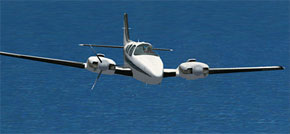 |
When an engine fails while flying twin-engine aircraft, the pilot must immediately focus on three fundamental priorities:
-
Maintain aircraft control (airspeed, pitch, and yaw)
-
Achieve maximum available power from the remaining engine
-
Reduce drag as much as possible
A structured engine-out procedure helps compensate for the sudden loss of power and the effects of asymmetrical thrust. Modern twin-engine aircraft are certified to continue flying after the loss of one engine; however, this certification does not guarantee continued climb performance. In many situations, maintaining altitude may not be possible.
Once initial control is established, the primary objective becomes extracting the maximum usable performance from the operating engine while minimizing aerodynamic drag.
The Big Picture: Engine Failure Priorities
Before memorizing detailed checklist items, it is essential to understand the overall priorities when an engine fails while flying twin-engine aircraft:
-
Take care of the failed engine
-
Take care of the operating engine
-
Identify a suitable place to land
-
Proceed there without delay
This high-level sequence provides a clear mental framework that supports correct decision-making under time pressure.
Aircraft Control Comes First
When an engine fails in real-world flying, directional control is immediately compromised. The power imbalance causes the aircraft to yaw toward the inoperative engine. For this reason, the pilot’s first corrective action must be rudder input.
Applying rudder toward the operating (good) engine counteracts asymmetrical thrust and helps maintain heading. Whether using a twisting joystick or dedicated rudder pedals, the pilot must apply whatever rudder input is required to keep the aircraft under control.
Set Maximum Power on the Operating Engine
After initial control is established, power management becomes critical when flying twin-engine aircraft on one engine.
-
Ensure mixture controls, propeller controls, and throttles (in that order) are set to achieve maximum power.
-
Advance mixture and propeller controls fully forward, then fine-tune the mixture for maximum power, particularly at higher altitudes where leaning is required.
-
Advance both throttles to full power initially. This ensures maximum thrust from the operating engine before the failed engine is positively identified.
Maintain Vyse and Avoid Vmc
Maintaining Vyse, the best single-engine rate-of-climb speed, is essential after an engine failure. Vyse is indicated by the blue line on the airspeed indicator and represents the speed at which aircraft performance is optimized on one engine.
Attempting to climb faster than Vyse—especially at low altitude—can lead to airspeed decay and potentially result in flight below Vmc, the minimum controllable airspeed with one engine inoperative.
If control is lost near or below Vmc, recovery requires:
-
Reducing power on the operating engine to decrease asymmetric thrust
-
Lowering the nose to increase airspeed
Vyse represents the best achievable performance when flying twin-engine aircraft on a single engine. Holding this speed means the aircraft is performing as well as possible under the circumstances.
Reduce Drag Immediately
Drag reduction is essential for maintaining Vyse and maximizing performance:
-
Flaps up
-
Landing gear up
Reducing drag improves climb capability and controllability during engine-out flight.
Identify and Secure the Failed Engine
Correct engine identification is critical:
-
Use the principle “dead foot, dead engine.”
Reduced pressure on a rudder pedal indicates the side of the failed engine. -
Gradually reduce the throttle on the suspected engine.
-
If no change occurs, the correct engine has been identified.
-
If thrust decreases, reassess—partial power loss may be present.
-
Once confirmed:
-
Feather the propeller of the failed engine to stop windmilling and significantly reduce drag.
-
Exercise extreme caution to ensure the correct propeller is feathered.
Bank Toward the Operating Engine
While maintaining rudder input, apply a slight bank—approximately 5 degrees—toward the operating engine. This technique, often remembered as “raise the dead,” creates a horizontal component of lift that counteracts sideslip and improves overall aircraft efficiency.
Close Cowl Flaps on the Failed Engine
Since the failed engine no longer requires cooling, close its cowl flaps. Open cowl flaps create unnecessary drag and further degrade performance during single-engine operation.
Securing a Dead Engine While Flying Twin-Engine Aircraft
Once the engine-out procedure has been completed and it is clear that the failed engine cannot be restarted, the next step while flying twin-engine aircraft is to properly secure the inoperative engine. Securing the dead engine reduces drag, prevents further system complications, and allows the pilot to focus on aircraft control and navigation.
The purpose of securing the dead engine is to eliminate unnecessary fuel flow, electrical load, and aerodynamic drag while ensuring the operating engine continues to deliver maximum performance.
Steps to Secure the Dead Engine
To secure the inoperative engine:
-
Close the throttle on the failed engine
-
Set the mixture to idle cut-off
-
Feather the propeller, if not already feathered
-
Set the fuel selector to OFF
-
Turn the auxiliary fuel pump OFF
-
Switch the magnetos OFF
-
Turn the alternator switch OFF
-
Close the cowl flaps, if they are still open
Completing these steps ensures the failed engine is fully isolated and prevents additional drag or system interference during single-engine operation.
Climb Rate and Performance While Flying Twin-Engine Aircraft
When flying twin-engine aircraft, it may appear logical to assume that losing one engine results in a loss of only half the available power. In reality, the impact on aircraft performance is significantly greater.
Aircraft climb performance is determined by the excess power available above that required for level flight. Under normal conditions, approximately 40 percent of total power is required to maintain level flight. When one engine fails, the aircraft loses 50 percent of its power, but often up to 80 percent of its climb performance.
With one engine inoperative, the aircraft effectively becomes a single-engine airplane that must carry:
-
the dead weight of the failed engine, and
-
additional drag from the nonoperating engine and propeller.
As a result, climb capability may be minimal or nonexistent. If an engine fails during takeoff, a go-around may be difficult or impossible, particularly at high weight or density altitude.
Understanding these performance limitations is essential when flying twin-engine aircraft, as it reinforces the importance of early decision-making and disciplined airspeed control.
P-Factor and the Critical Engine in Twin-Engine Aircraft
The critical engine is defined as the engine whose failure most adversely affects directional control. It is the engine a pilot least wants to lose, because when the critical engine fails, maintaining directional control can become extremely challenging.
In propeller-driven twin-engine aircraft, the P-Factor—also known as asymmetric propeller thrust—plays a primary role in determining which engine is critical. P-Factor occurs when rotating propeller blades produce unequal thrust due to differences in blade angle of attack, particularly when the aircraft is pitched up or operating at high power and low airspeed.
Because the downward-moving blade has a greater angle of attack than the upward-moving blade, it produces more thrust. This effect becomes especially noticeable during takeoff and initial climb.
On twin-engine aircraft where both propellers rotate in the same direction—typically clockwise when viewed from the cockpit—the center of thrust for each engine is shifted to the right side of the engine. As a result, the yawing force produced by the right engine is greater than that produced by the left engine because it acts farther from the aircraft’s centerline.
When the left engine fails, the operating right engine produces a stronger yawing moment that requires greater rudder input to counteract. This makes directional control more difficult and identifies the left engine as the critical engine in a conventional twin-engine configuration.
In contrast, when the right engine fails, the remaining left engine produces a less severe yawing moment, making control easier to maintain.
Some twin-engine aircraft are equipped with counter-rotating propellers, which rotate toward the fuselage. In these aircraft, the thrust lines are symmetrical, and no critical engine exists, because the yawing forces are equal regardless of which engine fails.
The Dangers of Falling Below Vmc While Flying Twin-Engine Aircraft
Vmc is the minimum airspeed at which a pilot can maintain directional control while flying twin-engine aircraft with one engine producing full power and the other inoperative. Below Vmc, by definition, the available rudder authority is insufficient to counteract the yawing moment created by asymmetric thrust.
Although directional control is lost below Vmc, the pilot does not lose all control of the aircraft. Pitch control remains available and is essential for recovering from a sub-Vmc condition.
When a twin-engine aircraft operating on one engine decelerates to or below Vmc, the asymmetric thrust from the operating engine causes an immediate yaw toward the inoperative engine. The moment any uncommanded directional change is detected at or near Vmc, the pilot must take immediate action to increase airspeed to at least Vmc and restore controllability.
Recovering From a Sub-Vmc Condition
To regain control when operating below Vmc while flying twin-engine aircraft:
-
Reduce power on the operating (good) engine.
Although this may seem counterintuitive—since previous steps emphasized maximum power—reducing power decreases the asymmetric thrust that is causing the yaw. -
Lower the nose to reduce angle of attack.
Applying forward pressure on the controls increases airspeed, allowing the aircraft to accelerate back above Vmc. -
Once airspeed is safely above Vmc, gradually increase power on the operating engine as control authority is restored.
Note: Intentional flight at or below Vmc should never be attempted except in a controlled training environment.
Below Vmc, the aircraft lacks directional control, and recovery outcomes can vary depending on altitude, aircraft configuration, and pilot response. In some cases, the aircraft may enter an unusual attitude, potentially including a roll or inversion. The essential principle remains constant: to regain control, asymmetric thrust must be reduced and airspeed increased. This typically requires pitching the nose down.
Adequate altitude significantly improves the chances of recovery. At low altitude, however, encountering a sub-Vmc condition can have severe consequences, underscoring the importance of disciplined airspeed management while flying twin-engine aircraft.
Restarting an Engine While Flying Twin-Engine Aircraft
In some situations, it may be possible to restart a failed engine while flying twin-engine aircraft. The following procedure is adapted from the Beechcraft Baron 58 Pilot Operating Handbook and assumes that aircraft control has already been established and engine-out procedures have been completed.
Before attempting an in-flight restart, determine the most likely cause of the engine failure. An airstart should only be attempted when conditions permit and aircraft control can be maintained throughout the procedure.
Engine Restart Procedure
To attempt an engine restart:
-
Set the fuel selector valve to ON
Confirm proper positioning by feel and visual check. -
Set the throttle approximately one-quarter open
-
Set the mixture control:
-
Full Rich below 5,000 feet
-
Approximately halfway above 5,000 feet
-
-
Set the fuel boost pump to LOW
-
Set magnetos to CHECK / ON
-
Move the propeller control forward of the feather detent
Allow the engine to reach approximately 600 RPM, then return the control to the detent to prevent overspeeding.
Use the starter momentarily if required to assist with unfeathering.
Throughout the restart attempt, maintain situational awareness and be prepared to abandon the restart if aircraft control, performance, or terrain clearance becomes a concern. In many cases, especially at low altitude or high workload, securing the engine and proceeding to a landing may be the safer option.
Approach and Landing with an Engine Out While Flying Twin-Engine Aircraft
An approach and landing with one engine inoperative while flying twin-engine aircraft is often similar to a normal approach, but it requires stricter speed control and more conservative decision-making.
Until you are absolutely certain that the runway can be made, the final approach speed should remain above Vyse. Maintaining a speed greater than Vyse preserves the best single-engine climb capability in the event that the landing must be aborted.
When configuring the aircraft for landing, special attention must be given to flap selection. Most light twin-engine aircraft cannot perform a go-around on a single engine with full flaps extended. For this reason, flap extension should be delayed and applied gradually, ensuring that the aircraft can still maintain control and performance throughout the final approach.
The goal during an engine-out approach is to arrive stabilized, configured conservatively, and with sufficient energy to manage unexpected changes while flying twin-engine aircraft on one engine.
Differential Thrust: Controlling Engines Independently
When executing engine-out procedures—or when using differential thrust during taxi operations or crosswind landings—independent engine control is essential while flying twin-engine aircraft.
By default, throttle, mixture, and propeller controls are synchronized in Flight Simulator. To apply correct multi-engine technique, the pilot must be able to control each engine separately.
Selecting Individual Engine Control
To control engines independently:
-
Left engine: press E, then 1
-
Right engine: press E, then 2
-
Return to synchronized control: press E, 1, 2
Once an engine is selected, throttle, mixture, and propeller commands will affect only that engine.
Alternatively, independent control can be achieved using the on-screen engine control panel by dragging individual levers. To move both levers together, click and drag the area between them.
Twin-Engine Flying Tips for Engine Control
Feathering the Propeller
To feather a propeller while flying twin-engine aircraft:
-
Select the engine using E+1 or E+2
-
Drag the propeller control fully aft
Keyboard shortcuts:
-
Feather propeller: CTRL + F1
-
Unfeather / high RPM: CTRL + F4
-
Decrease RPM: CTRL + F2
-
Increase RPM: CTRL + F3
Throttle Control
-
Select the engine using E+1 or E+2
-
Adjust throttle manually using the control knob
Keyboard shortcuts:
-
Increase throttle: F3 or Num Pad 9
-
Decrease throttle: F2 or Num Pad 3
-
Full throttle: F4
Mixture Control
-
Select the engine using E+1 or E+2
-
Adjust the mixture control as required
Keyboard shortcuts:
-
Lean mixture: CTRL + SHIFT + F2
-
Enrich mixture: CTRL + SHIFT + F3
-
Full rich: CTRL + SHIFT + F4
-
Idle cutoff: CTRL + SHIFT + F1
Cowl Flaps and Magnetos
-
Open cowl flaps: CTRL + SHIFT + V
-
Close cowl flaps: CTRL + SHIFT + C
-
Magnetos: press M, then + or –
Proper use of these controls improves aircraft handling and system management while flying twin-engine aircraft under both normal and abnormal conditions.
Moving Up to Jets After Flying Twin-Engine Aircraft
After mastering flying twin-engine aircraft in light piston twins, many pilots progress to turbine aircraft such as turboprops and jets. This transition introduces higher speeds, longer ranges, and more advanced systems.
Jet operations require an understanding of:
-
pressurization systems
-
instrument flight planning (mandatory above 18,000 feet)
-
fuel and descent planning
-
high-altitude and high-speed navigation
The concept of a critical engine changes in turbine aircraft. Because P-factor is not present in jet engines, no single engine is considered critical in the same way as in propeller-driven twins. Instead, jet pilots often refer to engines as being equally critical, since the loss of any engine significantly affects performance and safety margins.
In multi-engine turbine aircraft with more than two engines, engine position also matters. Outboard engine failures typically have a greater impact on directional control than inboard engine failures due to increased mechanical leverage against the rudder.
Understanding these differences builds naturally on the skills developed while flying twin-engine aircraft, forming a solid foundation for advanced aircraft operations.
Conclusion
Flying twin-engine aircraft demands a higher level of skill, discipline, and situational awareness than single-engine flying. Throughout this article, you’ve explored critical aspects of multi-engine operations — from pre-takeoff planning and managing engine failures to maintaining control below Vmc, performing approaches with an engine out, and operating engines independently. Each of these elements reinforces the importance of proper technique, consistent procedures, and a thorough understanding of aircraft performance.
The challenge of flying twin-engine aircraft is what makes it rewarding: it pushes pilots to integrate knowledge of systems, aerodynamics, and emergency response into confident and safe flying. Whether in a real cockpit or a simulator environment, developing these skills enhances overall aviation proficiency and builds a foundation for further advancement.
If you’re preparing for formal multi-engine training or interested in structured syllabus guidance, this resource offers a deeper dive into standardized training frameworks used in Europe:
👉 https://melibrary.pro/article/easa-multi-engine-training/
