ETOPS twin engine operations define how a twin-engine aircraft is allowed to fly extended-range routes beyond 60 minutes from an adequate airport. ETOPS (Extended Range Twin Operations) describes the regulatory framework that governs extended-range twin engine operations, including ETOPS regulations, ETOPS requirements, and approved ETOPS alternates along the planned route.
In the early years of aviation, piston-powered engines lacked reliability, which led the FAA to adopt the original 60-minute rule for twin engine aircraft. Under this rule, aircraft with two engines were restricted from flying more than 100 miles (approximately 60 minutes) away from an adequate aerodrome, ensuring that a diversion could be made quickly in the event of an engine failure.
As engine reliability improved—especially with the introduction of jet engines—regulators began expanding allowable diversion times, eventually forming the modern ETOPS regulations that permit twin engine long-range operations such as ETOPS-120, ETOPS-180, ETOPS-240, and beyond. These extended-diversion authorizations allow twin-engine aircraft to operate more direct routes over oceans, polar regions, and remote airspace while meeting strict ETOPS requirements for reliability, maintenance programs, and crew training.

ETOPS twin engine operations: origins and purpose
ETOPS (Extended Range Twin Operations) describes how a twin engine aircraft can operate on routes where parts of the flight are more than 60 minutes from an adequate airport. The concept of ETOPS twin engine regulation emerged because early multi-engine aircraft were not as reliable as modern designs.
In the early 1930s, the FAA introduced restrictions preventing twin engine aircraft from flying more than 100 miles (about 60 minutes) away from an adequate aerodrome. This early safety rule addressed the high probability of engine failures in piston-powered aircraft.
Because engine reliability was limited, extended range twin engine operations required that routes stay within the 60-minute diversion range. This meant airlines could not fly direct paths across remote areas, and flight planning had to comply strictly with the early ETOPS requirements.

Getting ETOPS approval
Obtaining ETOPS approval is a highly regulated process within modern ETOPS twin engine operations and is governed by strict ETOPS regulations. Contrary to common belief, extended range twin engine operations are not automatically permitted simply because an aircraft type is ETOPS-certified. Approval is granted directly to the operator by its civil aviation authority, which evaluates compliance with all ETOPS requirements, including reliability, maintenance capability, and operational readiness. For example, an airline operating in the UK must obtain authorization from the UK CAA before conducting any twin engine long range operations under ETOPS.
There are two primary pathways to apply for ETOPS authorization: Accelerated ETOPS approval and In-service ETOPS approval.
The accelerated pathway applies to operators with no previous ETOPS experience for a specific aircraft/engine combination. Because these airlines lack operational history, they must demonstrate mitigation strategies showing they can safely conduct extended range twin engine operations. This includes manufacturer support, verified reliability data, and sufficient organizational resources to sustain ETOPS activity.
A critical aspect of earning approval involves maintenance capability. The operator must prove that it maintains a robust program that includes:
-
A proven ETOPS reliability program
-
An effective oil-consumption monitoring program
-
A comprehensive engine condition-monitoring and reporting system
-
A propulsion system monitoring program
-
An ETOPS parts control and tracking program
-
A clear system for resolving aircraft discrepancies in a timely manner
The operator must also define planned ETOPS routes, maximum diversion time, designated ETOPS alternates, and demonstrate adherence to all published ETOPS requirements. Additionally, a dedicated ETOPS training program must be established for flight crews, dispatchers, and operations personnel.
The In-service ETOPS approval pathway is designed for operators with existing experience on a particular aircraft/engine combination. For example, if an airline has operated the Airbus A320 with CFM LEAP-1A engines for more than two years, it may apply using its historical operational data. This prior experience allows regulators to assess reliability trends and determine suitability for ETOPS twin engine authorization.
Diversion time limits—such as ETOPS-120 or ETOPS-180—can only be increased through demonstrated operational experience. An airline must complete at least one year of ETOPS-120 operations before seeking ETOPS-180. To exceed 180 minutes, the operator must already hold ETOPS-180 approval and show consistent compliance with ETOPS regulations and performance standards for twin engine long range operations.
ETOPS operational factors and regulatory requirements
In extended range twin-engine operations (ETOPS twin engine), several operational and regulatory elements determine whether a flight may legally and safely enter an ETOPS segment. According to ETOPS regulations and international guidance, the operator must ensure that all ETOPS requirements related to aerodrome suitability, diversion capability, and aircraft performance are met before dispatch.
Adequate and suitable aerodromes (ETOPS alternates)
For extended range twin-engine operations, the designated ETOPS alternates must be both adequate and suitable for use during the entire period in which an ETOPS diversion may be required.
An adequate aerodrome for twin engine long range operations must meet the following criteria:
-
The aerodrome must be open and operational at the time of the ETOPS flight.
-
The operator must hold all necessary overflight and landing permissions.
-
Essential ground services must be available, including ATC, meteorological support, runway lighting, and airport infrastructure.
-
Navigational aids (ILS, VOR, NDB) must be present and operational.
-
Adequate rescue and firefighting capability must be ensured.
A suitable aerodrome is an adequate airport that also meets ETOPS dispatch weather minima (ceiling and visibility) during the validity period, which begins one hour prior to the earliest possible ETA and ends one hour after the latest ETA. The aerodrome must also meet crosswind limitations for the aircraft and crew.
ETOPS maximum diversion time and diversion distance
The core principle behind ETOPS regulations is the control of maximum diversion time. An operator certified for ETOPS 180 may only conduct extended range twin-engine operations in areas where the aircraft would remain within 180 minutes of a suitable ETOPS alternate in the event of an engine failure or other significant system malfunction.
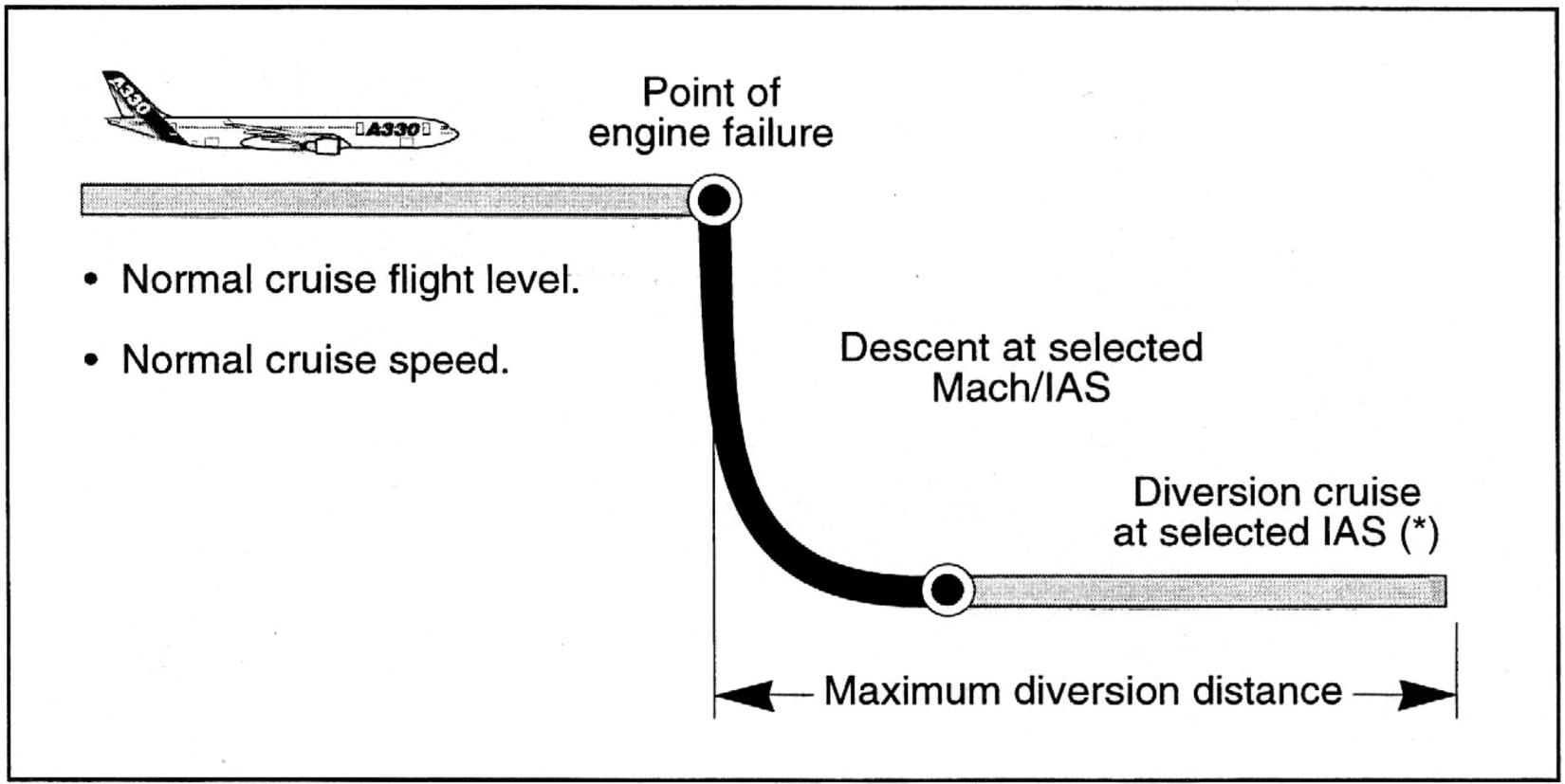
The maximum diversion distance is derived from the maximum diversion time and the aircraft’s approved one-engine-inoperative cruise speed. This calculation is performed in still-air (ISA) conditions.
For example, if a twin-engine aircraft maintains approximately 400 knots TAS during a single-engine diversion, an ETOPS 180 authorization provides a diversion radius of roughly 1,200 NM. This value defines the operational boundary for twin engine long range operations, ensuring that the aircraft can safely reach an alternate aerodrome even under degraded performance conditions.
The resulting diversion distance is then used to construct the ETOPS area of operation, within which the flight transitions through key ETOPS points such as the Entry Point (EEP), Equal Time Point (ETP), Critical Point (CP), and Exit Point (EXP). These points are essential navigation references for the safe execution of ETOPS twin engine procedures.
ETOPS area of operation
The ETOPS area of operation defines where extended-range twin engine operations may legally and safely occur under ETOPS regulations. It includes the ETOPS Entry Point (EEP), Equitime Point (ETP), Critical Point (CP), and ETOPS Exit Point (EXP). These elements are essential in planning twin engine long range operations, ensuring that the aircraft always remains within certified ETOPS alternates coverage and complies with all ETOPS requirements for diversion capability.
The EEP marks the point at which the aircraft becomes more than 60 minutes from an adequate aerodrome, officially entering the ETOPS twin engine segment. The ETP is the position equidistant in flying time to two ETOPS alternates, commonly used for fuel planning and contingency procedures in extended-range twin engine operations. The CP represents the moment at which fuel becomes critical relative to the remaining ETOPS alternate options. After passing the ETP, only the closer ETOPS alternate remains viable within approved ETOPS requirements.
How ETOPS’s area of operation is determined
Determining the ETOPS area of operation requires calculating the maximum diversion distance permitted under the approved ETOPS twin engine rating (for example, ETOPS-120 or ETOPS-180). Following ETOPS regulations, distance is derived from the formula Distance = Speed × Time, where the certified one-engine-inoperative diversion speed—defined in the operator’s manual—is used. This ensures that the aircraft can reach an ETOPS alternate within the assigned diversion time under extended-range twin engine operations.
Because TAS changes with altitude, operators determine ETOPS diversion performance using a constant IAS and the corresponding TAS profile during descent on one engine. The resulting maximum diversion distance defines the boundaries within which twin engine long range operations must remain to satisfy all ETOPS requirements for safety, fuel planning, and accessibility to ETOPS alternates.
ETOPS area of operation defines the geographical region in which extended range twin engine operations may be conducted in accordance with ETOPS regulations and approved procedures. The ETOPS operational area includes four reference points: the ETOPS Entry Point (EEP), the Equitime Point (ETP), the Critical Point (CP), and the ETOPS Exit Point (EXP). These points determine how a twin engine long range operation is planned, monitored, and executed.
EEP marks the moment when the aircraft becomes more than 60 minutes from an adequate aerodrome. Crossing the EEP signifies the official entry into the ETOPS twin engine segment, where ETOPS requirements and fuel rules begin to apply.
ETP is the point equidistant in flying time between two ETOPS alternates. Depending on route structure, weather, and aircraft performance, an ETOPS flight may have one or multiple ETPs. Longer twin engine long range operations typically require multiple equitime calculations to ensure continuous compliance with ETOPS dispatch criteria.
CP (Critical Point) represents the moment where fuel becomes limiting relative to the available ETOPS alternate aerodromes. Beyond the CP, only one diversion option remains feasible in accordance with ETOPS fuel requirements. This point is essential for safe and compliant extended range twin engine operations.
To determine the ETOPS area of operation, the basic formula Distance = Speed × Time is used. The diversion speed is calculated using the aircraft’s one-engine inoperative performance. This speed, typically specified in the operator’s ETOPS manual, is expressed as a constant IAS with TAS varying by altitude. Using these values, the maximum diversion distance is established according to ETOPS regulations, defining the total envelope within which the aircraft may legally operate under ETOPS.
ETOPS critical fuel determination
To illustrate how ETOPS twin engine planning works, consider an operator using a diversion speed of 320 knots. This speed must be flown during any ETOPS diversion, including descent and routing toward an approved ETOPS alternate. Based on altitude changes, the average TAS may be approximately 400 knots, requiring descent to around 16,000 ft after an engine failure to maintain performance. With an ETOPS 180 authorization, this results in a maximum diversion distance of roughly 1,200 nautical miles. This calculation defines how far the aircraft may proceed into the ETOPS area of operation while still meeting ETOPS requirements for safe diversion.
A key operational principle of extended range twin engine operations is that higher diversion speeds expand the ETOPS radius, while lower speeds reduce the operational envelope. This relationship directly affects route planning and the identification of suitable ETOPS alternates.
ETOPS critical fuel determination evaluates fuel sufficiency in three scenarios:
-
Pressurization failure
-
Pressurization failure combined with engine failure
-
Engine failure only
Scenario 3 rarely limits fuel because an engine-out descent remains relatively shallow. However, depressurization requires descent to 10,000 ft or below, significantly increasing fuel burn. When both pressurization failure and engine failure occur simultaneously, the situation becomes the most restrictive case for fuel planning in ETOPS twin engine operations.
The ETOPS critical fuel calculation incorporates:
• descent at predetermined engine-out speed,
• cruise at diversion altitude,
• descent to 1,500 ft over the diversion field,
• 15 minutes of holding,
• approach, missed approach, and second landing attempt.
This methodology ensures compliance with ETOPS regulations and confirms that fuel reserves meet all ETOPS requirements for twin engine long range operations.
 Credit: Photo: Wenjie Zheng | Shutterstock
The critical fuel scenario in ETOPS twin engine operations is determined by several performance conditions that ensure regulatory compliance with ETOPS regulations and ETOPS requirements for safe extended-range twin-engine operations. The calculation includes a descent at the pre-determined speed to the diversion flight level, cruise at a pre-determined diversion speed, a normal descent to 1500 ft above the diversion field, 15 minutes of holding fuel at 1500 ft, an instrument approach followed by a go-around, and a second approach and landing. These elements form the basis of the ETOPS critical fuel model and ensure that the aircraft can safely reach an approved ETOPS alternate even under degraded conditions.
How the aircraft is flown during an ETOPS diversion depends on the nature of the failure. In both pressurization failure and pressurization plus engine-failure scenarios, pilots follow a structured diversion profile designed for ETOPS twin engine long range operations. If only a pressurization failure occurs, the diversion is flown at a more conservative speed, known as Long Range Cruise (LRC), to reduce fuel consumption and extend available range. Because depressurization does not involve engine loss, the aircraft is not restricted to the defined ETOPS area of operation and can divert to a wider selection of suitable aerodromes beyond the ETOPS alternates originally planned.
In contrast, when the failure involves both pressurization and an engine shutdown, the diversion must be flown at the regulated one-engine-inoperative speed that ensures the aircraft remains within the certified extended-range twin-engine operations envelope. This protects the aircraft from exceeding the limits of twin engine long range operations and guarantees that performance remains sufficient to reach an ETOPS alternate within the maximum allowed diversion time. This distinction between LRC diversions and one-engine-inoperative diversions is a fundamental aspect of ETOPS requirements and reflects the operational safeguards embedded in ETOPS regulations.
ETOPS operational and inflight procedures
An ETOPS flight begins at the dispatch stage. At this stage, the dispatchers prepare the flight plan and get the latest weather and airport information or the NOTAM (Notification to Airmen).
The dispatch weather requirement for ETOPS alternate(s) is different from the weather requirement once in the flight. During dispatch, the minima at the airport(s) are raised as follows (the table is based on EASA AMC 20-6):
| Approach facilities | Ceiling Visibility | Ceiling Visibility |
| Precision Approach | Precision Approach Authorized DH/DA plus an increment of 200 ft | Authorized visibility plus an increment of 800 meters |
| Non-Precision Approach or Circling approach | Authorized MDH/MDA plus an increment of 400 ft | Authorized visibility plus an increment of 1500 meters |
Once the flight begins, the pilots no longer worry about the dispatch minima. They fly the normal charted minima of the aerodrome.

The critical fuel scenario in ETOPS twin engine operations considers the following factors: a descent at the pre-determined speed to the diversion flight level, cruise at diversion at a pre-determined speed, a normal descent down to 1500 ft above the diversion field, 15 minutes of holding fuel at 1500 ft above the field, an instrument approach followed by a go-around, and then a second approach and landing. These steps form part of the ETOPS requirements used by regulators when assessing extended range twin engine operations and ensuring adequate ETOPS alternates are available throughout the route.
How you fly the ETOPS diversion is similar for both pressurization and pressurization + engine failure situations. If only a pressurization failure occurs, the aircraft is flown at a more conservative Long Range Cruise (LRC) speed, which saves fuel and increases the efficiency of twin engine long range operations. Because a depressurization event does not involve an engine failure, the aircraft is not strictly limited to the ETOPS area of operation. However, when the failure involves both pressurization and the loss of an engine, the aircraft must be flown at the pre-determined ETOPS diversion speed schedule to ensure it remains within the protected one-engine-inoperative area defined by ETOPS regulations and extended range operational limits.
From the piloting side, the pilots prepare for an ETOPS twin engine flight by checking the flight plan, verifying ETOPS weather minima, and confirming that the aircraft carries sufficient fuel to divert to an ETOPS alternate if a failure occurs while enroute. During pre-flight, the crew determines the locations of the Entry Point (EEP), Equitime Point (ETP), and Exit Point (EXP) and enters them into the flight management system as required by ETOPS procedures. The technical log is checked to ensure that all systems required for extended range twin engine operations are fully operational, meeting the necessary ETOPS requirements for dispatch.
As the aircraft approaches the EEP, the pilots obtain up-to-date weather reports for all ETOPS alternates. If conditions remain above the required minima, the flight enters the ETOPS area of operation. If the weather does not meet ETOPS dispatch standards, the flight may need to divert or designate another suitable airport.
Within the ETOPS segment, if alternate conditions deteriorate, the flight may continue at the discretion of the Pilot in Command, provided the aircraft remains compliant with ETOPS regulations and extended range safety criteria. If fuel drops below the ETOPS diversion limit, the flight may still continue, given that it has already entered the extended range twin engine operations segment and remains within the allowable limits for one-engine-inoperative navigation and drift-down performance.
Conclusion
ETOPS twin engine operations represent one of the most significant advancements in modern aviation, allowing twin-engine aircraft to safely operate on extended-range routes that were once reserved exclusively for three- and four-engine airframes.
Through strict ETOPS regulations, thorough maintenance programs, well-defined ETOPS alternates, and rigorous operational requirements, operators maintain the capability to fly long-range routes with high levels of safety and efficiency. Understanding ETOPS requirements, diversion planning, critical fuel calculations, and extended-range decision-making is essential for pilots, dispatchers, and operators involved in twin engine long range operations.
For further study on factors that influence aircraft performance under varying atmospheric conditions, see:
https://melibrary.pro/article/density-altitude-and-aircraft-performance/
