A crucial part of earning a multi-engine rating is understanding what truly happens when an engine fails. Knowing the theory is not enough — you must understand how performance, control, and aerodynamic forces change instantly when thrust becomes asymmetric.
Two core multi engine memory items — P.A.S.T. and C.O.M.B.A.T.S. — are designed to help pilots understand both the power and the danger that twin engines provide. These acronyms are not just checkride material; they explain why certain engine-out situations become unstable so quickly.
While the multi-engine rating may not be as procedurally complex as the Instrument or Commercial certificate, the aerodynamic concepts behind engine-out control can be initially overwhelming. Terms like PAST, COMBATS, VMC, and critical engine often sound abstract until their real-world implications are understood.
Before breaking down these multi engine memory items, we must first understand what actually happens when an engine fails in a twin.
What Happens When an Engine Quits in a Twin?
When one engine fails in a multi-engine aircraft, the situation is not symmetrical. One engine continues producing thrust while the other creates drag — often significant drag if the propeller is windmilling.
This imbalance produces:
-
Yaw toward the inoperative engine
-
Roll toward the inoperative engine
-
Increasing aerodynamic instability if not corrected
If the pilot does not respond correctly and promptly, the aircraft can enter an uncontrollable yaw-roll coupling that may lead to loss of control. Historically, improper engine-out response during takeoff and climb has resulted in many accidents.
Because these scenarios are predictable and repeatable, aircraft manufacturers and the FAA require pilots to understand them as part of the Airman Certification Standards (ACS). Mastering multi engine memory items is therefore not optional — it is fundamental to safe twin-engine operation.
Conventional vs Counter-Rotating Twins
To fully understand the PAST acronym, it helps to recognize the difference between the two primary types of piston twin aircraft.
Conventional Twins
In a conventional twin, both propellers rotate in the same direction (typically clockwise when viewed from the cockpit). This configuration creates a critical engine, usually the left engine.
The critical engine is defined as the engine whose failure most adversely affects aircraft controllability and performance. In conventional twins, losing the left engine produces greater yawing and rolling moments than losing the right engine.
Counter-Rotating Twins
In a counter-rotating twin, the propellers rotate in opposite directions toward the aircraft’s centerline. This design reduces asymmetric aerodynamic effects and eliminates the traditional critical engine.
While counter-rotating twins still experience asymmetric thrust, the yawing forces are more balanced and generally easier to manage.
Understanding which configuration you are flying is essential before analyzing multi engine memory items like PAST.
P.A.S.T.: The Aerodynamic Factors Behind Engine-Out Instability
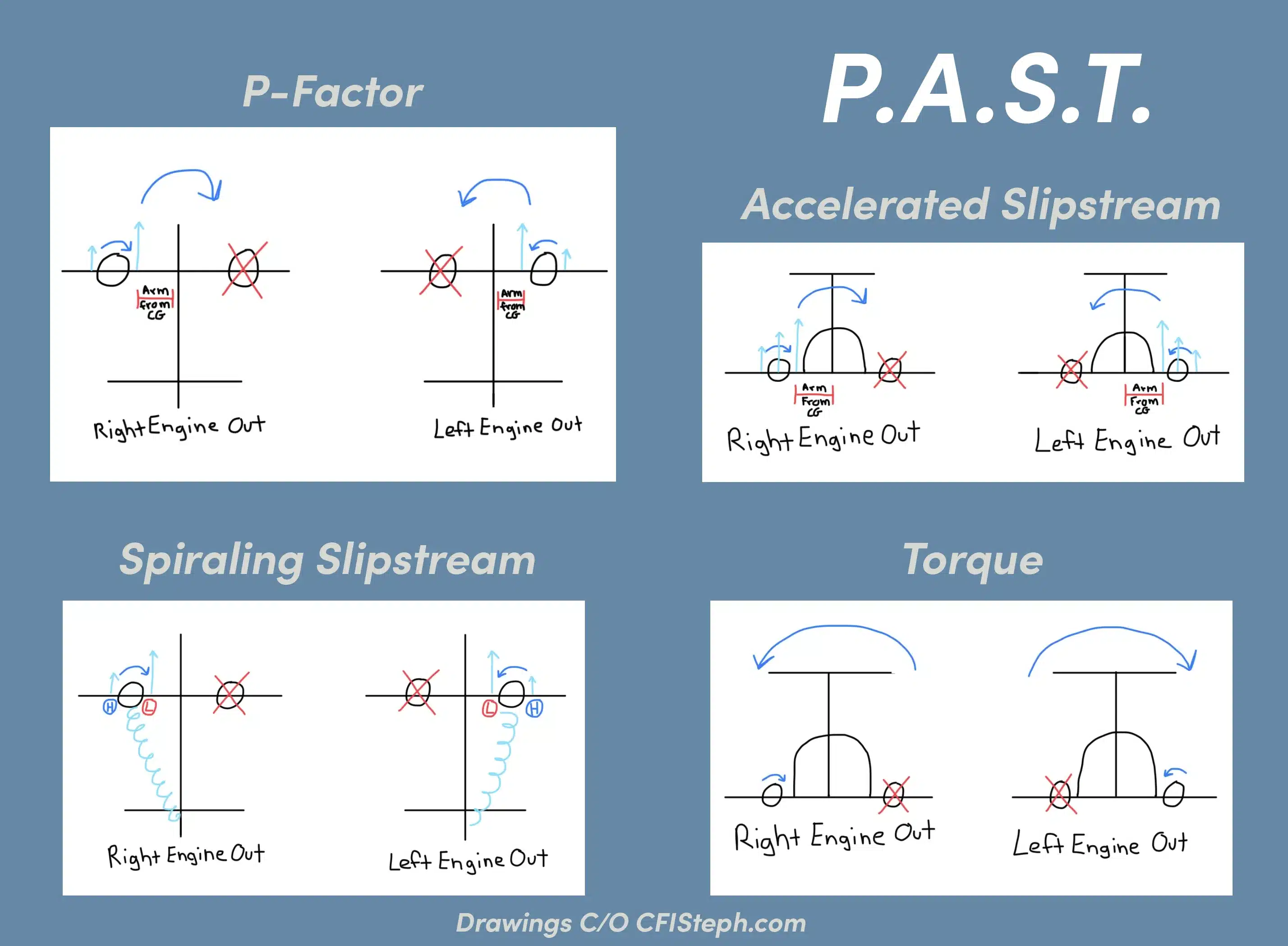
P.A.S.T. is one of the foundational multi engine memory items. It identifies four aerodynamic forces that intensify yaw and roll when a critical engine fails in a conventional twin:
-
P-factor
-
Accelerated slipstream
-
Spiraling slipstream
-
Torque
Each of these forces contributes to asymmetric control challenges. When combined — especially at high power and low airspeed — they can overwhelm rudder authority and lead to loss of control below VMC.
P-Factor
Most pilots learn about P-factor during single-engine training. It refers to asymmetric thrust created by the descending propeller blade at high angles of attack and high power settings.
In a conventional twin, P-factor becomes significantly more critical. If the left (critical) engine fails, the right engine’s descending blade operates farther from the aircraft centerline. This longer moment arm increases yawing force dramatically.
That is why the left engine is considered critical in conventional twins. Its failure produces the most severe yaw and roll tendencies.
In counter-rotating twins, P-factor still exists, but the opposing propeller rotation reduces the severity of asymmetric yaw.
Accelerated Slipstream
Accelerated slipstream refers to the increased airflow over the wing produced by the operating engine’s propeller. In single-engine aircraft, this effect is centered along the fuselage. In twins, however, engines are mounted on or under the wings.
When one engine operates and the other is windmilling, the operating engine increases lift on its wing due to accelerated airflow, while the opposite wing experiences drag from the windmilling propeller.
This creates:
-
Increased lift on the operating-engine side
-
Reduced lift and increased drag on the inoperative side
-
Rolling tendency toward the dead engine
If not corrected with proper rudder and bank, this roll increases angle of attack and stall speed on the inoperative side, compounding instability.
Spiraling Slipstream
Spiraling slipstream is the helical airflow produced by a rotating propeller. As this airflow travels aft, it strikes the vertical stabilizer, producing yawing forces.
In a conventional twin, spiraling slipstream may either help or worsen control depending on which engine fails.
-
If the right engine fails, the left propeller wash can strike the vertical stabilizer in a way that partially counteracts yaw.
-
If the left engine fails, the right engine’s slipstream may not provide that stabilizing benefit.
This asymmetry further explains why the left engine is considered critical in conventional twins.
Torque
According to Newton’s Third Law, every action produces an equal and opposite reaction. As propellers rotate clockwise (in conventional twins), the airframe tends to roll left.
If the left engine is operating, torque may help counteract some roll toward a dead right engine. However, if the left engine fails, torque from the right engine adds to the rolling tendency toward the dead engine.
Combined with P-factor and slipstream effects, torque becomes another contributor to the dangerous yaw-roll coupling that multi engine memory items are designed to help pilots recognize.
Why PAST Matters
Understanding PAST allows pilots to clearly articulate why a critical engine failure is more dangerous in a conventional twin. It also demonstrates to examiners that the pilot understands not just procedures, but underlying aerodynamic risks.
More importantly, mastering these multi engine memory items builds real-world awareness. When an engine fails at low altitude, there is no time to debate theory. A pilot must recognize the forces at work immediately and respond with correct rudder, bank, configuration, and airspeed control.
C.O.M.B.A.T.S. and VMC: Certification Conditions Every Twin Pilot Must Know
After understanding PAST and the aerodynamic forces that destabilize a twin during an engine failure, the next essential concept is C.O.M.B.A.T.S. — one of the most important multi engine memory items for checkride preparation and real-world safety.
C.O.M.B.A.T.S. identifies the seven certification conditions under which aircraft manufacturers must demonstrate VMC (Minimum Controllable Airspeed) in accordance with 14 CFR §23.149.
VMC is not just a red line on the airspeed indicator. It represents the slowest speed at which directional control can be maintained with the critical engine inoperative under specific worst-case conditions. Below that speed, the aircraft may become uncontrollable due to asymmetric thrust.
Understanding these certification factors helps pilots understand why VMC exists — and why it can be dangerous.
What Is VMC?
VMC (Minimum Controllable Airspeed) is the minimum speed at which the aircraft can maintain directional control with:
-
The critical engine inoperative
-
The operating engine at full power
-
Maximum adverse certification conditions
Below VMC, full rudder authority is insufficient to counteract yaw, and the aircraft may roll and yaw uncontrollably toward the inoperative engine.
This is why C.O.M.B.A.T.S. is one of the most important multi engine memory items.
C.O.M.B.A.T.S. Breakdown
Each letter represents a required certification condition designed to create a worst-case controllability scenario.
C — Critical Engine Inoperative and Windmilling
In conventional twins, the critical engine (usually the left engine) must be inoperative and windmilling — not feathered — during VMC certification.
A windmilling propeller produces significant drag, worsening asymmetric yaw. Cowl flaps are also open to increase drag and degrade performance further.
This ensures the demonstrated VMC reflects a truly adverse engine-out condition.
O — Operating Engine at Full Power
The remaining engine must be set to maximum available power.
This creates maximum asymmetric thrust — the most demanding yaw condition possible — simulating a takeoff or climb scenario where engine failure is most critical.
Full power on the operating engine is essential for proper VMC demonstration.
M — Maximum Unfavorable Weight
Typically interpreted as maximum takeoff weight (MTOW), this condition challenges overall aircraft performance.
While VMC itself tends to increase at lighter weights due to reduced inertia, certification focuses on a weight that creates an unfavorable controllability and performance combination.
Understanding how weight affects both VMC and single-engine performance is critical for safe multi-engine operation.
B — Bank into the Operating Engine (5°)
During VMC demonstration, the aircraft is banked approximately 5° toward the operating engine.
This slight bank reduces the amount of rudder required to counteract yaw by introducing a horizontal lift component that assists directional control.
Banking into the good engine is a core single-engine technique and an essential part of practical multi engine memory items.
A — Aft-Most Center of Gravity
The aircraft must be configured at its aft-most allowable center of gravity.
An aft CG reduces rudder effectiveness by shortening the moment arm between the vertical stabilizer and the aircraft’s center of mass.
This increases instability and reduces yaw control margin — raising VMC and worsening engine-out controllability.
T — Takeoff Configuration
The aircraft must be in takeoff configuration, typically:
-
Flaps in takeoff position
-
Landing gear retracted (gear down is not required for certification)
This high-drag configuration simulates real-world engine failure shortly after takeoff.
Interestingly, extended gear can sometimes provide directional stability by acting as a keel, but certification assumes a configuration that stresses controllability.
S — Standard Temperature and Pressure
VMC must be demonstrated under standard atmospheric conditions (ISA: 15°C and 29.92 inHg).
This provides a consistent baseline for certification and ensures performance data remains standardized.
Why C.O.M.B.A.T.S. Matters
These certification conditions intentionally stack the deck against the pilot. They combine:
-
Maximum asymmetric thrust
-
Maximum drag
-
Reduced rudder authority
-
Destabilizing CG location
The result is a worst-case directional control scenario. Understanding this framework allows pilots to interpret VMC correctly rather than treating it as just another number.
C.O.M.B.A.T.S. is not simply a checkride memory exercise — it explains how controllability limits are established.
Recovery Near VMC: Practical Considerations
Even with a strong theoretical understanding of multi engine memory items, real-world flying demands disciplined technique near VMC. Knowing PAST and COMBATS explains why directional control can be lost — but applying that knowledge correctly in flight is what keeps the aircraft controllable.
VMC represents a controllability limit, not a performance goal. Operating close to it reduces safety margin and increases the risk of loss of control following an engine failure.
1. Maintain a Safe Margin Above VMC
Never operate unnecessarily close to the red line. Speed directly improves rudder effectiveness and overall directional stability. As airspeed increases, airflow over the vertical stabilizer strengthens, increasing yaw control authority.
One of the most important practical applications of multi engine memory items is recognizing that airspeed equals control margin. Flying comfortably above VMC gives you time to react, reduces the likelihood of abrupt yaw-roll coupling, and preserves controllability.
VMC is a boundary — not a target.
2. Reduce Operating Engine Power if Necessary
If the aircraft begins approaching VMC and directional control is degrading, reducing thrust on the operating engine may be the correct action.
This can feel counterintuitive. Many pilots instinctively add power when performance decreases. However, near VMC the problem is not insufficient thrust — it is excessive asymmetric thrust.
Reducing power decreases yawing moment and allows rudder authority to regain control. Understanding this principle is a direct application of multi engine memory items and their emphasis on asymmetric forces.
Directional control always comes before climb performance.
3. Use Altitude to Recover Airspeed
If altitude permits, lowering the nose to increase airspeed is critical. Increased airspeed improves:
-
Rudder effectiveness
-
Aileron authority
-
Overall aerodynamic stability
Pitching for airspeed restores controllability and moves the aircraft safely away from the VMC boundary.
This reinforces one of the core principles behind multi engine memory items: control is the priority. Climb can only occur once directional stability is secured.
Final Practical Reminder
Near VMC, the aircraft is operating close to its controllability limits. The pilot must think in terms of:
-
Asymmetric thrust
-
Rudder authority
-
Bank angle management
-
Airspeed protection
Multi engine memory items provide the framework. Proper recovery technique turns that framework into safe action.
Control first. Airspeed second. Performance third.
Environmental and Aircraft Considerations
Aircraft configuration and environment significantly affect both VMC behavior and overall engine-out control.
Conventional vs Counter-Rotating Twins
In conventional twins, the left engine is typically critical. Losing it produces stronger yaw and roll tendencies due to P-factor and moment arm differences.
Counter-rotating twins eliminate the traditional critical engine, reducing asymmetric severity — but all other memory items still apply.
Hot, High, and Heavy Conditions
Density altitude reduces:
-
Engine power output
-
Propeller efficiency
-
Lift production
Under hot and high conditions, controllability margins shrink and engine-out performance degrades. VMC characteristics may feel more aggressive, and climb capability may disappear entirely.
This is why multi engine memory items must always be interpreted within the context of real-world operating conditions.
Training and Mastery
Memorizing acronyms is only the first step. True mastery of multi engine memory items requires repetition, structured practice, and scenario-based training that connects theory to real aerodynamic behavior.
PAST and COMBATS are not designed to be recited — they are designed to shape instinctive responses. When an engine fails, especially during takeoff or climb, there is no time to mentally “search” for the correct step. The response must be immediate, controlled, and precise. That level of response comes only from disciplined training.
Effective preparation methods for mastering multi engine memory items include:
Chair-flying procedures
Rehearse engine failure scenarios step-by-step. Visualize the runway, airspeed, yaw onset, rudder input, pitch correction, and configuration changes. Mental repetition strengthens reaction speed and sequencing.
Flight simulators
Modern simulators allow repeated exposure to engine-out scenarios under varying conditions: high density altitude, maximum weight, aft CG, or partial power loss. This builds understanding of how multi engine memory items apply dynamically rather than theoretically.
Flight training devices (FTDs)
Even basic training devices can reinforce muscle memory and control coordination. Practicing VMC recovery, power reduction, and proper bank angles builds physical familiarity with asymmetric control inputs.
Structured flashcards and verbal drills
Being able to clearly explain PAST and COMBATS aloud reinforces comprehension. During a checkride, examiners are not looking for memorization alone — they are evaluating whether you understand why those multi engine memory items matter.
Scenario-based discussion with instructors
Discuss real accident case studies and hypothetical departures. Ask:
What was the density altitude?
Was the aircraft near maximum weight?
Was the correct bank angle used?
Was VMC approached?
Connecting multi engine memory items to real operational decisions deepens mastery.
The ultimate goal is automatic response based on understanding — not reflex without thought, but disciplined control rooted in aerodynamic awareness. When an engine fails, the pilot must instinctively:
-
Maintain directional control
-
Protect airspeed above VMC
-
Apply correct bank and rudder
-
Configure efficiently
-
Make a clear continue-or-land decision
There is no time for hesitation. Mastery of multi engine memory items ensures that reaction is controlled, measured, and aligned with aerodynamic reality.
Conclusion: Why Multi Engine Memory Items Matter
Understanding multi engine memory items such as P.A.S.T. and C.O.M.B.A.T.S. — and how they relate to VMC — is more than just checkride preparation. These concepts explain the aerodynamic forces and certification conditions that define how a twin-engine aircraft behaves when an engine fails, especially during critical phases like takeoff and initial climb.
Knowing these memory items helps you anticipate the effects of asymmetric thrust, recognize why directional control can fail below VMC, and apply corrective control inputs confidently. This knowledge also bridges the gap between theoretical performance data and actual engine failure performance in real flight conditions.
However, mastering engine-out control does not end with memorizing acronyms. A thorough understanding of how certification standards like CS-23 twin engine requirements influence aircraft behavior deepens your grasp of why VMC exists and how controllability limits are established.
For a detailed look at how regulatory certification criteria shape multi-engine performance and safety requirements, see our full breakdown here:
👉 https://melibrary.pro/article/cs-23-twin-engine-requirements/
By integrating aerodynamic understanding with certification context and practical training, you build the awareness and skill necessary to handle engine failures safely — not just for checkrides, but in real-world flying.
