Multi engine rating requirements are a key milestone for pilots who want to move beyond single-engine aircraft and build a professional aviation career. If you’re considering adding a multi-engine rating to your pilot certificate, it’s a smart and strategic step—especially for aspiring airline pilots and career-focused students.
To meet multi engine rating requirements, you must already hold at least a Private Pilot Certificate (PPL). From there, the process focuses on demonstrating your knowledge, systems management, and flight skills during a practical exam, commonly known as a checkride, with an FAA examiner.
One important detail often overlooked is that the FAA does not specify a minimum number of flight hours for a multi-engine add-on. However, “no minimum” does not mean “no preparation.” In practice, most pilots require 10–20 hours of structured dual instruction to safely handle asymmetric thrust, engine-out procedures, and the increased complexity of twin-engine aircraft.
Why a Multi Engine Rating Is Your Ticket to the Airlines
If your long-term goal is a career with the airlines, the multi-engine rating isn’t just another checkbox—it’s the absolute bridge defined by multi engine rating requirements, moving you from flying single-engine trainers to commanding an airliner. Your Private Pilot License (PPL) proved you can fly an airplane. Meeting the multi engine rating requirements proves you can handle the complexity, systems management, and power that define the commercial flight deck. For any student serious about an airline career, earning a multi engine rating is a fundamental step.
Think of it this way: earning your PPL is like mastering a solo instrument, say, an acoustic guitar. You learn the chords, the rhythm, and the fundamentals. But stepping up to a multi-engine aircraft as part of multi engine training is like being handed a conductor’s baton for an entire orchestra. Suddenly, you’re managing multiple power sources, more complex systems, and a whole new level of performance—all while keeping everything in perfect harmony, exactly as required by professional multi engine operations.
The Foundation of a Professional Career
This rating is far more than just a piece of paper; it’s a signal to employers that you’re ready for serious responsibility. The skills you master here—handling an engine failure on takeoff, managing systems like retractable gear and controllable-pitch propellers—are the core of what an airline pilot does every single day.
A multi-engine rating is a crucial add-on qualification for pilots, enabling them to operate aircraft with more than one engine, significantly expanding their career prospects globally.
For nearly every aspiring airline pilot, getting a multi-engine rating is a non-negotiable step. Why? Because airlines almost exclusively fly aircraft with two or more engines. The training you receive directly prepares you for the real-world operational environment you’ll encounter from your very first day in the right seat of an airliner. If you want to see what that training entails, programs like the one at ATP Flight School offer a great look at the curriculum.
More Than Just Fixed-Wing Ambitions
While the airline track is the most common reason to get this rating, it’s valuable for other aviation professionals too. Helicopter pilots looking to transition into the fixed-wing world will find it opens up corporate and charter opportunities. For people looking to buy or sell airplanes and helicopters, a deep understanding of multi-engine systems is critical for making smart financial and safety decisions.
This guide will walk you through the specific multi engine rating requirements you’ll need to meet to take this defining step in your aviation journey.
Ticking the Boxes: Your Pre-Flight Eligibility Checklist
Before you can feel the unique rush of pushing two throttles forward for takeoff, you need to make sure your pilot qualifications are squared away. Think of it just like the meticulous pre-flight checks you perform on an aircraft—verifying your eligibility is the critical first step. The FAA lays out a clear set of prerequisites for any pilot looking to add a multi-engine rating to their certificate.
First things first: you absolutely must already hold at least a Private Pilot Certificate (PPL). This is non-negotiable. Your PPL is the foundation, proving you’ve mastered the fundamental stick-and-rudder skills, know how to navigate, and have the aeronautical knowledge to be a pilot in command. Without it, you can’t even start multi-engine training.
Building on a Solid Foundation
Now, while it’s not a hard-and-fast FAA rule, I strongly recommend getting your Instrument Rating (IR) before you jump into a twin. Why? Flying a multi-engine aircraft, especially when things go wrong, ratchets up your workload significantly. An instrument rating instills the discipline, precision, and procedural fluency needed to manage complex situations without losing control of the airplane. For any student aiming for an airline career, this is an essential skill.
Think of it this way: your Instrument Rating trains you to fly with exacting precision using only your instruments. That skill becomes your lifeline when you’re suddenly juggling two engines, two propellers, and a whole new set of complex systems.
This infographic breaks down how different medical certificate classes line up with various aviation careers.
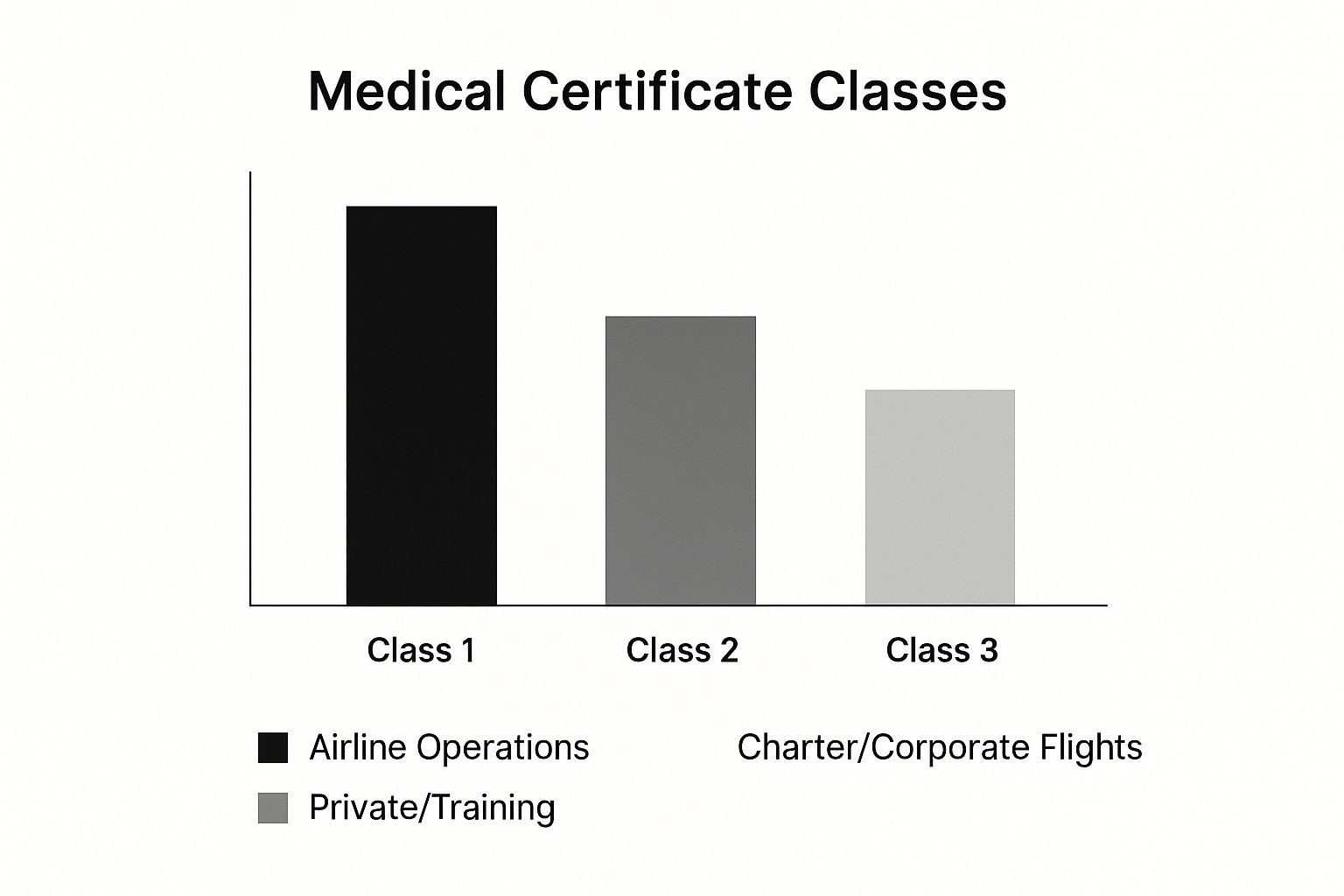
As you can see, the medical certificate you need is tied directly to your career goals, with a First Class being the standard for the airlines.
Medical and Citizenship Requirements
You’ll also need a valid FAA Medical Certificate. If your dream is to fly for the airlines, you’ll need a First Class Medical to use the privileges of an Airline Transport Pilot (ATP) certificate down the road. For pilots aiming for corporate or charter jobs, a Second Class Medical will do the trick. While you can complete your training on a Third Class Medical, it’s always smarter to get the medical certificate required for your end goal as early as possible.
Of course, preparing for a flight is more than just paperwork. You can brush up on the essentials by reviewing our guide on pre-flight checks for a Cessna 172.
Lastly, if you are a non-U.S. citizen, you must get clearance from the Transportation Security Administration (TSA) through the Flight Training Security Program (FTSP) before you can start any new flight training course. Getting all these certifications and approvals sorted out upfront prevents frustrating delays and lets you focus completely on learning to fly the twin.
Getting Your Hands on the Throttles: What to Expect in Multi-Engine Flight Training
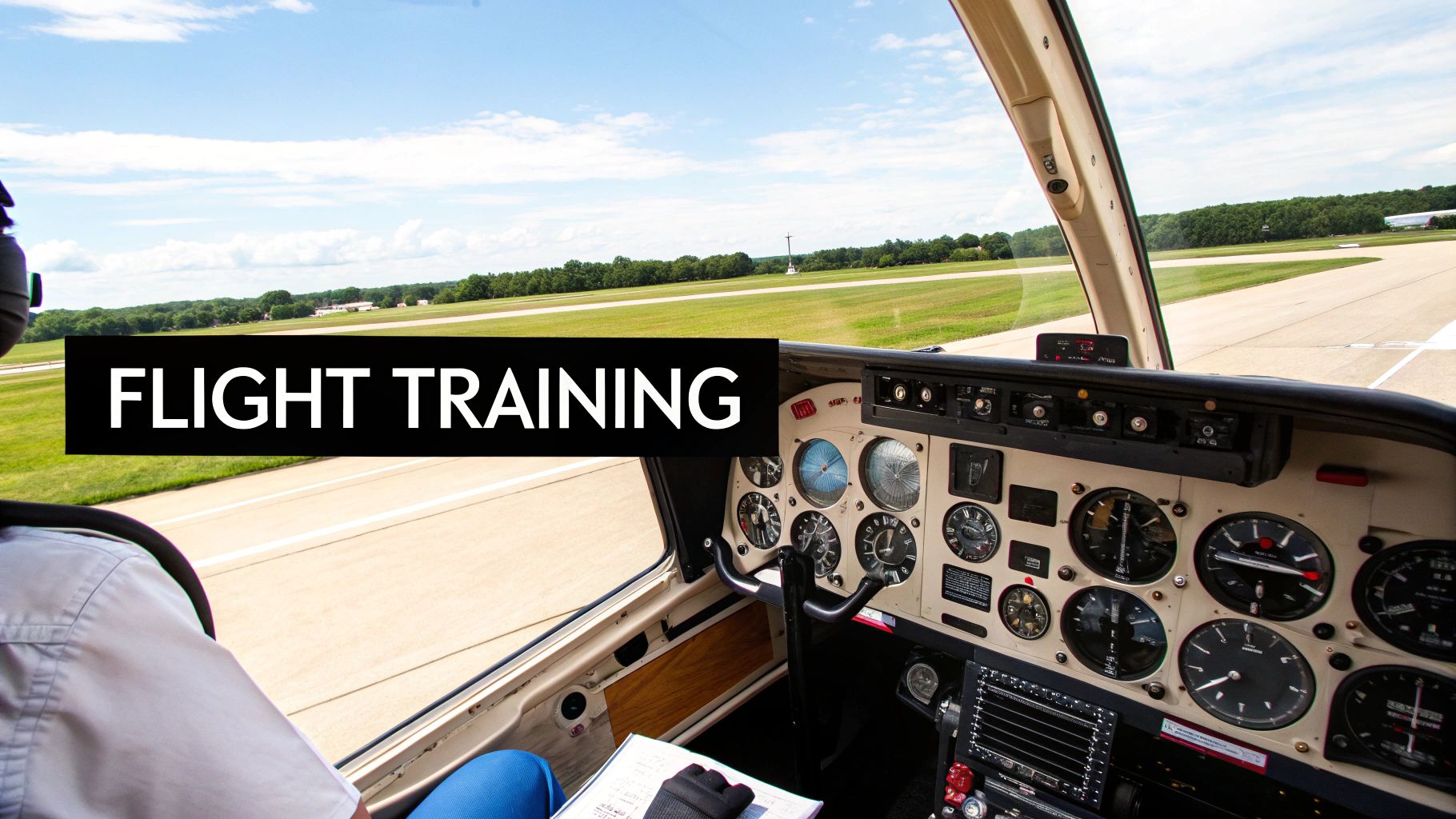
Alright, this is where theory meets reality. Your multi-engine flight training takes you out of the books and into the cockpit of a more complex and powerful machine. The entire experience for a student pilot is built around answering one crucial question: what do you do when one of those engines decides to quit?
This is where you’ll get intimately familiar with asymmetrical thrust, the absolute cornerstone of multi-engine flying. Imagine one engine pulling you forward while the other becomes dead weight, creating a whole lot of drag. The plane will want to yaw and roll aggressively toward that dead engine, and it’s your job to stop it. Your training will hammer home the procedures to counteract this—identify, verify, and apply the right rudder and aileron to keep the aircraft flying straight. It’s a whole new ballgame compared to flying a single.
The Two Pillars: Vmc and Complex Systems
Your instructor will quickly introduce you to Vmc, or minimum controllable airspeed. This isn’t just another number to memorize; it’s the speed that separates a manageable situation from a full-blown emergency. Below Vmc with an engine out, you simply don’t have enough rudder authority to stop the plane from turning. You’ll spend a lot of time practicing maneuvers that nudge you toward this speed so you can recognize the signs and recover instantly.
Vmc is arguably the most critical safety concept in multi-engine flying. It’s the airspeed that keeps an engine failure from turning into an uncontrollable spin.
Beyond just handling engine-out scenarios, you’ll also be mastering the aircraft’s more advanced systems. This isn’t like your trusty Cessna 172. You’ll be managing:
- Retractable Landing Gear: Learning the proper procedures for raising and lowering the gear, and just as importantly, what to do if it doesn’t come down.
- Controllable-Pitch Propellers: You’ll learn to manage the props to get the best performance, from a full-power takeoff climb to an efficient cruise.
- Advanced Fuel Systems: With two engines comes a more complex fuel system. You’ll need a new level of diligence to manage fuel flow from multiple tanks.
What’s the Time and Financial Commitment?
The FAA doesn’t actually set a minimum number of flight hours for a multi-engine add-on rating, but don’t expect to be ready for your checkride after a weekend of flying. Realistically, most student pilots need somewhere between 10 to 20 hours of dual instruction to get comfortable and proficient. The training is fast-paced and intense, designed to build muscle memory for emergency procedures.
As you might expect, this specialized training costs a bit more. The total price for the rating typically falls somewhere between $3,000 and $6,000. This reflects the higher rental rates and operating costs of twin-engine aircraft. For instance, you can expect to pay around $250 to $270 per hour for a common trainer like a Piper Seminole. Major schools like ATP Flight School often provide detailed cost breakdowns on their websites.
Common Multi Engine Training Aircraft Comparison
To give you an idea of the planes you might be flying, here’s a quick look at some of the most popular multi-engine trainers out there. Each one has its own personality and teaches slightly different lessons.
| Aircraft Model | Typical Hourly Rate (Wet) | Key Training Features |
|---|---|---|
| Piper Apache | $250 – $300 | A classic, gentle trainer known for its forgiving flight characteristics, making it an excellent platform for learning fundamental engine-out skills. |
| Piper Seminole | $350 – $425 | Features counter-rotating propellers that eliminate the “critical engine,” simplifying engine-out handling. A very common modern trainer. |
| Beechcraft Duchess | $375 – $450 | Known for its slightly higher performance and T-tail design, offering a different flight handling experience for students. |
This table gives you a general idea, but the best way to understand the full scope is to see how it all fits together in a structured curriculum. For a deeper dive into what a complete program looks like from start to finish, you can check out our detailed guide on multi-engine pilot training.
Preparing for the Oral Exam
So, you’ve heard there’s no separate, sit-down written exam for the multi-engine add-on. While that’s true, don’t for a second think you get a free pass on the theory. The oral exam is where the Designated Pilot Examiner (DPE) really digs in to see if you know your stuff.
Think of it less as a test and more as a conversation with a very experienced pilot who needs to be convinced you understand the why behind every single move you make. This is your moment to prove you’re more than just a stick-and-rudder pilot; you’re a systems manager, ready to be a safe, professional pilot in command—exactly what airlines are looking for.
Mastering Aerodynamics and Aircraft Systems
The heart and soul of the multi-engine oral exam boil down to two big topics: the unique aerodynamics of flying on two engines and the specific systems of the airplane you’re sitting in. The examiner isn’t looking for textbook definitions; they want to hear you explain complex ideas clearly and confidently.
You’ll need to walk them through precisely what happens, aerodynamically, when an engine quits. Get ready to talk about Vmc (minimum controllable airspeed), all the factors that make it better or worse, and why your rudder is suddenly your best friend. On top of that, you need to know your training aircraft inside and out—from how the fuel gets from the tanks to the engines to how the propellers feather.
You can expect to hear questions like:
- “So, what happens to Vmc when you move the center of gravity aft? Why?”
- “Without looking at the checklist, talk me through the engine failure procedure from start to finish.”
- “Explain how this plane’s feathering system works. What’s actually happening to reduce that drag?”
The oral exam is all about showing you truly get it. Rote memorization won’t cut it. The DPE needs to see you can connect the dots and apply what you know to real situations, especially the ones where everything is going wrong.
Articulating Performance and Procedures
Beyond the nuts and bolts, the DPE will want to see that you have a firm handle on performance numbers and emergency procedures. You should be able to whip out a POH and calculate takeoff and landing distances for any given scenario, explaining each step of your calculation.
This is a big deal for everyone, but especially for helicopter pilots transitioning to airplanes. The world of performance management is completely different, and demonstrating a solid grasp of it is non-negotiable. Whether you plan to fly for a living or eventually buy and sell multi-engine aircraft, this deep understanding of what the aircraft can—and can’t—do is what separates the amateurs from the pros.
How to Pass Your Multi-Engine Checkride
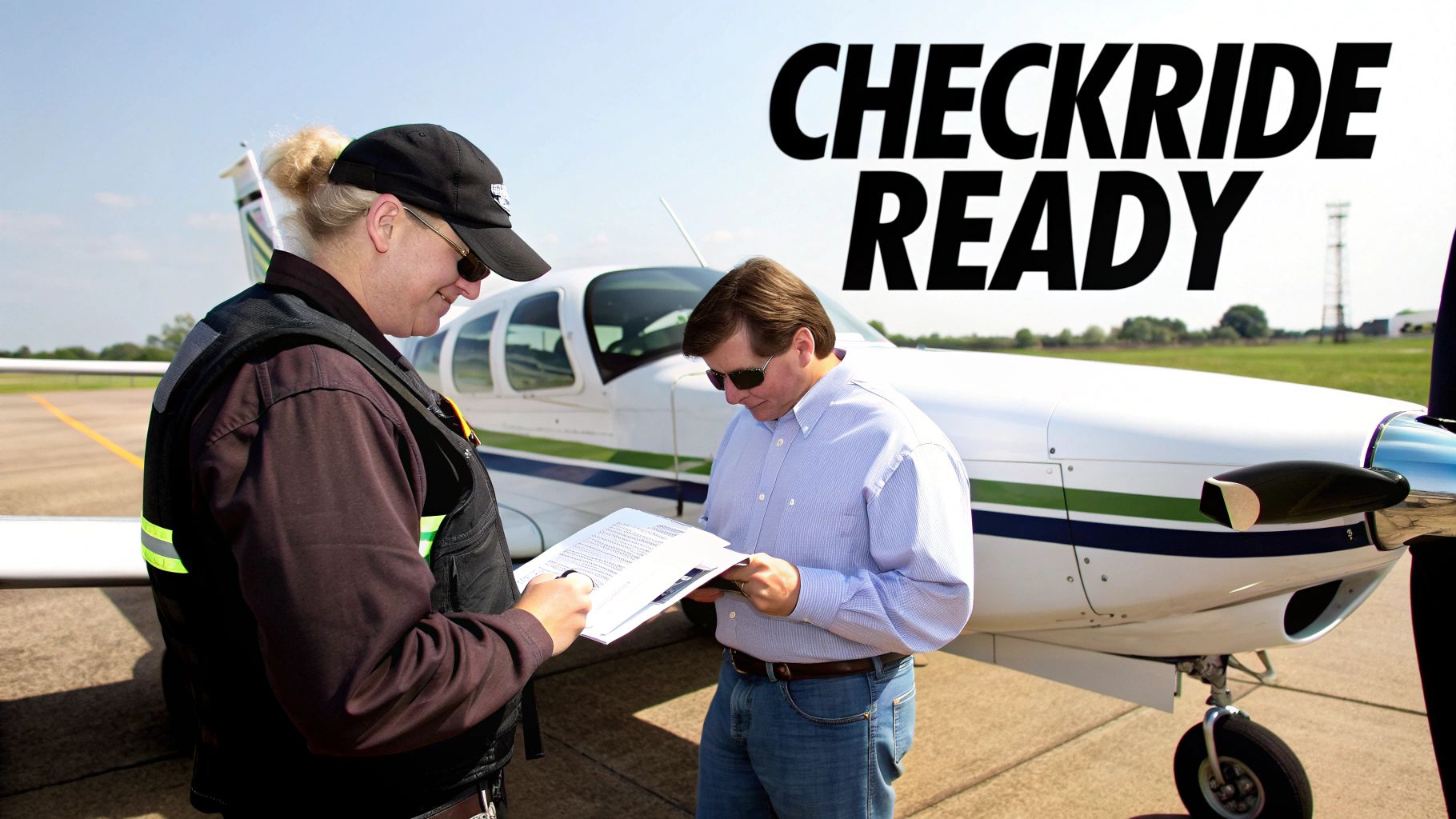
The multi-engine checkride is the final hurdle, the culmination of all that ground school and flight time. It’s where you sit down with a Designated Pilot Examiner (DPE) and prove you have what it takes to be the pilot in command of a complex, twin-engine airplane. This is a critical milestone for any student pilot aiming for an airline career.
The best advice I can give you is to stop thinking of it as a pass/fail interrogation. The FAA’s Airman Certification Standards (ACS) is the playbook, and the DPE is just there to see you run the plays. They aren’t trying to trick you; they’re methodically checking boxes to ensure you meet a very clear, established standard. Your job is to fly the airplane with the precision and confidence you’ve been trained for.
Mastering the Maneuvers
The practical test isn’t just about one or two things; it’s a comprehensive evaluation of your skills. You’ll cover a lot of ground, from the absolute basics to some pretty advanced performance maneuvers, and the DPE will be looking for a high degree of accuracy throughout.
While every maneuver in the ACS is fair game, the examiner will pay close attention to how you handle the things that make a twin a twin.
You can expect to demonstrate:
- Normal and Crosswind Takeoffs and Landings: The foundation of all flying. Can you maintain a stable approach and have smooth control on touchdown?
- Short-Field and Soft-Field Takeoffs and Landings: This is where you show you can squeeze every last bit of performance out of the aircraft when you need to.
- Steep Turns and Stalls: You need to show a solid understanding of how a heavier, more powerful aircraft behaves at the edges of the envelope.
- Instrument Approaches: If you’re instrument-rated, you’ll be flying approaches, and you can almost guarantee at least one will be under simulated single-engine conditions.
Beyond the stick-and-rudder skills, the DPE is watching your workflow. Are you using your checklists every single time? Are you managing systems like the landing gear and propellers correctly? These aren’t minor details—they’re proof that you have the disciplined mindset of a professional pilot.
The checkride is more than a test of flying ability; it’s a test of your Aeronautical Decision-Making (ADM). The examiner needs to see that you can manage a high workload, accurately assess risk, and make safe, logical choices, especially when things get busy.
The Defining Challenge: Engine Failure Scenarios
Let’s be blunt: how you handle a simulated engine failure is the single most important part of your multi-engine checkride. This is the moment that truly defines your readiness. The DPE is going to simulate an engine failure at the most critical times imaginable, like right after liftoff or in the middle of an instrument approach.
Your reaction needs to be drilled into muscle memory: immediate, correct, and methodical. The DPE is looking for a textbook execution of the “identify, verify, feather” flow. All the while, you must maintain positive control of the aircraft, keep your airspeed safely above Vmc, and follow your emergency checklists to the letter.
When you nail these scenarios, you’re showing the examiner that you won’t freeze up when it really counts. You’re proving you have the command and confidence to manage the worst-case scenario and bring the airplane home safely. For student pilots with airline ambitions, this skill is the bedrock of your entire career. It’s the skill that truly earns you the rating.
A Different Path: For Helicopter Pilots and Aircraft Owners
The journey to a multi-engine rating isn’t just for career airline pilots coming up through the fixed-wing world. It’s a valuable rating that opens up entirely new possibilities for other aviators and aircraft owners, though each path comes with its own set of challenges.
The Helicopter Pilot’s Leap to Fixed-Wing
If you’re a helicopter pilot, you already have a fantastic set of “stick and rudder” skills. Your sense of precision control and situational awareness is top-notch. However, meeting multi engine rating requirements and adding a multi-engine airplane rating is a whole different ballgame. The helicopter flight training path provides a unique foundation, but multi-engine flying introduces new challenges that require a different mindset.
You’re not just learning to fly another aircraft; you’re learning to manage entirely new aerodynamic principles that are central to multi engine training. Handling an engine failure in a twin-engine aircraft, with its powerful asymmetric thrust, is fundamentally different from dealing with a tail rotor failure in a helicopter and is a key part of mastering the multi engine rating.
This transition demands a serious focus on fixed-wing aerodynamics, complex aircraft systems, and the unique performance calculations that twins require. You’ll need an instructor who understands this specific transition. For a deeper look into the kind of foundational skills you’d be adapting, you can learn more about what’s involved in dedicated helicopter training.
For Owners and Buyers: Doubling Down on Due Diligence
For people looking to buy or sell airplanes and helicopters, the stakes are high, especially with multi-engine aircraft. If you’re looking to buy a multi-engine plane, your pre-buy inspection just became twice as important—and twice as complex.
When you’re inspecting a twin, you’re not just looking for problems. You’re trying to piece together the aircraft’s entire life story to predict what it will cost you down the road. Two engines, two props, and more systems mean double the chances for a very expensive surprise.
When you’re kicking the tires on a potential purchase, you absolutely must dig into these key areas:
- Engine Logs: Go through the maintenance records for each engine with a fine-tooth comb. Are the compression numbers solid and consistent? Is there a history of regular oil analysis? Any signs of major overhauls or recurring issues?
- Systems Integrity: The landing gear, propeller governors, and fuel systems are notorious high-dollar maintenance items, especially on older twins. Give them extra scrutiny.
- The Real Cost of Ownership: Don’t get star-struck by the purchase price. Insurance premiums will be significantly higher, especially if you’re a low-time multi pilot. Then there’s the cost of annuals, reserves for engine overhauls, and of course, double the fuel burn. A smart buyer budgets for all of it.
Whether you’re a helicopter pilot adding a new rating or an owner making a significant investment, understanding these unique multi engine rating requirements and the realities of ownership is key to making a safe, smart, and financially sound decision.
Your Top Multi-Engine Rating Questions, Answered
Adding a multi-engine rating is a huge step toward an airline career, but it naturally comes with a lot of questions. Let’s clear up some of the most common ones student pilots ask when they’re ready to add that second engine.
How Long Does a Multi-Engine Rating Take?
For pilots researching multi engine rating requirements, one of the most common questions is how long the training actually takes. Believe it or not, a multi-engine rating can be one of the quickest add-on ratings to earn. If you’re training full-time, most pilots complete their multi-engine rating in as little as one to three weeks.
When it comes to flight time, the FAA does not define a minimum, which is an important part of multi engine rating requirements. In practice, however, most pilots need around 10–20 hours of dual instruction to become proficient enough for the checkride. Your personal timeline will depend on factors such as scheduling, aircraft and instructor availability, and, of course, weather conditions.
Is a Multi-Engine Rating Harder Than a Private Pilot License?
In terms of multi engine rating requirements, the challenge is different—not necessarily harder. Earning a Private Pilot License (PPL) is about building a broad foundation of aviation knowledge and basic flying skills from the ground up. A multi-engine rating, by contrast, is a highly focused specialization built on top of that foundation.
During multi-engine training, pilots dive deep into multi-engine aerodynamics, complex aircraft systems, and critical emergency procedures such as engine failures and asymmetric thrust. The level of precision and workload management is higher, but every skill builds directly on what you’ve already mastered as a single-engine pilot. For many, this focused intensity is what makes multi-engine training both demanding and rewarding.
Do I Need to Take Another FAA Written Exam?
Good news: multi engine rating requirements do not include a separate FAA computerized knowledge test for a multi-engine add-on rating.
That said, your aeronautical knowledge is evaluated in depth during the oral portion of the multi-engine checkride. At this stage, the examiner needs to see that you truly understand why each procedure exists—not just how to memorize it. A solid grasp of multi-engine aerodynamics, aircraft systems, and engine-out decision-making is essential to meeting multi engine rating requirements and demonstrating safe command of a twin-engine aircraft.
While you get to skip the written test, the oral exam is more focused and intense. Expect the examiner to dig deep into your understanding of Vmc, systems management, and emergency procedures to ensure you’re ready for the responsibility that comes with flying a multi-engine aircraft.
Can I Combine It with My Commercial License?
Yes—combining your commercial training with a multi-engine rating is one of the most efficient ways to meet multi engine rating requirements, especially if your goal is a professional or airline career. Pilots are allowed to complete their Commercial Pilot checkride in a multi-engine aircraft, provided all training and experience requirements are met.
By taking this approach, you can satisfy both the commercial pilot requirements and the multi engine rating requirements during a single practical test. This not only reduces the number of checkrides you need to pass, but also helps save a significant amount of time and training costs. For pilots planning a career in the airlines, combining these steps is often the fastest and most strategic path toward flying twin-engine aircraft professionally.
Conclusion
Earning a multi-engine rating is more than just adding another endorsement to your pilot certificate—it’s a fundamental shift in how you think, fly, and manage risk as a pilot. Understanding the multi engine rating requirements means understanding responsibility: higher performance, more complex systems, and critical decision-making under pressure.
Whether your goal is the airlines, corporate aviation, or simply becoming a safer and more capable pilot, multi-engine training builds the skills that define professional aviation. From mastering asymmetric thrust to confidently handling engine failures, this rating prepares you for real-world scenarios that single-engine flying simply cannot replicate.
If you want to deepen your understanding of one of the most critical aspects of multi-engine operations, make sure to read this detailed guide on engine failure scenarios in light twins:
👉 https://melibrary.pro/article/light-twin-engine-aircraft-failure/
It’s an essential next step for any pilot serious about flying twin-engine aircraft safely and confidently.