Multi-Engine Aerodynamics: Chair-Flying and Engine-Out Readiness
Twin-engine airplanes feel much like singles—until an engine quits. That’s the moment when multi-engine aerodynamics truly matters. You can and should prepare for it anywhere you can sit and rehearse.
I’m a firm believer in chair flying: sit in the cockpit with engines secured and external power available, and rehearse flows, callouts, and eye movements. Early in training I spent hours in a hangared aircraft practicing difficult maneuvers. “Hand here, eyes there, now confirm here.” The coordination and timing improved dramatically after focused chair-flying sessions. You don’t need spinning propellers to build motor skills and hand–eye coordination—just as ballplayers use a tee to groove precise swings.
I earned my multi-engine rating in 1995, and ever since, every drive to the airport includes a short mental rehearsal for an engine-out on takeoff. Skipping that preparation once showed in the simulator: during V1 cuts at decision speed I was behind the airplane. A quick lunch break of chair flying—dozens of clean mental reps—turned the afternoon session around.
Practice, Practice, Practice: Identify • Verify • Feather
Approaching the airport, I run the multi-engine pilot’s core flow—Identify, Verify, Feather—because disciplined flows are the backbone of safe twin-engine aerodynamics.
Identify. “Working foot, working engine.” Or, “Dead foot, dead engine.” Use rudder pressure and cues to decide which side failed.
Verify. Gently retard the suspected throttle/power lever and confirm on the appropriate gauges. With constant-speed propellers, RPM may hold initially, so I scan the power indicators and note that pedal pressure to keep straight does not change.
Multi-Engine Aerodynamics and Yaw Control
That’s the verification part of the Identify–Verify–Feather sequence. Then comes the final motion — feathering the propeller, a vital action in multi-engine aerodynamics and engine-out control. I reach for where the propeller control would be and simulate the motion of securing the failed engine. The exact procedure depends on aircraft type: some airplanes require moving the prop lever through a mechanical gate or stop to engage feather. Repetition builds instinct — and instinct is what keeps twin-engine aerodynamics predictable when real failure occurs. I practice this every time.
Yaw in Multi-Engine Aerodynamics
Yaw is one of the defining aerodynamic challenges in twin-engine flight. The first multi-engine airplane I flew extensively was a Piper Seneca II, whose turbocharged engines provided ample thrust even at high-density altitudes above 8000 feet. That thrust, however, comes with consequences familiar to anyone studying multi-engine aerodynamics — asymmetric thrust and yaw.
During preflight, I can barely fit between the propeller and fuselage, which actually illustrates efficient aerodynamic design: the thrust and drag forces act close to the centerline, shortening the yaw arm. In aerodynamic terms, torque equals force times arm; the shorter the arm, the smaller the yaw moment.
Every engine’s thrust produces yaw, and a windmilling propeller on a failed engine adds additional drag — a double source of yaw that challenges even experienced multi-engine pilots. A feathered propeller, with blades aligned to the airflow, eliminates much of that drag and stabilizes the aircraft. That’s why the Identify–Verify–Feather sequence is central to multi-engine aerodynamics training and why I rehearse it on every drive to the airport.
Counter-Rotating Engines and Critical-Engine Effects
The Piper Seneca II is somewhat unique among twins because its engines are counter-rotating, turning in opposite directions. Most twin-engine airplanes — and even many four-engine designs such as the C-130 and P-3 Orion — have engines rotating the same way. That asymmetry matters: propellers don’t generate thrust evenly. The descending blade (usually on the right) creates more thrust than the ascending blade, shifting the thrust line away from the fuselage and increasing yaw.
This imbalance defines the concept of the critical engine in multi-engine aerodynamics — the engine whose failure causes the greatest yawing moment and control difficulty. In most conventional twins, the left engine is critical. Recognizing and managing that asymmetry is the essence of mastering multi-engine aerodynamics and flight safety.

Flying a multi-engine airplane is different from commanding a single, for more reasons than just aerodynamics. Two engines generally means there’s more power available. There also may be more systems to deal with, and they’re likely to be more complicated. The twin likely also will be heavier than the airplane you’ve grown accustomed to. Let’s run through what that can mean.
Power and Performance in Multi-Engine Aerodynamics
Two engines mean more available thrust, but also faster-developing situations. With both engines operating, the aircraft accelerates briskly on the runway, climbs better, and responds more sharply to throttle movement. In training, this is often presented as an advantage, yet it demands that the pilot stay well ahead of the airplane. Multi-engine aerodynamics is as much about anticipating acceleration and energy changes as it is about controlling asymmetry when one engine fails.
The Effect of Weight and Stability on Twin-Engine Flight
A heavier twin generally rides more smoothly in turbulence and tolerates crosswinds better than a light single. Differential power—slightly adjusting throttles—can further help maintain directional control in gusty conditions. However, greater mass also brings higher approach and landing speeds. In the flare, additional momentum requires carrying a touch more power than in a single-engine aircraft to maintain control authority. All of this forms part of applied multi-engine aerodynamics, where lift, drag, and weight interact with thrust management.
Systems Complexity in Multi-Engine Aircraft
The aerodynamic advantage of redundancy comes with mechanical trade-offs. A twin-engine airplane introduces more complex fuel systems, including crossfeed selectors that allow fuel balancing between tanks. Many twins also feature combustion cabin heaters and auxiliary systems that consume fuel, slightly reducing endurance. Managing these systems safely demands the same procedural discipline as managing asymmetric thrust—it’s all part of understanding how multi-engine aerodynamics and systems combine in practical flight.
The Problem With Yaw in Multi-Engine Aerodynamics
In multi-engine aerodynamics, yaw is one of the most demanding forces a pilot must manage. The primary control for yaw is the rudder. Every instructor reminds students that active feet on the pedals keep the aircraft coordinated and minimize P-factor and adverse yaw.
The rudder acts as an airfoil, and the aerodynamic force it produces increases with the square of airspeed. At 45 knots, full rudder provides only one quarter of the control authority available at 90 knots. When a multi-engine airplane becomes too slow, the rudder simply cannot counteract the yaw that results from asymmetric thrust after an engine failure.
The minimum speed at which the rudder still maintains directional control is the minimum control speed (Vmc). It is marked with a red radial line on the airspeed indicator. Exact test conditions matter less than the aerodynamic principle: below Vmc the aircraft will yaw toward the inoperative engine. Even if full rudder momentarily stops the yaw, recovery requires lowering the nose to increase airflow over the control surfaces.
In practical twin-engine flight training, the rule is clear — never allow the airplane to get slow near the ground.
Yaw also introduces a dangerous roll component. The outside wing travels faster, generating more lift and causing the airplane to roll toward the dead engine. This is known as a Vmc rollover, and it can develop in seconds. At low altitude, especially after takeoff, there is little room for recovery. That is why maintaining airspeed, practicing asymmetric flight, and rehearsing the Identify–Verify–Feather sequence remain central to multi-engine aerodynamics training.
Returning to Multi-Engine Proficiency
I have not flown a multi-engine airplane in over a year, but soon I will check out in a beautifully maintained Piper Apache once it returns from inspection. It is not fast, yet it handles gracefully — a classic design that demands respect. Despite its reliability, any piston twin carries higher failure probability than a turbine aircraft, and a Vmc rollover on the first takeoff would leave no margin for error.
When I flew the Apache years ago, I was mostly acting as a multi-engine instructor, reminding the owner to lower the landing gear on short final. To instruct again, I need five hours of pilot-in-command time in type, as required by FAR 61.195. Legally, my logbook makes me current; aerodynamically, I am not yet proficient.
So before the next flight, I will return to chair-flying practice — mentally running checklists, reviewing asymmetric thrust reactions, and restoring tactile familiarity with every control. Even parked on the ramp, this rehearsal strengthens understanding of multi-engine aerodynamics and builds the reflexes needed for real-world emergencies. On each drive to the airport, I repeat the same ritual: Identify, Verify, Feather.
Every time.
Turboprop Engines and Multi-Engine Aerodynamics
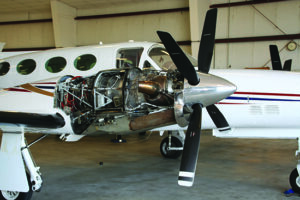
Turboprop engines, like the Pratt & Whitney Canada PT6 pictured at right on a Cessna Conquest, are amazing. They produce lots of thrust and are super-reliable. The downside is that on some flights they can burn a ton of fuel. Literally.
Turboprop engines behave differently from piston powerplants, and that difference directly affects multi-engine aerodynamics. A turbine engine cannot truly idle in the same way a piston engine can. This becomes critical when an engine fails close to minimum control airspeed (Vmc).
At Vmc, the yawing moment from the operating engine can easily exceed the corrective moment available from a fully deflected rudder. In a piston twin, a pilot experiencing a Vmc problem can often regain control by reducing power on the operative engine to idle, equalizing thrust. In a turboprop, however, even at flight idle, the engine continues to produce residual thrust. That residual thrust can push the aircraft further into yaw, complicating recovery.
Vmc is one of the defining differences between single-engine and multi-engine aerodynamics at low airspeeds. In a single, yaw at low speed usually leads to a stall and possible spin entry. In a twin, it can escalate into a Vmc rollover, a rapid and often unrecoverable loss of control. Adding power in that situation may actually worsen the problem.
The only reliable recovery step is lowering the nose to regain airspeed and restore rudder effectiveness.
Maintaining Proficiency in Multi-Engine Aerodynamics
Experience once led me to believe that flying multi-engine airplanes safely required constant practice. When I was logging hundreds of King Air hours a year, it seemed obvious. Yet proficiency is not just a function of flight time — it’s the product of awareness and repetition.
Even without frequent flying, a pilot can stay sharp by mentally rehearsing asymmetric flight responses: Identify, Verify, Feather. Chair-flying, checklist visualization, and reviewing multi-engine aerodynamic principles at the desk are as valuable as any simulator hour. Each repetition strengthens coordination and reduces hesitation during real emergencies.
Ultimately, multi-engine aerodynamics is about discipline — knowing how forces behave when balance is lost and how to restore it through skill, not luck.
For an in-depth comparison of how piston twins handle aerodynamic asymmetry and performance loss, read
Multi-Engine Piston Airplane — a detailed look at engine-out dynamics, propeller drag, and control strategies across twin-engine configurations.
