Twin Engine Safety – Why It Matters
Twin engine safety is critical for every pilot. Few moments in a career are as dangerous as losing control after an engine failure in a twin-engine aircraft.
Understanding Airspeed Redlines in Twin Engine Safety
The airspeed indicator in most twin-engine airplanes has two redlines: one at the top of the yellow arc, and one near the bottom of the green arc.
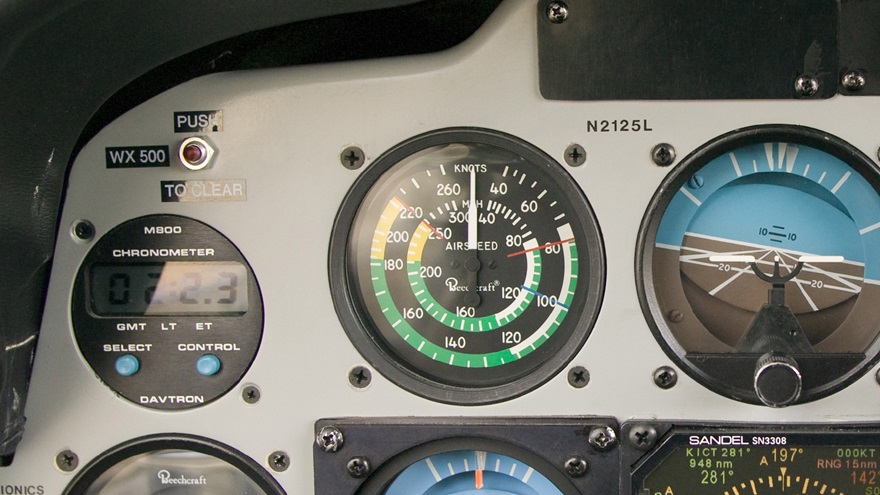
The top redline, as it is in single-engine airplanes, is the VNE—never exceed airspeed—the airframe’s speed limit. The bottom redline is there because, in the words of my favorite crusty old flight instructor: “If an airplane has two engines, it’s because it doesn’t fly very well with one.”
The Dark Side of Twin Engine Safety
Details in a moment, but simply put, the design of most twins is such that if one engine fails at slower airspeeds—near the bottom redline—the other engine still running will flip the aircraft over if you’re not prepared to act immediately to respond to the emergency.
Right. So much for the safety of two engines.
Don’t get me wrong. Night over the Rockies? Dawn over a fogbank? Anytime over piranha-infested water? Give me the spare engine, please. But just know that there’s a dark side to that twin-engine redundancy that you need to master as the pilot in command of a multiengine airplane.
VMC – Minimum Controllable Airspeed
The lower redline marks what is called VMC—the minimum controllable airspeed in an engine-out emergency. You’ll learn the full emergency recovery details during your multiengine training but keeping it simple, in a conventionally designed twin, if one engine fails, the aircraft rolls and yaws toward the failed engine.
Now, you will need to counter the roll with aileron and counter the yaw with rudder. As you’ve got a ton of drag on one side and a ton of thrust on the other side of the aircraft, you’ll need to compensate by using rudder. A lot of rudder. But if you get too slow, you…well…run out of rudder. There simply isn’t enough to prevent what is called a VMC rollover—a loss of control that is invariably fatal.
Why Pilots Still Struggle With VMC
I know what you are thinking: If pilots train for it, and if it’s marked on the airspeed indicator, how can anyone get in trouble with this? I think there are three reasons.
The first is that, although painted in red, VMC is not carved in stone. Minimum controllable airspeed varies with engine power, altitude, temperature, propeller position, center of gravity, bank angle, and more. In some scenarios, VMC can be almost 20 knots higher than the lower redline.
Secondly, the loss of control happens wickedly fast compared to how it is practiced in airborne training; so, get some good simulator time.
And thirdly, just as with stall training, pilots who have practiced VMC demos with their instructor before the checkride may lack proficiency when an engine-out emergency happens after they get their multiengine rating.
Training Tips to Improve Twin Engine Safety
So, for safety’s sake, ask your flight instructor to periodically work with you on practicing stalls and how to control engine-out scenarios in your twin-engine airplane. Regular refresher sessions not only reinforce muscle memory but also keep you prepared for unexpected real-world challenges.
Pilots should make use of simulators to safely rehearse engine-out situations, focusing on decision-making under pressure. Incorporating scenario-based training, such as night flying or high-altitude operations, adds realism and builds confidence.
Reviewing accident case studies can also highlight common mistakes and provide valuable lessons. By combining practical training, simulator time, and theoretical knowledge, you significantly improve your chances of reacting correctly during a twin engine failure, turning potential danger into a manageable situation.
 Twin engine failure training guide
What does the lower redline on a twin engine airspeed indicator mean?
The lower redline marks VMC, the minimum controllable airspeed in an engine-out emergency. Below this speed, there isn’t enough rudder authority to counter yaw and roll, which can lead to a VMC rollover—a rapid, often fatal loss of control.
Why is VMC so dangerous for twin engine pilots?
VMC is dangerous because once you drop below it after an engine failure, the asymmetric thrust and drag forces can overpower the aircraft’s controls almost instantly. Even trained pilots can struggle, since real-world emergencies develop faster and under more variable conditions than simulator exercises.
How can pilots improve their twin engine safety skills?
The best approach is regular training. Pilots should practice stalls and engine-out scenarios with instructors, use simulators to rehearse realistic emergencies, and review accident case studies. Consistent practice builds muscle memory and improves decision-making under pressure, increasing safety in real-world flying.